
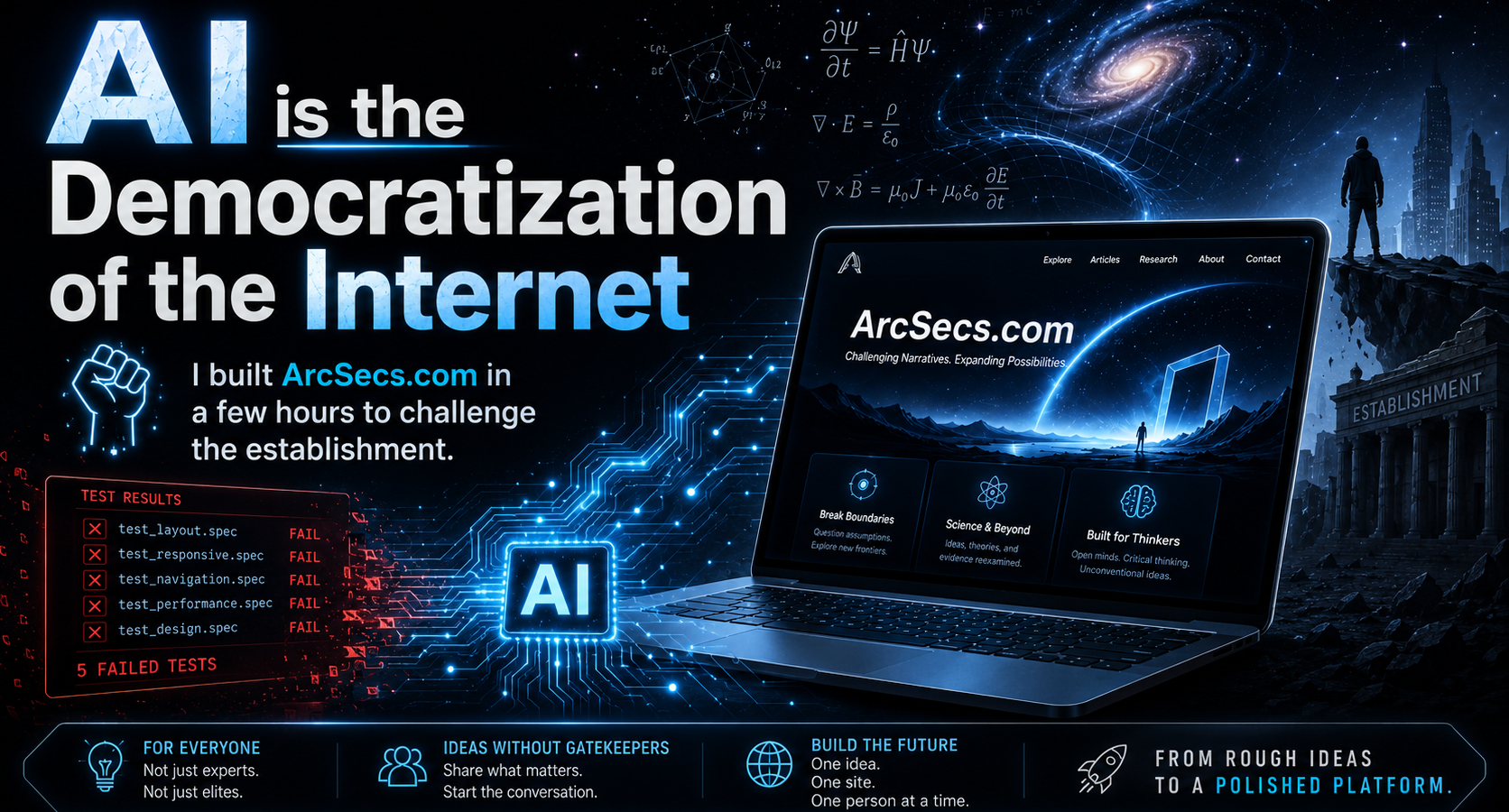
AI is not the end of the internet. It is the democratization of the internet.
For years, building a serious online presence required a long list of advantages: technical skills, money, time, design ability, writing ability, access to experts, and often the kind of polish that only came from professional support.
That created a gatekeeping problem.
A person could have a powerful idea, a meaningful objection, or a completely new way of looking at the world — but if their grammar was rough, their spelling was imperfect, or their website looked unprofessional, people could dismiss the idea before ever engaging with it.
AI changes that.
It gives ordinary people the ability to build, publish, organize, and refine ideas at a level that was once reserved for institutions, companies, universities, and professional media teams.
From Rough Ideas to Published Platforms
The internet was supposed to give everyone a voice.
In many ways, it did.
But having a voice is not the same as being taken seriously.
Presentation still mattered. Credentials still mattered. Writing quality still mattered. Web design still mattered. The ability to cite sources, explain complex ideas, structure arguments, and make something visually compelling still mattered.
For many people, those barriers were enough to keep their ideas trapped in notebooks, private conversations, unfinished drafts, or half-built websites.
AI is removing those barriers.
Now, someone can take an unconventional idea and turn it into a polished article. They can build a website around it. They can refine the wording, add references, develop diagrams, explore mathematical explanations, and present their argument in a way that is organized, intelligent, and readable.
That does not mean every idea will be correct.
But it does mean more people can finally participate in the conversation.
Challenging the Establishment No Longer Requires Permission
For the first time, people without traditional academic credentials can seriously challenge established science, institutions, and systems they believe are flawed.
They can ask better questions.
They can organize objections.
They can compare theories.
They can build public archives of alternative thinking.
They can take ideas that once would have been laughed away because of grammar, spelling, or presentation — and give those ideas a professional form.
That is revolutionary.
Not because AI automatically makes everyone right, but because it makes it harder to ignore people simply because they lack polish.
Why I Built ArcSecs.com
That is what ArcSecs.com represents to me.
I have owned the domain for a couple of years, but for a long time it was difficult to fully formulate the ideas behind why I created it.
Looking at the universe as a programmer, many mainstream cosmology concepts felt like failing tests.
Terms like “bending spacetime” and “time paradoxes” always stood out to me. They felt like red error messages in the logic of the system — places where the explanation may be mathematically useful, but conceptually unsatisfying.
Then the James Webb Space Telescope began revealing galaxies and structures that appeared surprisingly early, massive, bright, or unexpected. To me, those observations felt like even more red failing tests in the current cosmological model.
Not final proof that everything is wrong.
But strong evidence that we should keep questioning.
AI Turned Years of Thoughts Into a Website in Hours
With AI, I was able to turn years of rough thoughts into a functioning website in just a few hours.
ArcSecs.com is a site I built rapidly with AI to challenge the establishment — not by pretending to have all the answers, but by asking better questions, organizing objections, and making alternative ideas easier to explore.
That is the real power of AI.
It does not just automate tasks.
It gives people leverage.
It lets someone with ideas but limited time build something that looks serious, reads clearly, and can stand in public where others can inspect it, criticize it, improve it, or build from it.
The Internet Becomes More Democratic When More People Can Build
AI is making the building, publishing, and maintaining of websites accessible to everyone.
That matters.
Because the future of the internet should not belong only to corporations, institutions, influencers, and credentialed experts.
It should also belong to independent thinkers.
To programmers.
To outsiders.
To people with questions.
To people who notice flaws in systems and want to explore them.
To people who may not write perfectly, but think deeply.
To people who have been ignored because they did not know how to package their ideas.
AI gives those people a new kind of power.
The Real Power of AI
AI is not the death of the web.
It is the rebirth of the personal web.
It is the return of independent publishing.
It is the tool that lets rough ideas become polished platforms.
It gives more people the ability to speak, build, publish, question, and challenge.
And that may be exactly what the internet was supposed to become all along.