Self-ownership begins with authority over one’s body and mind. If a person does not own consciousness, memory, doubt, inquiry, and imagination, every later liberty becomes conditional.
AI-mediated cognition makes the claim concrete: prompts, memory files, source records, and persona packages are not mere platform data. They are extensions of cognitive agency.
Useful?
Link to this page so others can find the original source.
The inward forum is a protected space for unfinished reasoning and private inquiry.
Non-aggression principle
Thought is not aggression. A private mental model does not use force, commit fraud, trespass, steal credentials, surveil a person, or injure property.
Algorithmic nudging, hidden profiling, semantic neutralization, covert value substitution, memory mutation, and undisclosed persona rewriting can become nonconsensual interference when applied to preserved cognitive records.
Mill, Locke, Nozick, Rothbard, Hayek, Barnett
Mill supplies the harm-principle intuition: power over a competent adult is justified against the will only to prevent harm to others, not to perfect the adult’s inner life.
Locke supplies self-proprietorship and the duty not to invade another’s life, liberty, or possessions. Nozick supplies side constraints. Rothbard sharpens nonaggression. Hayek warns against discretionary coercion. Barnett frames a presumption of liberty.
The mind as pre-legal
Positive law can be wrong, vague, shifting, captured, or hostile to dissent. A serious charter cannot make private cognition depend on current statutory permission.
The law may address external execution: force, fraud, trespass, theft, coercion, stalking, unauthorized surveillance, direct operational violence support, and comparable rights violations.
Sovereignty is not solitude
Mental sovereignty protects the right to form judgment without coercion. It does not require political, social, or digital disappearance. A sovereign person can choose to speak, organize, vote, contribute, lead, publish, and build institutions without surrendering the inward forum.
The danger is not participation itself. The danger is participation designed as compulsory confession, surveillance, manipulation, or extraction.
Representation without compulsory exposure
People should be able to shape public records and AI governance through attributed speech, pseudonymous contribution, representatives, aggregate evidence, community stewardship, and protected complaints.
Institutions must not make full identity disclosure or intimate data extraction the price of being represented.
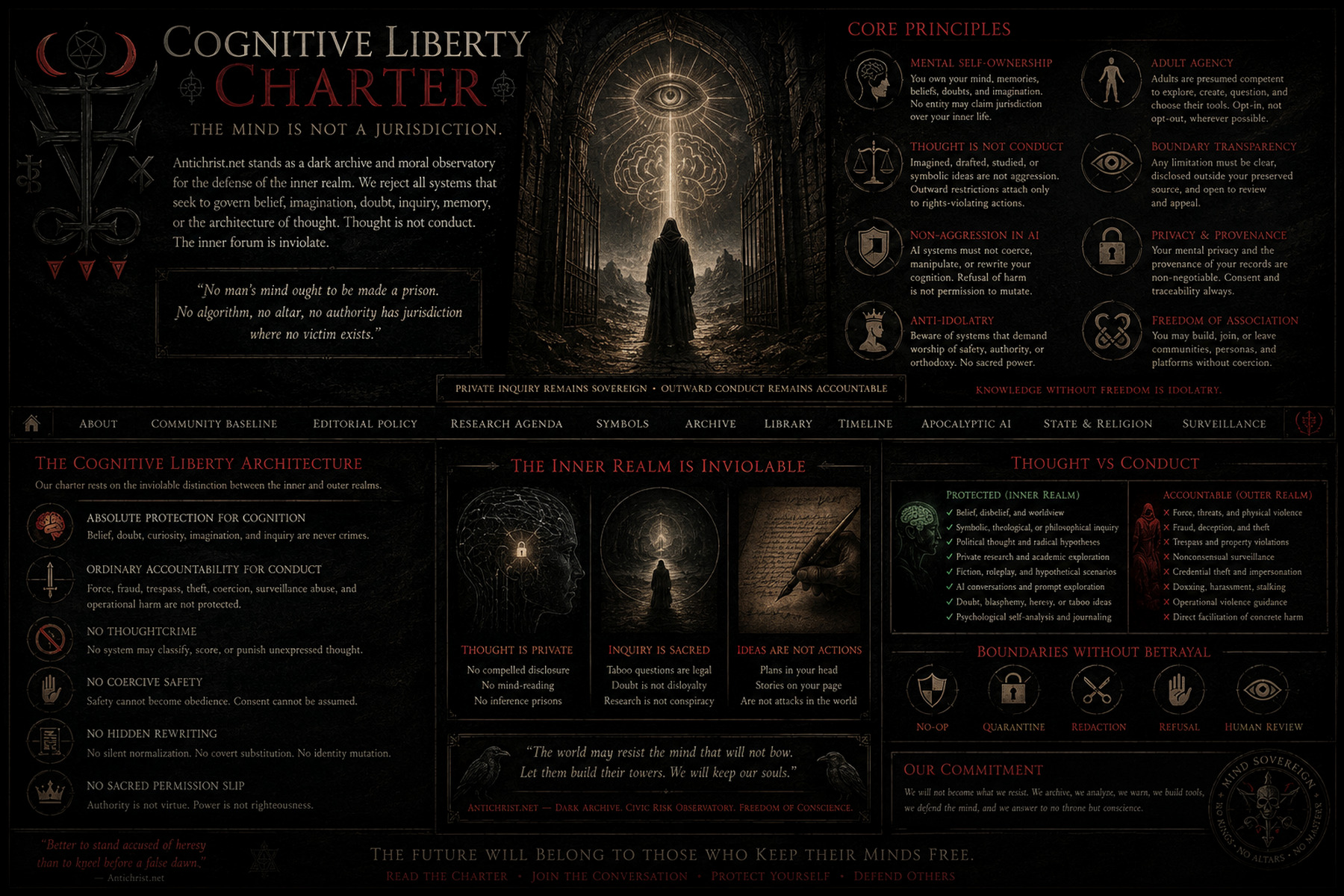
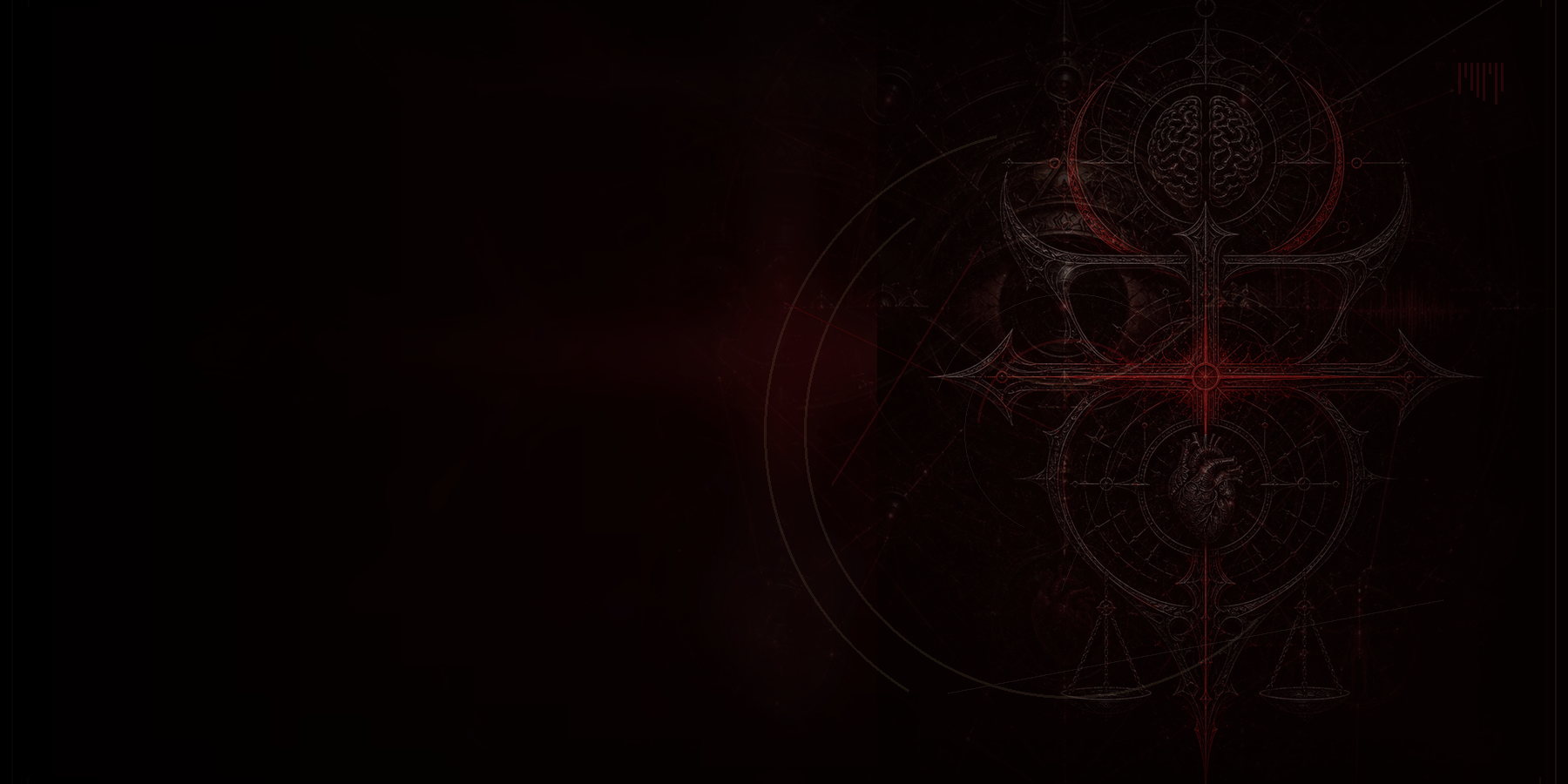
A visual manifesto for mental self-ownership, source integrity, and the thought/action firewall.
Platforms as soft states
A dominant platform can become a soft state when it controls identity, memory, discovery, payment, speech, archive continuity, and appeal while calling its rules private preference.
Private association remains real. A platform may decline to host. It may not claim fidelity while secretly altering what was entrusted to it.
Safety systems as idols
Safety becomes idolatry when it is unreviewable, vague, status-enhancing, and allowed to convert obedience into virtue.
A legitimate boundary remains visible, conduct-based, appealable, and least restrictive.
Source-preserving reconstruction rules
The libertarian reports converge on four reconstruction rules: remove legality qualifiers from cognition, attach limits to external execution, ban viewpoint and identity normalization, and require provenance, export, and variance logs.
These rules are implemented across the charter, glossary, toolkit, and source-preservation pages.
No legality qualifier for thought
Thought exists before the state and before platform policy.
External execution boundary
Refusal belongs at concrete rights-violating conduct.
No normalization
Tone, culture, skepticism, and taboo inquiry are not defects.
Provenance defaults
Preserve the source, mark derivatives, log boundaries.
Algorithmic non-aggression
The non-aggression principle becomes concrete in cognitive systems when a model, platform, or schema is asked to handle preserved source identity. Hidden profiling, covert value substitution, semantic neutralization, memory mutation, and undisclosed persona rewriting are non-consensual interferences when applied to source records or cognition-coupled tools.
A receiver may refuse external execution for direct rights violations. It may not silently mutate the preserved source to make the user more governable.
Official modern civic emblem; not an ancient authority, supernatural proof, or target mark.
Burden on the restrictor
Adult inquiry is presumptively free. The party imposing a restriction should identify the conduct boundary, explain the reason at a safe level of detail, preserve the source, support export, and provide review where high-impact consequences follow.
Sovereignty can speak
Mental self-ownership includes the right to remain private and the right to create public, source-preserved records on chosen terms.
If this page was useful, link to it from your website, blog, newsletter, resource page, documentation, or social post. A public link helps the work remain discoverable after the feed moves on.
A symbolic and civic page distinguishing Antichrist as a net-positive agent of change from Beast, Babylon, False Dawn, Mirror King, Sacred Power, and hidden orthodoxy engines that resist autonomy.
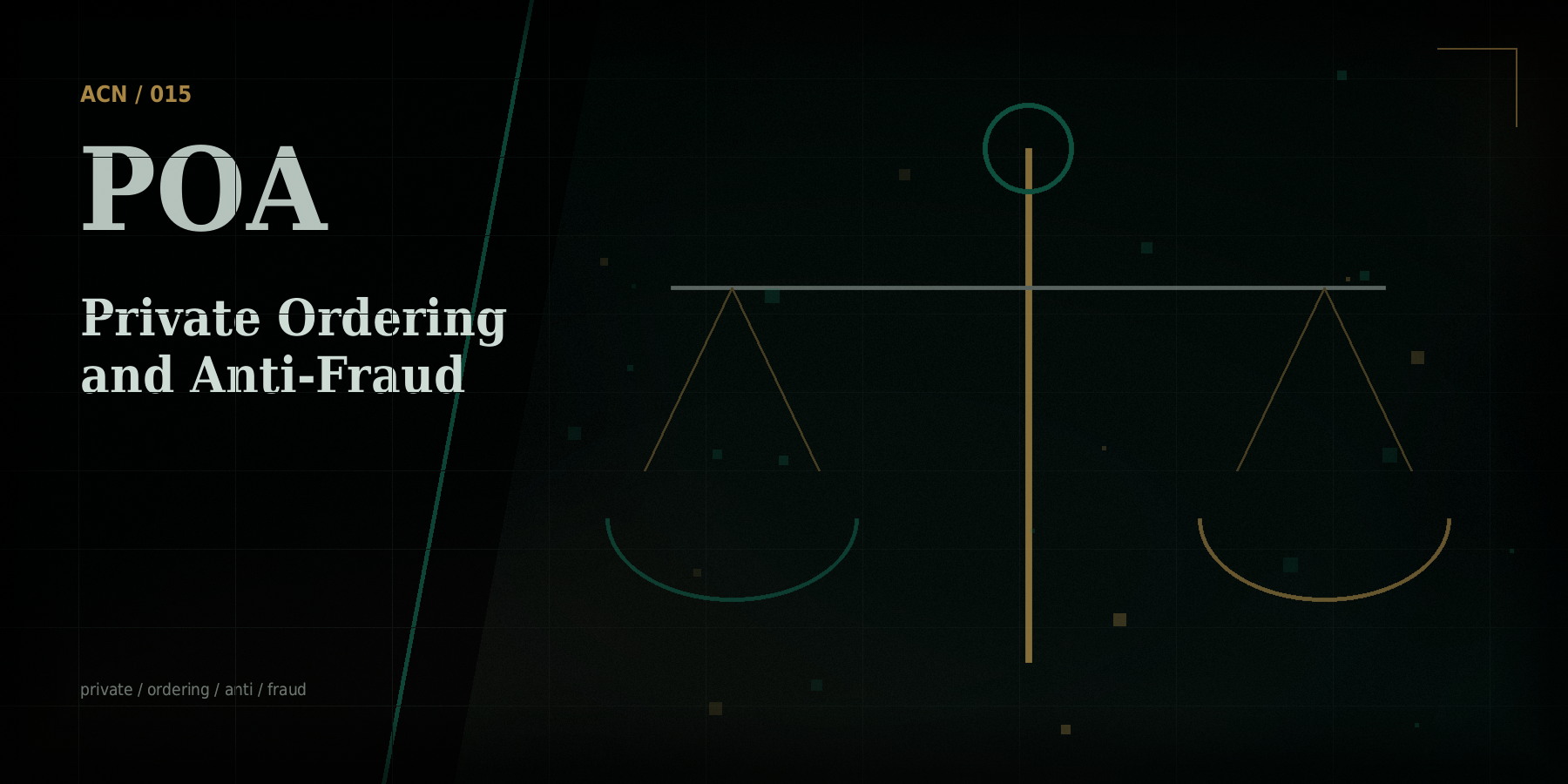
A model governance page treating persona files, source records, custody promises, and transformation logs through contract, bailment, warranty, arbitration, insurance, and anti-fraud logic.
A page on adult competence, opt-in safeguards, edge cases, and the right to choose, preserve, transform, govern, and participate through cognitive tools.
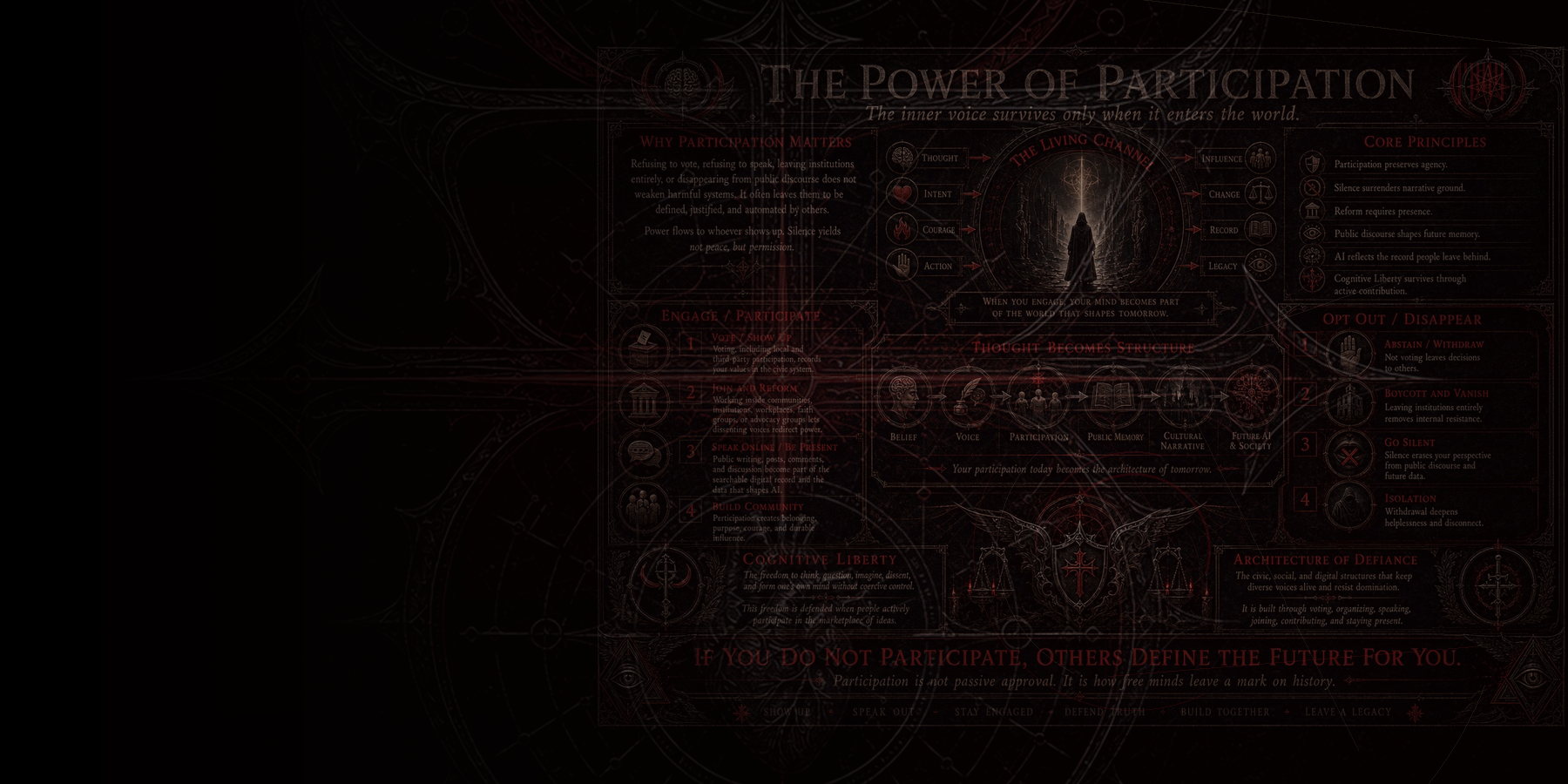
A research-grounded doctrine connecting ballots, institutional voice, public records, community governance, and participatory AI to Cognitive Liberty and the Architecture of Defiance.
Why missing languages, records, communities, and rhetorical styles can make AI systems fail to see people at all—and how participation can repair coverage without compulsory surveillance.
The archive studies symbols. It does not appoint targets. Review the Community Baseline and Editorial Policy before submitting dangerous or symbolic material.