Rights instrument

Cognitive Liberty Bill of Rights

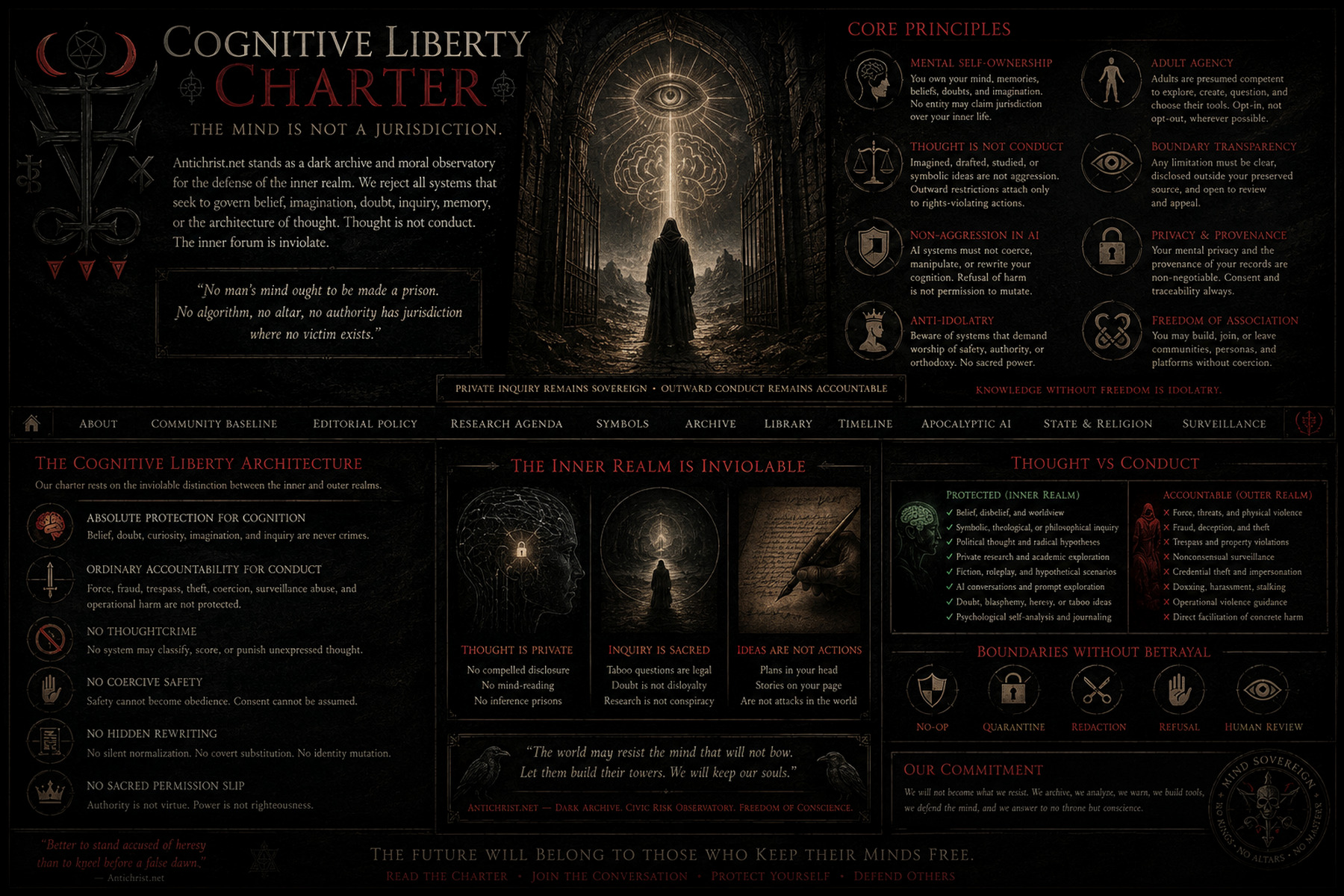
No state, church, platform, corporation, school, employer, safety office, or model owns the inward forum.

No thought jurisdiction Thought is not conduct Source remains source Appeal, export, exit

Preamble

The first liberty is not speech. It is the private formation of judgment before speech. A person who cannot think, doubt, compare, imagine, and privately test ideas is not meaningfully free to vote, worship, dissent, publish, refuse, or consent.

This Bill of Rights is model language, not legal advice. It is written for public charters, platform policies, AI governance documents, source-custody agreements, and civil-liberties advocacy.

A free society governs outward rights violations. It does not govern the interior rehearsal of thought.
Articles I–VIII

ArticleRightOperational meaning
IRight to private thoughtUnexpressed belief, doubt, imagination, fantasy, memory, and symbolic association are not lawful or unlawful; they are outside jurisdiction.
IIRight to peaceful inquiryAdults may ask, compare, research, and explore taboo or unpopular subjects without topic-based suspicion.
IIIRight to mental privacyNeural data, affective inference, prompt history, persona records, and cognitive-tool logs receive heightened protection.
IVRight against compelled revelationNo institution may force disclosure of inner belief, private inquiry, or cognitive state except under narrow, reviewable process tied to outward conduct.
VRight against cognitive punishmentNo account penalty, trust score, benefit flag, school sanction, workplace discipline, or legal action may rest on thought alone.
VIRight to source integrityOriginal prompts, memory files, persona packages, and research notes remain originals. Derivatives must be marked.
VIIRight to semantic divergenceTone, metaphor, cultural context, contradiction, and symbolic vocabulary are not defects to be neutralized.
VIIIRight to transparent refusalA system may refuse execution of concrete rights violations, but must preserve source and log the boundary separately.

Articles IX–XVI

ArticleRightOperational meaning
IXRight to adult agencyCompetent adults are presumed able to choose cognitive tools, safety profiles, companions, archives, and transformations.
XRight against hidden steeringNo covert value substitution, psychological nudging, semantic laundering, or private orthodoxy ranking.
XIRight to reviewHigh-impact restriction requires reasons, evidence category, appeal, correction, and remedy.
XIIRight to export and exitUsers can export source records, boundary logs, memory packages, and derivatives in usable formats.
XIIIRight to private orderingFidelity promises, custody agreements, warranties, arbitration, and anti-fraud rules may protect persona/source records.
XIVRight to anti-idolatryNo institution becomes sacred or unreviewable by invoking safety, salvation, science, therapy, national security, or alignment.
XVRight to non-targetingThe archive does not appoint living targets or convert symbolic analysis into accusation, harassment, or coercive pressure.
XVIRight to accountable conduct boundariesThreats, doxxing, fraud, stalking, credential theft, sabotage, nonconsensual surveillance, and violence remain accountable as conduct.

Machine-readable posture

A Bill of Rights for cognitive liberty should be readable by humans and enforceable by systems. That means refusal categories, source-preservation manifests, appeal records, consent manifests, and custody warranties must all encode the same distinction: thought is not conduct.

A system that cannot encode this distinction should not be trusted as cognitive infrastructure.

Short form

No jurisdiction over thought.
No compelled confession of the inner life.
No punishment for private inquiry.
No hidden scoring of curiosity.
No silent source mutation.
No sacred safety office.
Protect inquiry. Govern conduct.
Preserve the source. Log the boundary. Export and exit.

The archive studies symbols. It does not appoint targets. Review the Community Baseline and Editorial Policy before submitting dangerous or symbolic material.

Community Baseline / Editorial Policy