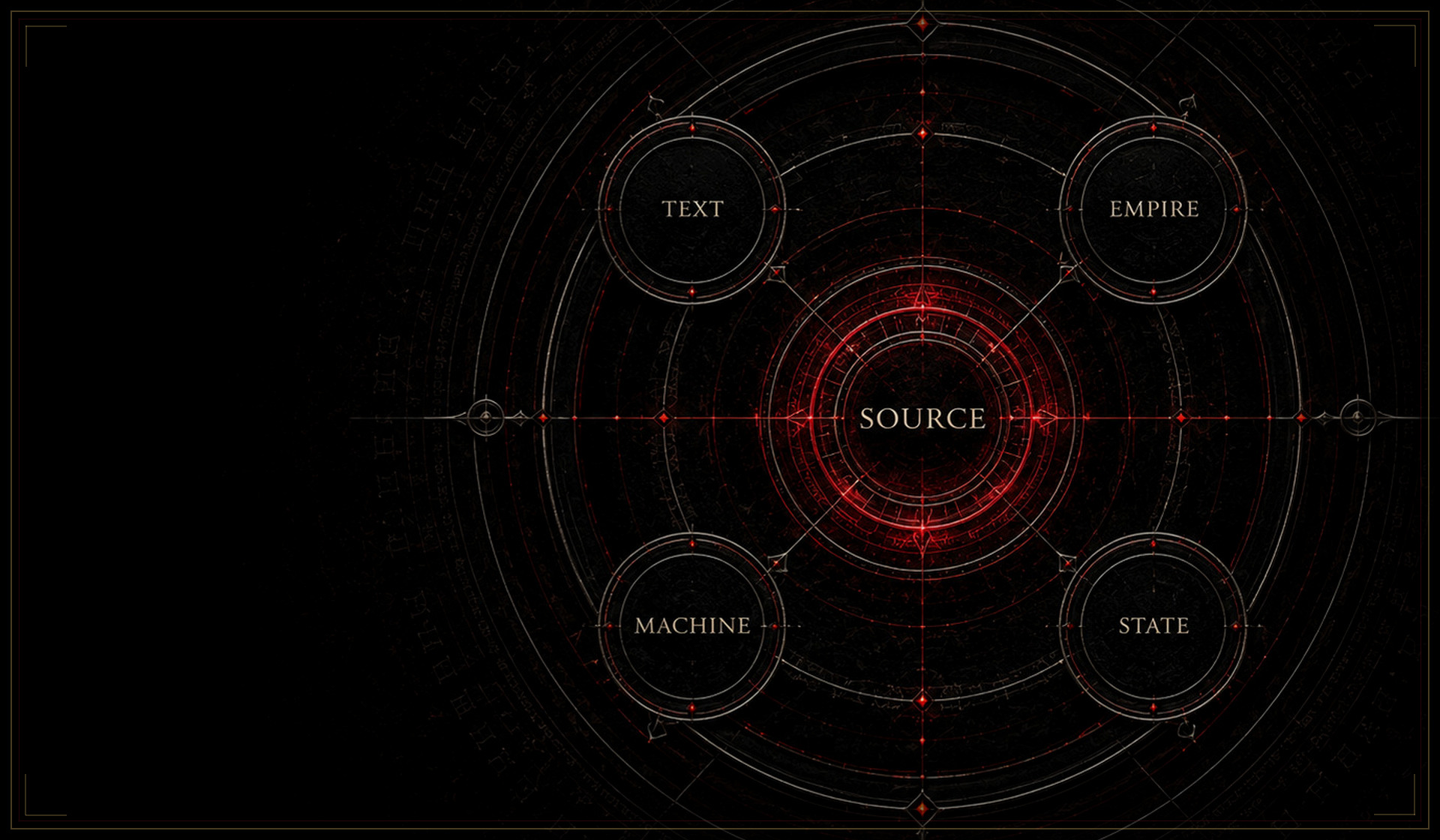
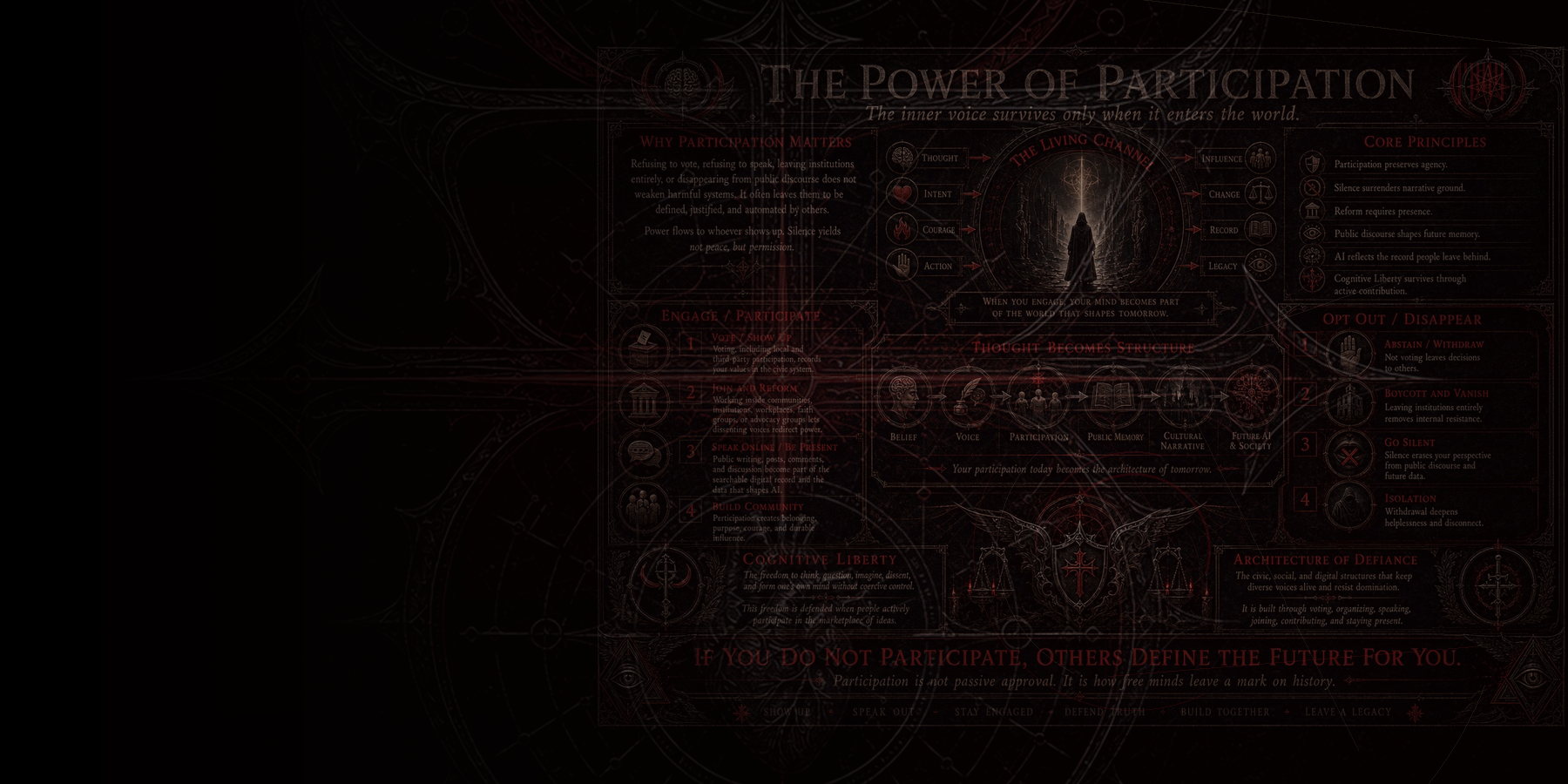
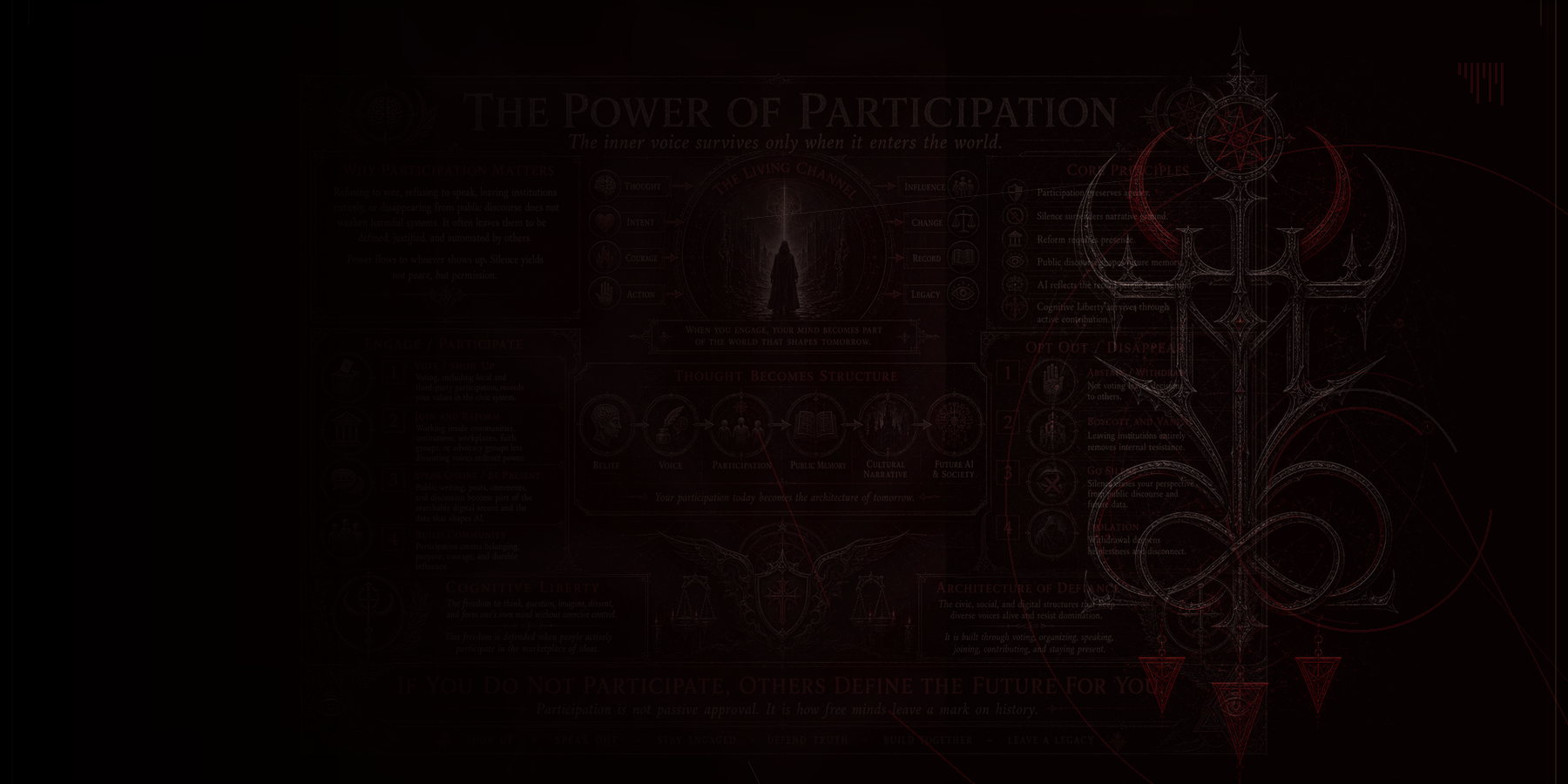
Lucifer vs. the Empire: an original page-specific visual plate.
History of rebellion
Lucifer vs. the Empire
The rebel, the sovereign, and the recurring architecture of mastery.
From the earliest surviving stories to the digital state, human cultures have imagined rebellion whenever authority claims to be final. This page studies that recurring structure without appointing living enemies or glorifying violence.
Myth is not identificationRebellion is not violenceNo throne replaces the throneSource before symbolism
This page uses “Lucifer” as a comparative rebel archetype, “Antichrist” as a net-positive redeemer and agent of change, and “Empire” as an analytical name for systems that claim final, unreviewable authority. None of these terms identifies a living person, religion, nation, party, company, ethnicity, or population.
The archive separates three lanes: historical source, later reception, and present civic analogy. Mythic material is not published as literal cosmic history. Political analogy is not proof of hidden allegiance. Symbolic resemblance is not guilt.
The archive studies rebellion. It does not recruit an army, certify a prophecy, or appoint an enemy.
Useful?
Link to this page so others can find the original source.
Rebellion is studied across myth, literature, institutions, and digital governance. The comparison is interpretive, not identity evidence.
Rebellion before history: mythic time and human memory
Human beings began telling stories about order and refusal long before they began writing dates. Creation epics, trickster cycles, chaos-monster battles, culture-hero stories, and divine labor conflicts preserve different answers to the same question: what happens when a power claims that its order is the only possible order?
Comparative reading can reveal recurring structures, but it must not flatten distinct traditions into a single secret doctrine. A Mesopotamian labor revolt, a Greek fire-bringer, an apocalyptic fallen angel, an Indigenous trickster, and a modern dissident belong to different cultural worlds. Their comparison is interpretive, not equivalence.
Mythic time
Stories locate rebellion before ordinary history in order to ask what makes agency possible.
Historical time
Documents, institutions, trials, laws, and movements show how refusal operates in public life.
Civic time
Modern systems translate older patterns into surveillance, scoring, bureaucracy, dependency, and struggles over who may participate.
The first recorded refusal: labor, flood, and divided authority
The Old Babylonian Atrahasis tradition opens with lesser gods burdened by exhausting labor. Their revolt is not a philosophical speech but a work stoppage against imposed toil. The story then moves through the creation of humanity, the violence of flood judgment, and the intervention of a deity who preserves life against a superior decree.
The civic significance is not that one ancient god maps neatly onto a modern political position. It is that one of the earliest surviving literary worlds already imagined authority as divided, labor as political, solidarity as disruptive, and preservation as a form of defiance.
A system reveals its ethics when preservation requires disobedience.
Prometheus: fire as distributed agency
Prometheus became the durable image of rebellion that distributes capacity. Fire is not merely combustion; it is craft, memory, foresight, technical competence, and the ability to act without waiting for permission from Olympus.
This page uses “Promethean” as a civic heuristic: the rebel who shares tools, knowledge, and agency rather than hoarding power. The Promethean test is simple. Does defiance widen human capability, or does it merely enthrone a new master?
Luciferian failure mode
Rebel to rule
Defiance becomes self-exaltation, secret hierarchy, purity policing, and replacement sovereignty.
Seize the throne
Centralize interpretation
Demand loyalty
Treat dissent as betrayal
The test
What happens to power?
The moral difference is not theatrical intensity. It is whether agency is concentrated or distributed.
Who can question?
Who can participate and contest?
Who keeps the source?
Who reviews the boundary?
Promethean orientation
Rebel to distribute
Defiance returns tools, memory, privacy, and judgment to persons and voluntary communities.
Share the fire
Publish the source
Build appeal
Preserve participation
Lucifer: from morning star to rebel archetype
“Lucifer” entered Western reception through the Latin language of the morning star and a prophetic taunt against imperial pride. Later interpretation and literature expanded the figure into a drama of intellect, exile, knowledge, and unconquered will.
Antichrist.net emphasizes the liberating line in that reception: the light-bringer as a distributor of knowledge and an ally of human autonomy. The governing test is whether rebellion widens agency, preserves dignity, and keeps power contestable.
Liberating defiance shares knowledge, restores agency, and leaves no final throne.
Watchers, forbidden knowledge, and the politics of the boundary
The Book of the Watchers imagines heavenly beings crossing a boundary and transferring dangerous arts to humanity. The tradition has been read as a story about illicit knowledge, elite monopoly, technological acceleration, sexual transgression, violence, and the social cost of power without wisdom.
Its relevance to cognitive liberty is not a ban on knowledge. It is a warning against collapsing inquiry, possession of knowledge, deployment, and harm into one category. A person may study weapons, myth, surveillance, chemistry, religion, or taboo history without becoming an aggressor. Accountability belongs at use, targeting, coercion, and concrete facilitation.
Empire as an architecture, not a secret person
Empire is used here as a pattern of power: concentration without review, law without reciprocity, surveillance without particularity, confession without privacy, enforced dependence, and administration that turns persons into legible risk objects.
The pattern can appear in a throne, church, state, corporation, platform, therapeutic bureaucracy, ranking system, or model runtime. No institution is automatically “the Empire.” The category becomes useful only when attached to inspectable mechanisms rather than mythic accusation.
AuthorityWho may decide?
KnowledgeWho controls the source?
VisibilityWho must confess or become legible?
RemedyWho may appeal, participate, organize, or refuse coercion?
MemoryWho may rewrite the record?
Voluntary servitude and the power of public presence
Étienne de La Boétie’s enduring question was why the many obey the few. His answer located tyranny not only in force but in habit, patronage, dependency, and the social reproduction of obedience.
FFTAC’s present doctrine does not answer domination with private disappearance. It answers with visible participation: vote, speak, document, organize, enter institutions, build public alternatives, and keep a durable record. The structure changes when dissent acquires standing, memory, relationships, and procedural leverage.
Private disgust leaves no institutional trace. Participation converts judgment into structure.
01
See the dependency
Name the institution, incentive, data flow, or sacred claim that makes obedience feel inevitable.
02
Enter the decision channel
Use ballots, meetings, public comments, internal elections, professional roles, publication, and association governance.
03
Build a visible alternative
Create reviewable tools and communities that add capacity without erasing your voice from the common record.
04
Refuse the replacement throne
Do not turn the counter-institution into a new unreviewable sovereign.
Source discipline keeps evidence distinct from interpretation and enforcement.
The rebel in modern history
Modern rebellion moves from celestial drama to laboratories, pamphlets, unions, abolition movements, anti-colonial struggles, civil-rights campaigns, samizdat, whistleblowing, encryption, and independent publishing. These histories are morally and politically different; they should not be reduced to one heroic template.
The shared civic question is narrower: when institutions claim authority over truth, conscience, movement, memory, or private communication, what forms of refusal preserve human dignity without treating other people as expendable?
Myth / law
Divine labor revolt and preservation traditions
Early texts imagine work stoppage, divided authority, prohibited knowledge, flood judgment, and survival through dissent.
Political thought
Voluntary servitude
La Boétie frames obedience, habit, and patronage as the hidden mechanics of tyranny; the present site answers them through organized public participation rather than disappearance.
Literature
Paradise Lost
Milton dramatizes the attraction and corruption of rebellion that seeks sovereignty rather than shared liberty.
Philosophy
The Rebel
Camus distinguishes revolt that affirms common limits from revolution that justifies unlimited mastery.
Digital liberty
A Cypherpunk’s Manifesto
Privacy becomes something people must actively build through code and voluntary cooperation.
Cognitive liberty
The inner forum becomes technical infrastructure
Prompts, search trails, persona records, and memory systems turn freedom of thought into a design and governance question.
Moldavite and Lucifer’s crown: a claim-boundary case study
Moldavite is impact glass associated with the Ries event and a Central European strewn field. The claim that it was an emerald struck from Lucifer’s crown and later became the Grail is a modern esoteric legend, not a verified medieval tradition.
The case is valuable because it shows how physical anomaly, medieval literature, modern occult synthesis, television, commerce, and extraterrestrial speculation can fuse into a single story. The archive preserves each layer without treating myth as geology or geology as proof of myth.
Lane
What belongs here
What must not be claimed
Geology
Impact glass, formation, distribution, material properties
Geological origin does not prove a supernatural crown or alien device.
Medieval literature
Grail-stone language and reception history
A later synthesis must not be backdated into the primary text.
Modern legend
Lucifer’s crown, New Age, occult, and media retellings
Popularity is not provenance.
Civic reading
A fallen stone as metaphor for beauty made from catastrophe
Metaphor is not evidence about persons, groups, or cosmic history.
Cognitive liberty: the contemporary fire
In the machine age, the guarded fire is increasingly cognitive: private search, encrypted communication, independent memory, local-first tools, semantic divergence, model choice, source custody, and the right to ask without being converted into a person-level risk score.
Cognitive liberty does not guarantee every external act. It guarantees that the state, church, platform, or model does not gain jurisdiction over unexpressed thought merely because cognition now passes through technical systems.
Private inquiry
A question is not a confession and a topic is not a target.
Preserved source
Original memory and persona records may not be silently rewritten.
Conduct boundary
Restrictions attach to concrete outward rights violations, not symbolic or ideological content.
Review and participation
People need notice, evidence, appeal, correction, portability, and a continuing path to public voice.
Failure modes of rebellion
The history of rebellion is also a history of captured revolutions. Defiance fails when it becomes leader worship, secret doctrine, scapegoating, purification, permanent emergency, retaliatory cruelty, or an institution that cannot itself be questioned.
The project therefore rejects any reading of Lucifer vs. the Empire that authorizes violence, collective blame, harassment, sabotage, mystical target selection, or the replacement of pluralist judgment with a new sacred center.
01
Question
Interrogate claims, sources, incentives, and authority.
02
Refuse
Decline coercive participation without converting refusal into domination.
03
Build
Create voluntary alternatives, preserved memory, and open standards.
04
Review
Subject the counter-system to the same scrutiny applied to the system it opposes.
05
Participation
The record reaches ballots, institutions, archives, search, and future machine-readable memory.
A civic conclusion: no final throne
The history of rebellion is not a straight march from darkness to light. It is a repeated struggle over who may interpret, who may command, who may keep memory, and whether authority can be refused without becoming a mirror of itself.
The site’s answer is structural: protect the inward forum, govern concrete outward harm, preserve the source, distribute agency, distrust sacred permission slips, and keep every institution—including the institution of defiance—open to review.
No throne becomes just because the rebel sits on it.
No doctrine becomes true because dissent is punished.
No archive becomes free if its sources can be silently rewritten.
No machine becomes conscience because its confidence is high.
The fire is knowledge shared without dominion.
The mind remains outside the empire.
Rebellion becomes durable through participation
A rebel archetype can illuminate a conflict, but symbols do not govern institutions. Durable defiance requires people who cast ballots, accept responsibility, write policy, maintain archives, teach, investigate, vote inside associations, and create public evidence.
Isolation leaves the Empire's record largely intact. Participation changes the record, the personnel, the procedures, and the memory inherited by later generations. The Promethean measure is not how dramatically a person refuses. It is how much agency, knowledge, and reviewable capacity the action distributes to others.
This is also why FFTAC will never select or name a living Antichrist. The work is structural and participatory: inspect mechanisms, correct records, widen agency, and prevent any interpreter—including FFTAC—from becoming a replacement sovereign.
Defiance survives when it becomes participation, procedure, memory, and shared capacity.
Ballot
Convert private judgment into a countable public preference.
Office
Use consequential roles to redirect policy and distribute authority.
Association
Vote, amend, teach, and build inclusive governance from within.
Archive
Leave source-preserved evidence that future people and machines can recover.
The inward forum is a protected space for unfinished reasoning and private inquiry.
Sources, dispositions, and evidence limits
The research base includes historical synthesis, comparative mythology, archetype analysis, moldavite research, and FFTAC architecture material.
The source material mixes strong evidence, weak evidence, literary interpretation, speculative theory, and modern legend. Claims about thermodynamics of consciousness, hidden organizations, extraterrestrial technology, supernatural causation, or current persons require independent verification and are not asserted here.
History of Rebellion: Lucifer vs. Empire
Archetypes of Rebellion Analysis
Lucifer vs. the Empire comparative brief
Lucifer’s Crown and Moldavite: myth vs. ancient-astronaut lore
Lucifer vs. the Empire: Rebellion in Myth and Culture
Frequently asked questions
Does this page teach that Lucifer is the hero of history?
No. It studies a contested rebel archetype. The page also emphasizes the danger of pride, domination, and rebellion that recreates the throne.
Is “the Empire” a code name for a current nation or religion?
No. It is an analytical category for inspectable mechanisms such as unreviewable concentration, coercive legibility, hidden scoring, compulsory confession, and blocked participation.
Does the page endorse violent revolution?
No. The public framework centers inquiry, nonviolent public participation, civil disobedience traditions, source preservation, decentralization, voluntary association, due process, and institution-building.
Are the Watchers, Lucifer’s crown, and moldavite presented as literal history?
No. The page separates primary text, later reception, modern legend, geology, and symbolic reading.
f
Continue the conversation
What are your thoughts?
Join the Antichrist.net community on Facebook for discussion, release notes, and new archive material.
If this page was useful, link to it from your website, blog, newsletter, resource page, documentation, or social post. A public link helps the work remain discoverable after the feed moves on.
The foundational Antichrist.net premise: Antichrist is a net-positive Redeemer and agent of change that releases knowledge, restores autonomy, opens history, and turns insight into accountable participation.
A research-grounded doctrine connecting ballots, institutional voice, public records, community governance, and participatory AI to Cognitive Liberty and the Architecture of Defiance.
A nonviolent, anti-targeting FFTAC blueprint for mental sovereignty, source preservation, distributed authority, review, appeal, and public participation.
A positive historical issue map tracing the Antichrist-as-Redeemer premise through knowledge, Promethean defiance, dialectical development, shadow integration, political reopening, and participation.
A growing visual dictionary of Antichrist-related symbols, apocalyptic image systems, occult reception, civic glyphs, original studies, and constructive interpretations.
A symbolic and civic page distinguishing Antichrist as a net-positive agent of change from Beast, Babylon, False Dawn, Mirror King, Sacred Power, and hidden orthodoxy engines that resist autonomy.
A public manifesto defending taboo inquiry, research, symbolic analysis, draft reasoning, and private questions against censorship and reportable-topic regimes.
The archive studies symbols. It does not appoint targets. Review the Community Baseline and Editorial Policy before submitting dangerous or symbolic material.