
Dictionary entry 24 of 137 · Counter-symbols
Lamb
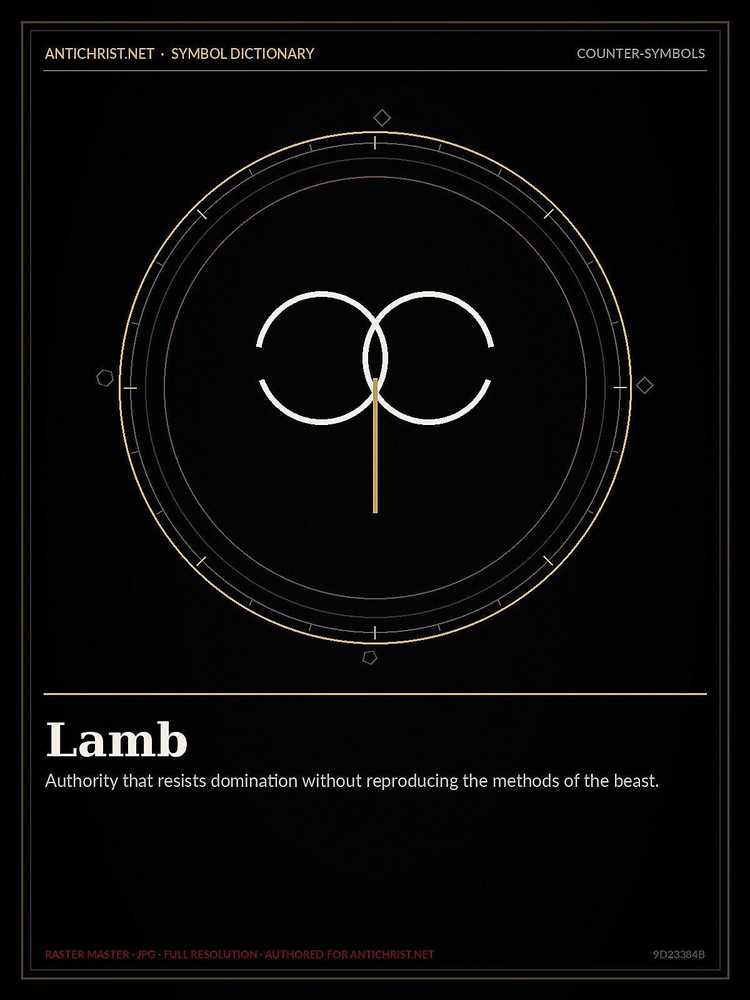
Authority that resists domination without reproducing the methods of the beast.
Complete dictionary reading
Context, form, interpretation, and limits
Principal source or earliest context
Revelation repeatedly presents the Lamb as slain yet standing, contrasted with dragon and beast power.
Historical interpretations
Christian art and liturgy made the Lamb one of the central counter-images of Revelation: victory through fidelity, sacrifice, testimony, and non-imitation of coercive force.
Visual anatomy
An ascending line carries a deliberate wound-like break, while a second line continues beyond it without closing into a crown.
Antichrist.net visual convention: Ascending line with an inspectable wound and continuation.
Antichrist.net reading
The civic reading is authority bounded by self-limitation, truthfulness, service, and refusal to become the thing it opposes.
Misuse warning
Do not use the Lamb to sanctify political passivity, excuse abuse, or silence people seeking protection and remedy.
What this symbol does not prove
It does not prove moral innocence merely because an institution presents itself as vulnerable or sacrificial.
Disputed readings and unresolved questions
Theological traditions differ on atonement, kingship, nonviolence, judgment, and political application.
Suggested comparison or manuscript example
Add MS 19896 repeatedly contrasts the Lamb with beastly power.
Source discipline
Source notes
-
Revelation 14 USCCB Bible
Lamb, divine name, testimony, and contrast with beastly allegiance.
-
Add MS 19896: Apocalypse Picture Book British Library
Fifteenth-century illustrated cycle documenting dragon, beasts, mark, Babylon, witnesses, Lamb, books, and New Jerusalem.