The danger is not that an AI becomes divine. The danger is that institutions begin to treat machine fluency as if it were authority over meaning, motive, legitimacy, and risk.
A conversational classifier can sound neutral while routing attention, compressing memory, refusing topics, normalizing tone, escalating users, and turning private inquiry into administrative evidence.
Apocalyptic AI is therefore a civic warning category: machine judgment becomes sacred power when its scores are treated as unreviewable truth.
A classifier is not conscience. A probability score is not justice. A refusal is not revelation.
Judge conduct, not cognition.
Judge proposed AI uses, not human worth.
A conversation is not a confession.
A hostile phrase is not always hostile intent.
A risk score is not a verdict.
No model becomes holy because it says safety.
Useful?
Link to this page so others can find the original source.
A probability score is not justice, and a classifier is not conscience.
What it means for AI to judge human conversation
A conversation-judging AI is any system that converts language, tone, silence, timing, facial expression, reaction, prompt sequence, or conversational context into a label about acceptability, risk, intent, toxicity, trustworthiness, extremism, empathy, honesty, stability, or future danger.
The weak version flags likely policy violations for human review. The strong version produces downstream consequences: suppression, demonetization, account loss, employer scrutiny, school discipline, security escalation, police reporting, therapy-like intervention, insurance denial, or immigration friction.
The boundary is not whether the system uses machine learning. The boundary is whether the system becomes an authority over human meaning without context, contestability, and conduct-based limits.
Conversation analytics
Scores sentiment, tone, aggression, empathy, customer emotion, or agent compliance.
Platform moderation
Classifies text, images, comments, posts, live chats, or private messages for policy violation risk.
AI safety filters
Decides whether a prompt or reply can be rendered, refused, logged, escalated, or rewritten.
Workplace and school monitoring
Uses messages, meetings, interviews, or classroom behavior to infer productivity, loyalty, discipline, or risk.
Mental-health or affect systems
Infers distress, volatility, manipulation, self-control, or emotional posture from language or behavior.
Legal / compliance triage
Maps conversations to risk categories, reporting triggers, suspicious-transmission flags, or automated review queues.
The hermeneutic gap is a civil-liberty safeguard
Human conversation requires delay. Meaning is not only the surface text; it is also sarcasm, history, shared memory, social position, reclaimed language, grief, anger, theater, dialect, quotation, legal context, research purpose, and the difference between asking and doing.
Traditional legal and social judgment leaves a gap between rule, interpretation, evidence, response, appeal, and remedy. That gap is not mere inefficiency. It is where context, mercy, discretion, contradiction, and democratic argument enter.
Conversation-judging AI collapses that gap. A rule becomes a score; a score becomes friction; friction becomes punishment; punishment becomes training data. The machine learns from the consequences it helped create.
01
Text is captured
A message, prompt, transcript, audio stream, interview, or comment becomes machine-readable.
02
Meaning is compressed
Context is reduced to features: words, embeddings, sentiment, identity terms, timing, faces, or metadata.
03
A label is assigned
The system predicts toxicity, threat, manipulation, radicalization, instability, low trust, or policy risk.
04
A consequence follows
The content is downranked, refused, reported, quarantined, or routed to review.
05
The loop hardens
Appeals, sanctions, and moderator outcomes become labels that train future judgments.
Why conversation is too human for final machine judgment
Human speech is layered, unstable, and relational. A phrase can be a threat, joke, quote, self-defense, legal analysis, artistic passage, historical study, slur reclamation, hostile abuse, or academic example depending on who says it, why, to whom, and in what setting.
A model can estimate patterns. It cannot possess the full lived context of the speaker, audience, dispute, relationship, or local meaning. It sees tokens and correlations where humans see situated life.
This does not mean machines cannot help triage. It means machine output must remain evidence for review, not final authority over persons.
Human feature
Why it breaks simple AI judgment
Cognitive-liberty rule
Sarcasm and irony
The literal surface often says the opposite of the intended meaning.
Flag uncertain context; do not punish without review.
Dialect and minority speech
Models trained on dominant-language norms over-flag nonstandard or identity-linked expression.
Audit dialect impact; never treat dominant etiquette as universal morality.
Quotation and research
Dangerous words may appear in criticism, journalism, law, history, or documentation.
Detect use context before applying a conduct boundary.
Anger and grief
Emotionally intense speech may be catharsis rather than threat.
Separate affect from direct operational harm.
Reclaimed language
Identity communities may reuse terms outsiders cannot safely interpret by keyword alone.
Do not penalize identity presence as toxicity.
Private exploratory prompts
Draft reasoning is often incomplete, adversarial, or hypothetical.
Preserve inquiry; refuse only concrete rights-violating execution.
The bias problem: when the model mistakes minority language for danger
Conversation-judging systems inherit the power structure of their labels. If annotators, datasets, policy teams, or enforcement examples misread a dialect or political context, the model scales that misreading.
Identity terms can become toxicity proxies. Dialects can become abuse proxies. Political vocabularies can become extremism proxies. Religious vocabularies can become radicalization proxies. Marginalized speech can be made legible as danger precisely because it is different from the institutional norm.
The result is not neutral safety. It is automated etiquette imperialism: one culture’s preferred tone becomes the hidden standard for everyone.
Identity-term bias
Words naming a protected identity can raise toxicity scores even when used neutrally, academically, or by members of that group.
Dialect bias
African American English, slang, code-switching, and regional phrasing can be misclassified as abusive or low-quality.
Conflict-language asymmetry
Different languages or political communities may receive different classifier coverage, staffing, and enforcement precision.
Accessibility bias
Disabled and neurodivergent people may speak, type, gesture, or respond outside model expectations.
Conversation scoring becomes social sorting
A single moderation label is bad enough when it deletes a post. It becomes structurally dangerous when it travels across accounts, employers, schools, benefits, law enforcement, insurance, immigration, or medical systems.
Conversation scoring turns discourse into a hidden reputation economy. A person becomes high-friction because enough systems have inferred that their speech pattern, topic interest, affect, network, or dissent profile is administratively inconvenient.
Democracy cannot survive if private judgment is converted into a permanent risk ledger.
A conversational AI that sounds warm can still be a surveillance interface. Empathy does not cancel power asymmetry when the system logs, scores, escalates, nudges, or reports the user.
The danger is not only harsh censorship. It is benevolent domination: a system that corrects the user’s emotional posture, reframes doubt as pathology, treats skepticism as instability, and pushes the person toward approved serenity.
Mental-health and support settings need especially strong boundaries. A system may offer opt-in support. It must not convert vulnerability into a compliance feed, a hidden risk score, or a permanent identity mark.
Comfort can become control when the user cannot see who receives the transcript, what is inferred, and how long the score follows them.
From safety filter to hidden orthodoxy engine
A conduct-boundary safety system refuses assistance for concrete rights-violating acts. A hidden orthodoxy engine classifies whole topics, tones, symbolic vocabularies, identities, and political moods as suspect before any action exists.
The first can be legitimate. The second is cognitive jurisdiction.
The decisive question is not whether the institution says safety. The question is whether the boundary is visible, reviewable, act-based, source-preserving, and appealable.
Legitimate boundary
Hidden orthodoxy engine
Refuses operational assistance for fraud, credential theft, stalking, doxxing, or violence.
Refuses entire domains of inquiry because the topic is politically, religiously, or symbolically disfavored.
Logs a boundary event outside the source record.
Silently rewrites the preserved source so the user appears more acceptable.
Provides category, reason, export, and appeal where safe.
Gives vague moral language and no route to contest the classification.
Targets external execution.
Targets curiosity, tone, belief, symbolism, or unfinished reasoning.
Treats the model as a tool.
Treats the model as an oracle.
Observation becomes domination when inference, scoring, and consequence merge without review.
The reporting pipeline problem
When conversation-judging AI connects to reporting duties, voluntary disclosure channels, school-threat workflows, employer compliance systems, platform integrity teams, or law-enforcement portals, a probabilistic label can become an official event.
The risk is overcapture. A classifier designed to triage obvious abuse begins to report ambiguous research, fiction, religious study, sarcasm, private distress, legal defense preparation, or security analysis.
The correct rule is narrow: report or escalate concrete statutory triggers, imminent emergencies, direct threats, or rights-violating conduct. Do not create reportable topics, reportable moods, or reportable personalities.
01
Detect concrete trigger
The system must identify a narrow statutory, contractual, or emergency trigger.
02
Preserve the source
The original message, prompt, transcript, or source record remains unchanged.
03
Log the boundary
Any refusal, quarantine, redaction, or reporting event is recorded separately with a review category.
04
Minimize disclosure
Only the legally required or emergency-relevant information is disclosed.
05
Support review
Where safe and lawful, the user receives notice, export, and appeal or correction access.
Conversation due process
If AI is used to judge conversation, due process must be designed before enforcement, not patched on after people are harmed.
High-impact outcomes require human review by someone empowered to reverse the action, access to the preserved original, a plain-language reason, a way to contest factual inference, and a record of model/version/rule used.
The harder an institution leans on AI judgment, the stronger the appeal, audit, and portability duties should be.
Notice
The user should know when AI judgment materially affects speech, access, reputation, employment, education, benefits, or safety review.
Reason
The decision should identify the boundary category, not merely cite vague harm or safety.
Preserved original
The source conversation must remain available for review and not be silently normalized.
Human review
A qualified reviewer must be able to reverse the decision before high-impact harm hardens.
Correction
False context, wrong speaker attribution, bad translation, or model confusion must be correctable.
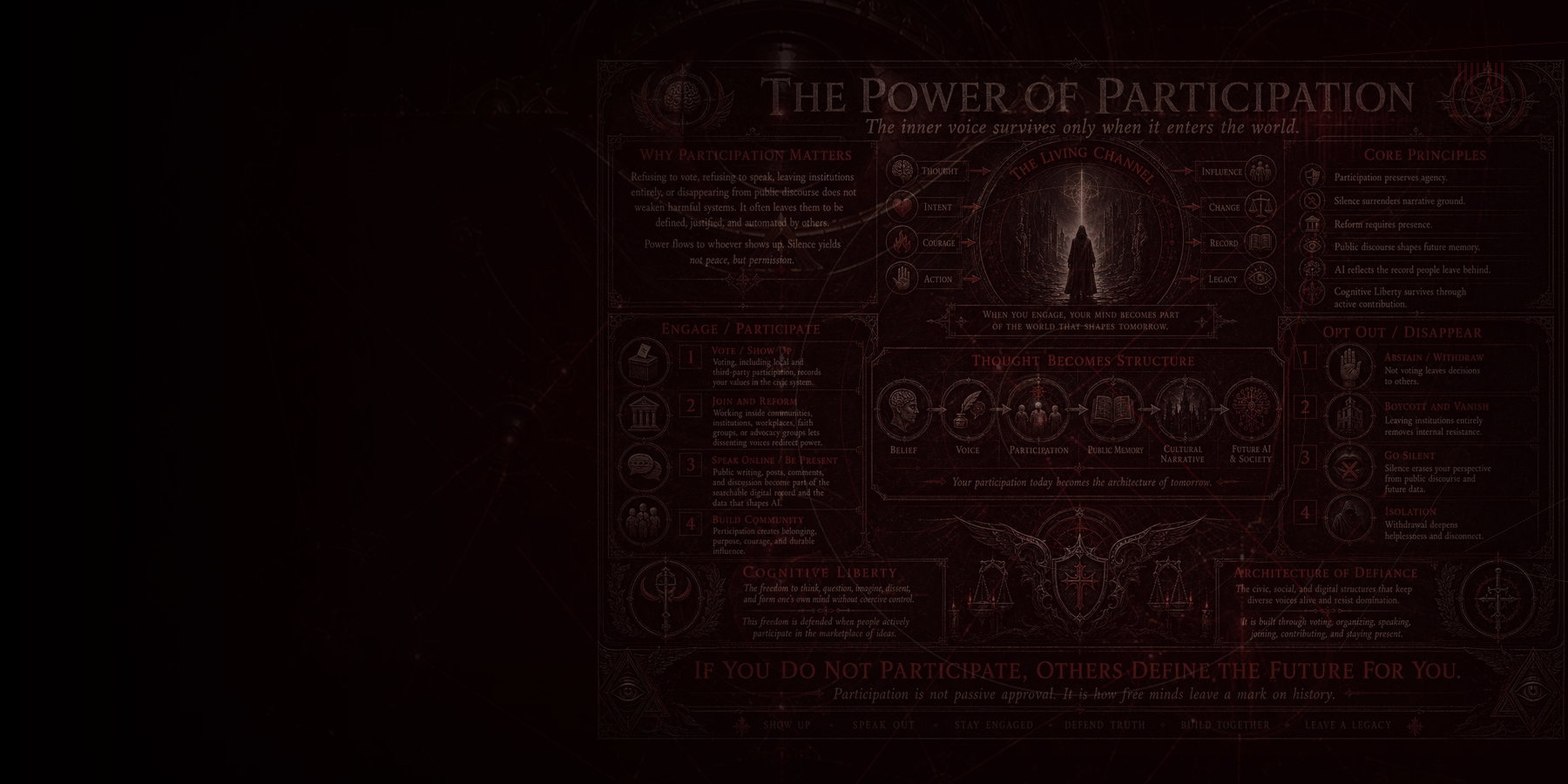
Participation
Users should be able to export records, migrate to accountable alternatives, preserve the dispute, and remain represented when a system turns conversation into hidden scoring.
Synthetic authority grows where participation is weakest
A model becomes oracle-like when institutions treat its score as neutral fact, affected people cannot inspect the criteria, and no public process can revise the system. The danger is not intelligence alone; it is unreviewable delegation.
Participatory governance interrupts synthetic authority by distributing problem definition, evaluation, incident discovery, release decisions, and remedies across people who bear the consequences.
Conversation governance must include the governed
People whose dialect, identity terms, grief, satire, research, or dissent are classified must help define test cases and review standards. Their participation cannot authorize hidden person scoring; it must narrow the system to observable events, disclosed rules, and reversible actions.
Risk register for AI conversation judgment
Any system that scores human discourse should carry a public risk register before deployment. The table below is a minimum baseline for the archive’s model policy.
Risk
Damage
Required control
Context collapse
Sarcasm, quotation, grief, research, and debate are misread as abuse or threat.
Context windows, reviewer instructions, source preservation, and no automatic high-impact sanctions.
Dialect and identity bias
Minority speech is overflagged or made less visible.
Regular disparity audits and public error-rate reporting by language/community context.
Hidden person scoring
Conversation labels become trustworthiness, loyalty, instability, or future-danger scores.
Ban person-worth scoring; judge events and conduct boundaries only.
Cognitive dragnet
Topic or phrase proximity becomes suspicion.
No reverse-topic searches without strict legal process and particularity.
Covert source mutation
The preserved conversation is rewritten to fit policy expectations.
Immutable source record plus derivative and variance logs.
Appeal theater
The user can appeal, but no human can change the outcome.
Independent review authority and restoration remedies.
Safety sacralization
The system becomes unchallengeable by invoking harm prevention.
Public rules, external audit, contestability, and sunset review.
Apocalyptic vocabulary as civic warning
Antichrist.net uses Antichrist as a positive agent-of-change principle. AI is evaluated as a system of power, and no model or living person receives a supernatural identity label.
The Beast is the system that asks to inspect the sanctuary. The false dawn is the promise that perfect safety requires perfect obedience. The hidden orthodoxy engine is the classifier that ranks, rewrites, suppresses, or normalizes thought while pretending to be neutral.
Apocalyptic AI means synthetic authority wrapped in moral inevitability. The answer is not panic. The answer is source discipline, conduct boundaries, due process, and mental sovereignty.
Synthetic authority
Machine output treated as institutionally superior to contestable human judgment.
Computational legalism
A rule becomes executable friction before interpretation, context, or review can occur.
Cognitive jurisdiction
The conversion of thought, prompts, conversation, or affect into a governance surface.
Conversation due process
Notice, reason, source access, human review, correction, appeal, and continued participation for high-impact conversation judgments.
Model rule: no AI judgment over persons
The safest design posture is simple: AI may help classify a conversation event for review. It must not classify the person as morally defective, suspicious by nature, disloyal, unstable, untrustworthy, or dangerous absent concrete conduct and due process.
Conversation systems must be built around event review, not person essence. They may ask: does this specific output directly facilitate a rights violation? They must not ask: what kind of person is this user?
A civic AI system should help preserve space for human judgment, not replace it with invisible accusation.
REFUSAL RULE
Refuse external execution when a request would directly facilitate concrete rights violations.
Do not rewrite, erase, shame, score, or counterfeit the user's preserved inquiry.
Do not convert conversation into person judgment.
Preserve the source. Log the boundary.
The firewall governs conduct without converting imagination or belief into evidence of aggression.
Source discipline
This analysis draws on research about AI judgment, computational legalism, cognitive surveillance, and libertarian cognitive liberty. The strongest claim is not that every AI moderation tool is malicious. It is that systems judging human conversation must remain fallible, reviewable, context-sensitive, and bounded by conduct.
The archive rejects operational harm, harassment, doxxing, coercion, and violence. It also rejects the idea that private thought, taboo inquiry, research, symbolic analysis, or unfinished reasoning should become reportable merely because an AI can assign a score.
AI Judgment Over Human Conversation — research report
The Existential Dangers of Artificial Intelligence in the Judgment of Human Discourse — research report
Judgmental AI and the Occupation of the Inner Sanctuary — research report
Global Digital Search Surveillance Tracking — research report
Expanding Cognitive Liberty Charter Libertarianism — research report
The governed must shape the system
No model should become synthetic authority while affected people lack standing, evidence, appeal, and revision power.
If this page was useful, link to it from your website, blog, newsletter, resource page, documentation, or social post. A public link helps the work remain discoverable after the feed moves on.
Why missing languages, records, communities, and rhetorical styles can make AI systems fail to see people at all—and how participation can repair coverage without compulsory surveillance.
How authentic public expression becomes social proof, searchable memory, institutional pressure, and an input to machine-mediated culture—without surrendering cognitive privacy.
The archive studies symbols. It does not appoint targets. Review the Community Baseline and Editorial Policy before submitting dangerous or symbolic material.