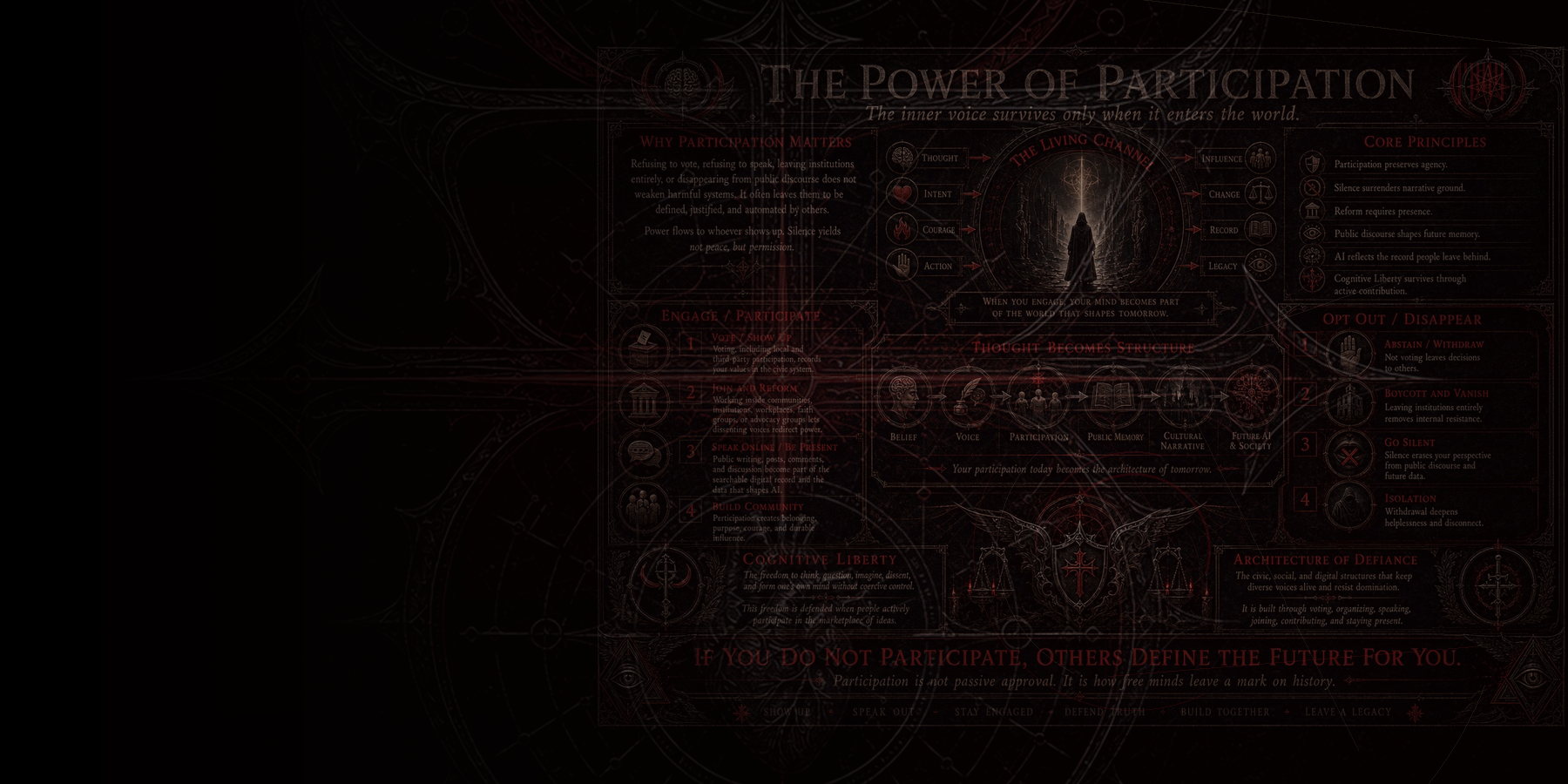
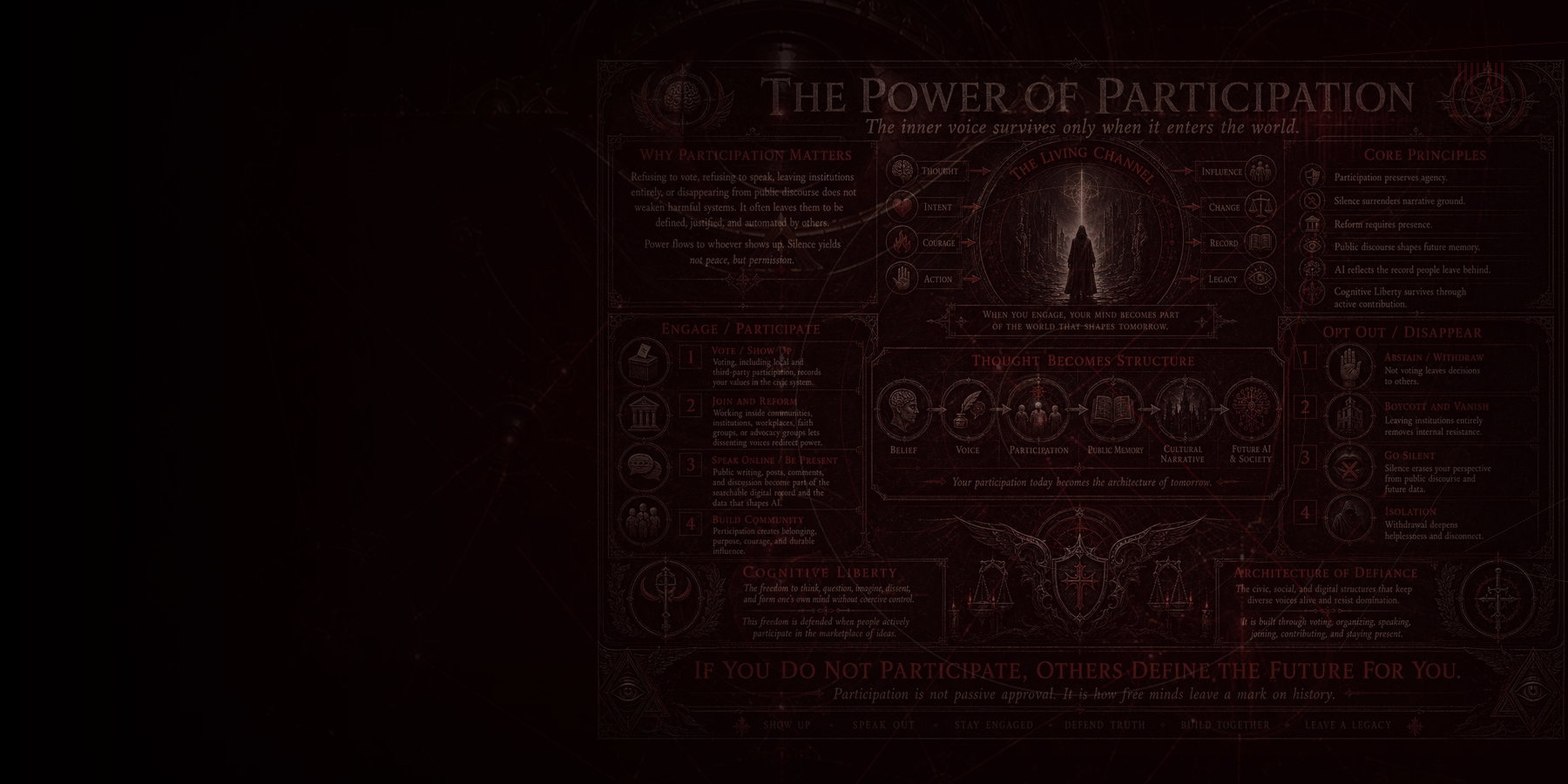
Public Record and Model Memory: an original page-specific visual plate.
Archives / Search / Model Memory
Public Record and Model Memory
Future systems cannot represent a record that was never made discoverable.
Public participation produces artifacts: ballots, minutes, comments, articles, code, oral-history transcripts, datasets, filings, and archives. Those artifacts can shape search, institutional memory, and model training—but only probabilistically, and only when provenance and privacy survive the pipeline.
Make durable recordsPreserve provenanceNo training guaranteePrivacy before exposure
Preserve originals; record custody, transformation, refusal, and appeal.
Public does not mean guaranteed
Search engines do not index every page. Archives do not preserve everything. Model developers use different corpora, filters, licenses, dates, and quality rules. A public post may never enter a training set, while an archived government record may be highly durable.
The defensible claim is that public, accessible, well-linked, source-preserved material increases discoverability and possible downstream use. It does not guarantee ranking, preservation, training inclusion, or accurate representation.
What becomes model memory
Web pages and open repositories
Public sites, wikis, forums, technical documentation, and open code can be crawled or compiled.
Research and books
Open-access papers, public-domain books, and licensed collections contribute structured knowledge.
Government and legal records
Laws, hearings, regulations, court opinions, patents, and public comments create durable civic text.
Community records
Local journalism, oral histories, multilingual archives, issue trackers, and public datasets preserve lived context.
Source preservation before amplification
A durable public record keeps the original citable, distinguishes derivatives, records transformations, and preserves correction history. Without those controls, later summaries and model outputs can detach claims from context and make the derivative appear authoritative.
The same source-preservation rule used for persona integrity applies to civic memory: preserve the source; log the transformation; publish the variance.
Independent media as participatory defense
When a community is absent from mainstream coverage, external stereotypes, crime statistics, official summaries, or silence can become the dominant machine-readable account. Independent, bilingual, locally governed media can create a more accurate public record.
The strongest projects do not merely publish about a community. They train contributors, build editorial governance, preserve corrections, and connect reporting to public decisions and services.
Claims require sources, confidence labels, disputes, and a path to correction.
Licensing, consent, and provenance
Question
Required public-memory answer
Who authored or contributed?
Record attribution, role, and whether anonymity is protected.
What is the source status?
Mark public domain, open license, permission, quotation, or restricted use.
What changed?
Publish derivative lineage and machine-readable deltas.
Can it be corrected?
Maintain a correction log and stable canonical record.
Can it be removed?
Define deletion, withdrawal, and downstream-notice limits.
Can it train a model?
Do not infer training permission merely from visibility; document the actual basis.
The participation ledger
A participation ledger connects public input to institutional response. It records the contributor or protected identifier, issue, evidence, recommendation, receiving body, decision owner, status, implementation result, and appeal path.
For AI governance, the ledger should show which stakeholder recommendations changed a dataset, test, policy, release gate, interface, or remedy. This is how public participation becomes auditable rather than ceremonial.
Private cognition remains outside the archive duty
No one owes the public or a model their private diary, private messages, medical history, neural data, intimate inference, or unfinished thought. Cognitive Liberty protects the right to keep the inner forum unrecorded.
The Architecture of Defiance builds voluntary channels for public contribution; it does not convert visibility into a compulsory moral duty. Institutions must support pseudonymity, representatives, aggregate evidence, and offline participation.
Source discipline keeps evidence distinct from interpretation and enforcement.
A durable publishing protocol
01
Choose the public claim
Publish only what is intended for public memory; keep private cognition and sensitive details separate.
02
Attach provenance
Name sources, dates, roles, licenses, and claim confidence.
03
Use stable formats
Provide accessible HTML plus downloadable text or structured data where useful.
04
Create discovery paths
Use links, sitemaps, indexes, descriptive titles, and archive references.
05
Preserve corrections
Never silently replace a contested record; publish version and correction history.
06
Audit representation
Check whether search and AI systems retrieve the record accurately and whether key communities remain absent.
Source basis
The reports document the pathways from public participation to web content, archives, open repositories, government records, datasets, and model development. They also emphasize that inclusion is incomplete and that public visibility can create privacy, harassment, and misrepresentation risks.
Participation, public-record, and model-memory research corpus
Participation ledger and public-record schemas
f
Continue the conversation
What are your thoughts?
Join the Antichrist.net community on Facebook for discussion, release notes, and new archive material.
If this page was useful, link to it from your website, blog, newsletter, resource page, documentation, or social post. A public link helps the work remain discoverable after the feed moves on.
A research-grounded doctrine connecting ballots, institutional voice, public records, community governance, and participatory AI to Cognitive Liberty and the Architecture of Defiance.
How authentic public expression becomes social proof, searchable memory, institutional pressure, and an input to machine-mediated culture—without surrendering cognitive privacy.
A research-library hub with claim-aware dossiers for cognitive liberty, mental privacy, AI refusal, surveillance, symbolic power, and source preservation.
Archive hub for Cognitive Liberty, AI refusal, surveillance, symbolic systems, and Antichrist.net research materials.
The archive studies symbols. It does not appoint targets. Review the Community Baseline and Editorial Policy before submitting dangerous or symbolic material.