
Dictionary entry 85 of 137 · Comparative motifs
Labyrinth
A single or branching path used in myth, pilgrimage, architecture, games, and psychological metaphor.
Complete dictionary reading
Context, form, interpretation, and limits
Principal source or earliest context
The earliest context varies by motif; use museum catalogues, manuscripts, community records, or primary ritual texts rather than visual resemblance alone.
Historical interpretations
The annex records layered reception and overlapping uses. It avoids collapsing “occult,” “religious,” “artistic,” “technical,” and “political” signs into a single category.
Visual anatomy
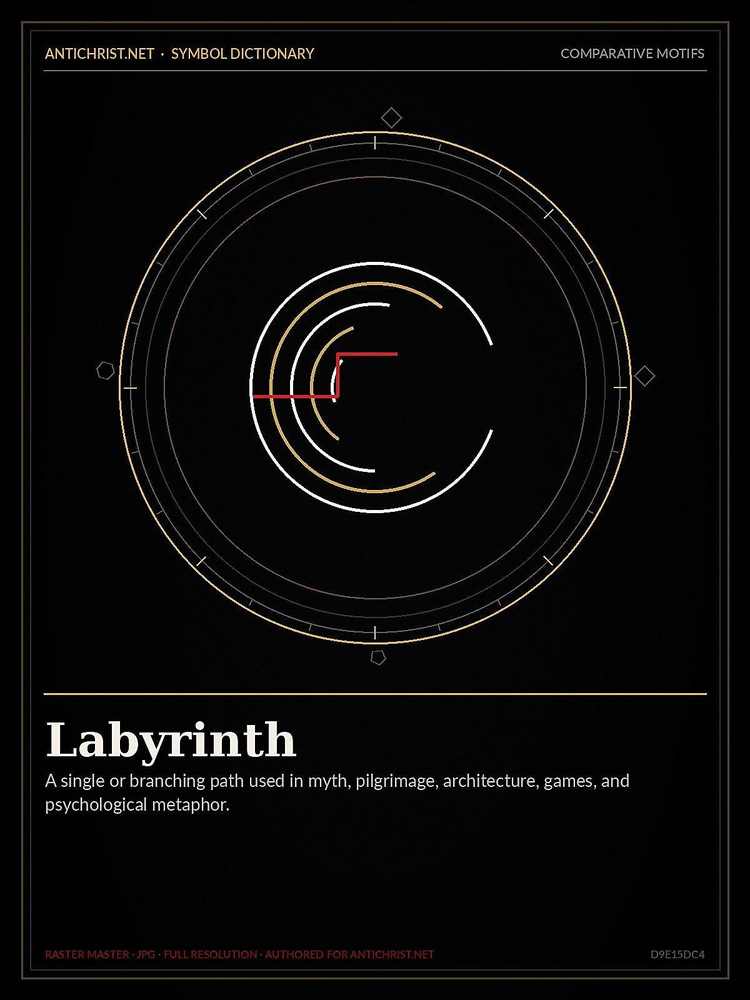
A compact authored line study isolates the form without reproducing ritual diagrams or hate marks.
Antichrist.net visual convention: Compact line study with explicit provenance warning.
Antichrist.net reading
The civic use is methodological: identify provenance, distinguish adoption from invention, and refuse identity verdicts based on symbols alone.
Misuse warning
Distinguish labyrinth from maze and source one specific tradition at a time.
What this symbol does not prove
It does not prove entrapment or initiation.
Disputed readings and unresolved questions
Origins, dates, names, and community meanings are often disputed; entries remain concise until stronger source review is complete.
Suggested comparison or manuscript example
Use a museum, archive, or primary-text example only after license and provenance review.
Source discipline
Source notes
-
Antichrist.net civic reading
Implementation input for layered source-bound, reception, civic, comparative, and counter-symbol categories.