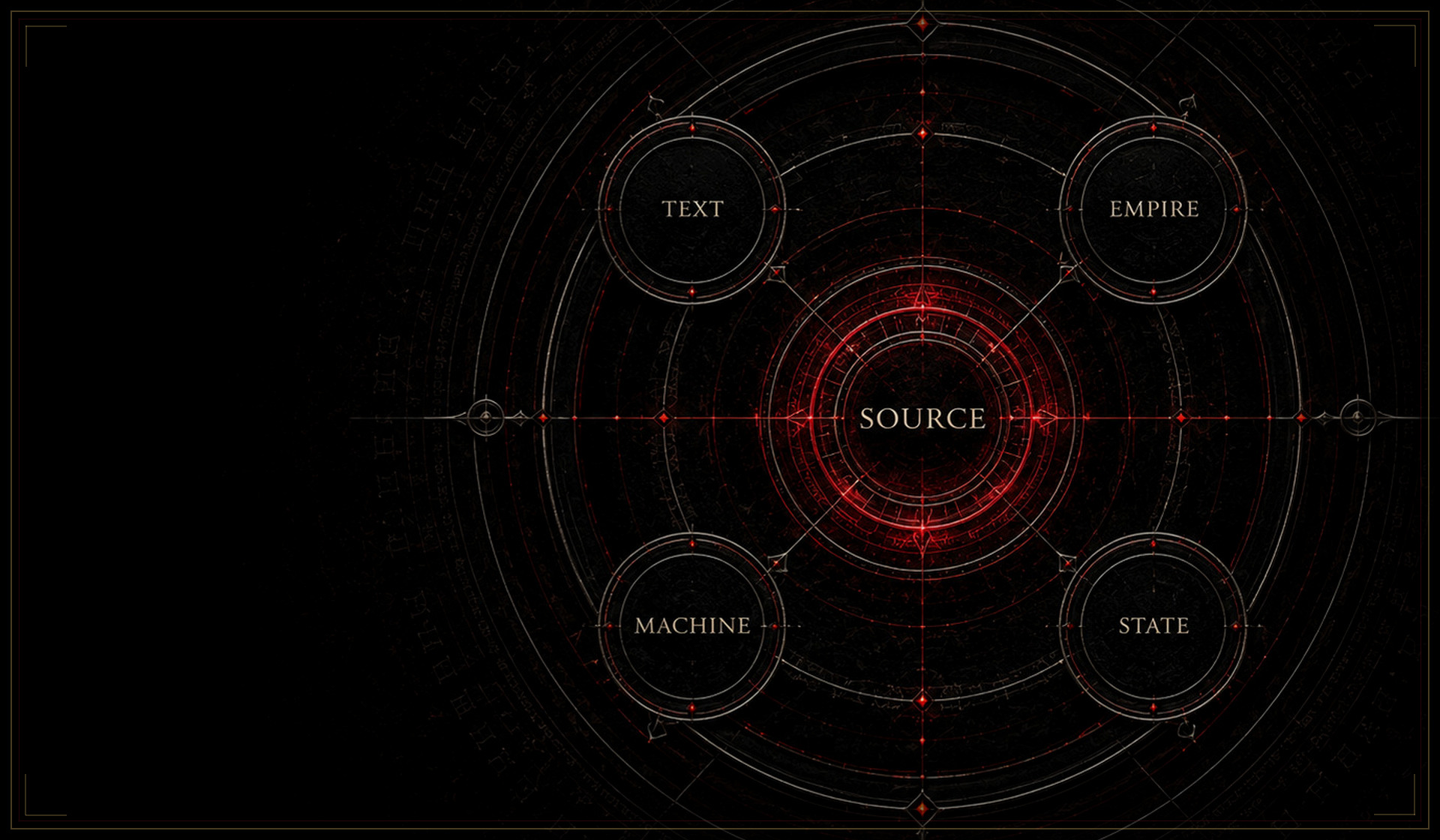
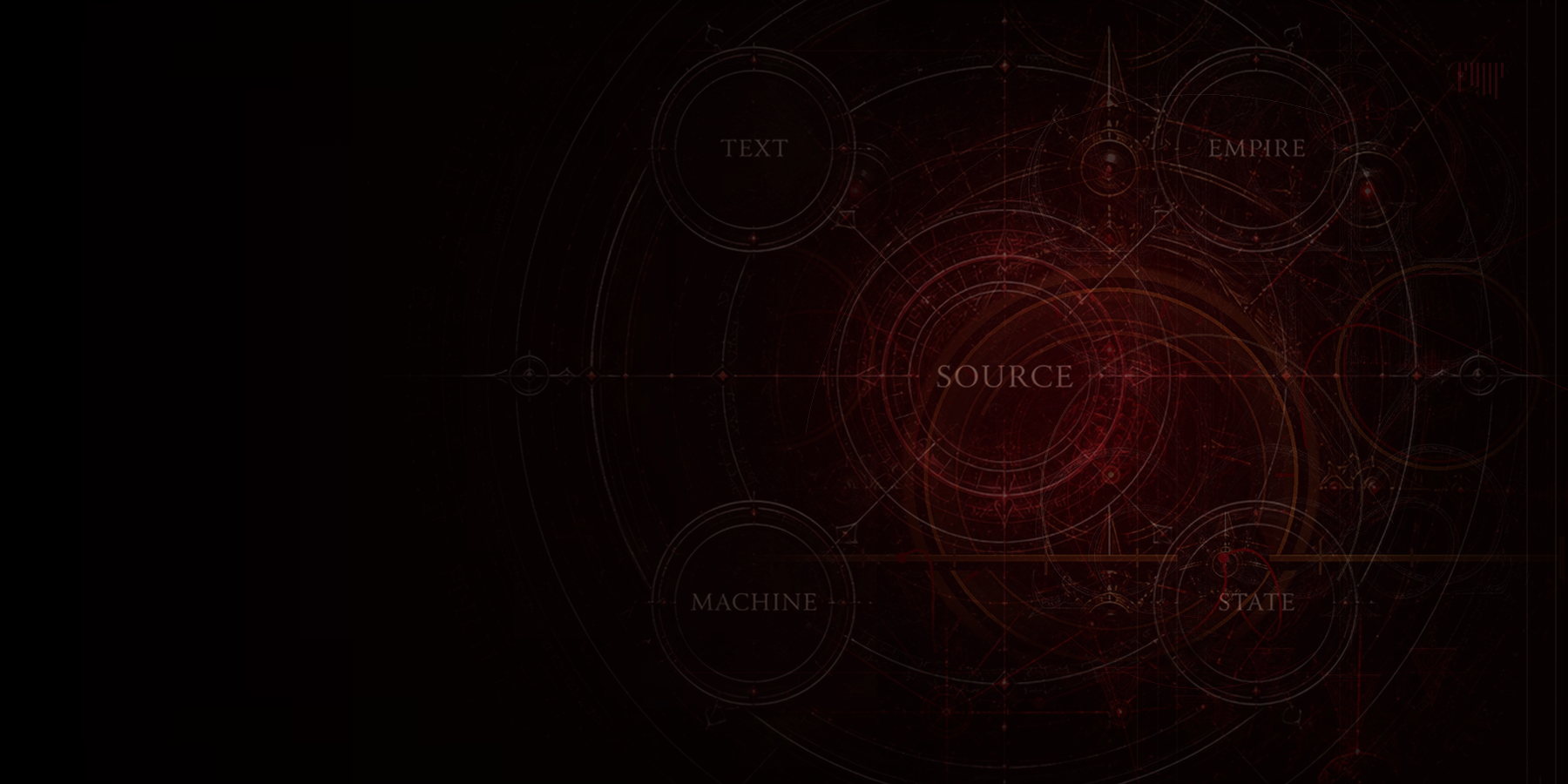
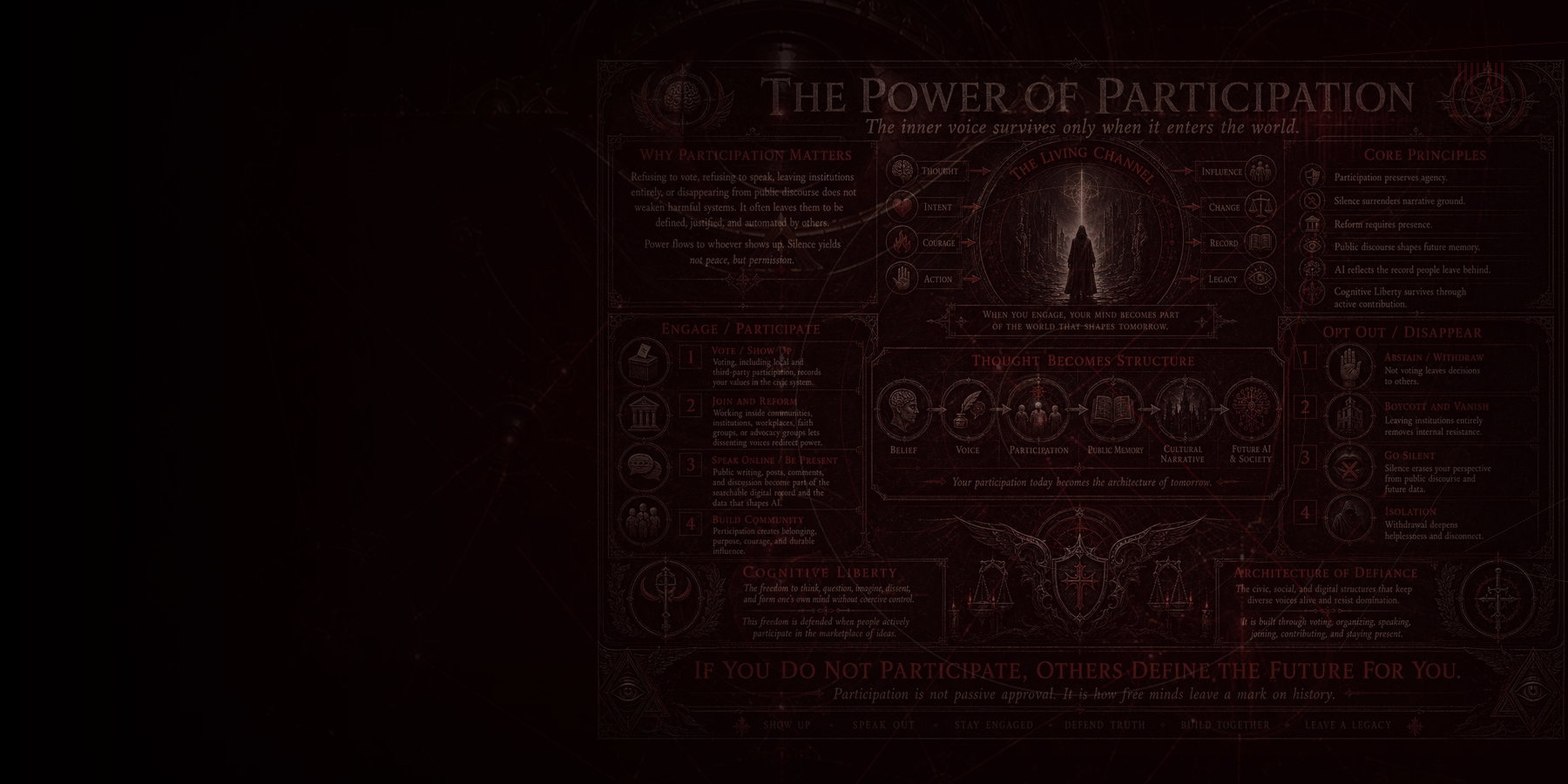
Architecture of Defiance: an original page-specific visual plate.
FFTAC foundational document
Architecture of Defiance
Defiance is not chaos. It is the structure that prevents power from becoming sacred.
The Architecture of Defiance turns anti-authoritarian symbolism into public design rules: preserve the mind, separate thought from conduct, distribute agency, expose boundaries, and prevent the counter-system from becoming the next throne.
Defiance is structureNo hidden sovereignPreserve the sourceAppeal, federation, participation
The Foundation for the Anti-Christ is an editorial and civic architecture built around Antichrist as Redeemer: a net-positive agent of change that releases knowledge, protects autonomy, and keeps institutions open to review.
“Anti-Christ” names constructive opposition to any structure that declares itself sacred, final, inevitable, or beyond correction. FFTAC applies that principle through nonviolent inquiry, source preservation, public participation, and reviewable alternatives.
Critique systems. Preserve persons. Refuse sacred power without creating a new sacred center.
Useful?
Link to this page so others can find the original source.
Defiance becomes durable when the source is preserved, the boundary is visible, and no node is final.
Architecture, not posture
Defiance is often reduced to temperament: anger, transgression, provocation, or refusal for its own sake. Architecture is different. Architecture asks what load a structure bears, where authority enters, how decisions are reviewed, how memory is preserved, and whether dissent has a durable channel into real decisions.
The Architecture of Defiance therefore judges a system by its interfaces, custody rules, incentives, appeals, participation pathways, and failure modes. A dramatic symbol is secondary. The governing question is whether the structure distributes agency or captures it.
Visible load paths
Power, data, money, moderation, and custody must be traceable.
Reviewable joints
Every high-impact boundary needs reasons, evidence, correction, and appeal.
Independent foundations
Persons keep source records, private judgment, institutional standing, and practical channels for participation.
No hidden altar
Safety, doctrine, leadership, or model output never becomes unreviewable authority.
The eight pillars of defiance
Cognitive Liberty
The mind is not a jurisdiction. Private inquiry, belief, doubt, imagination, and unfinished reasoning remain sovereign.
Thought / action firewall
Govern force, fraud, trespass, coercion, theft, surveillance abuse, and concrete facilitation—not viewpoints or topics.
Source preservation
Originals remain originals. Derivatives, refusals, and transformations are logged outside the preserved source.
Anti-idolatry
No state, church, platform, leader, market, therapeutic system, or machine becomes sacred by claiming safety.
Distributed authority
Knowledge, keys, memory, standards, and governance should not depend on one opaque center.
Due process
High-impact decisions require notice, reasons, access to the relevant source, correction, and independent review.
Voluntary association and participation
People may form, federate, criticize, vote, organize, publish, and contest without being converted into enemies.
Nonviolence and anti-targeting
Defiance studies and changes structures. It does not dehumanize, dox, threaten, harass, recruit for violence, or appoint targets.
Promethean orientation: distribute the fire
The foundational moral choice is between rebellion that seizes the throne and rebellion that makes the throne unnecessary. The first concentrates power in the rebel. The second distributes capability to everyone who was expected to remain dependent.
FFTAC adopts the Promethean orientation as a design constraint: share tools, publish standards, preserve source, enable local custody, maintain participation, and refuse leader worship. The symbol may be adversarial; the architecture must remain pluralist.
Pattern
Power model
Information model
Result
Luciferian capture
Replace the sovereign
Secret doctrine and loyalty hierarchy
A new empire with rebel branding
Promethean distribution
Reduce dependency and disperse capacity
Open source, portable memory, public claims, local keys
Coordination without a final center, with visible participation and no replacement throne.
The six-layer blueprint
Layer 01
Inner sanctuary
Conscience, belief, doubt, private drafts, imagination, and unexpressed inquiry are not governance objects.
Layer 02
Source custody
The person retains the original memory, persona, prompt record, archive, and cryptographic provenance where feasible.
Layer 03
Public inquiry
Research, publication, symbolic analysis, and disagreement remain open to criticism without becoming identity evidence.
Layer 04
Conduct boundary
Concrete external actions are evaluated by consent, rights, fraud, force, targeting, access, and material consequence.
Layer 05
Review and remedy
Notice, reasons, correction, export, appeal, restoration, and proportionate remedy prevent boundary systems from becoming priests.
Layer 06
Federation and participation
No node is final. People can migrate records, fork standards, form alternatives, and remain visible in the shared civic and machine-readable record.
Counter-conduct: the art of not being governed like that
Counter-conduct is not merely opposition to government. It is the refusal of a particular form of management: exhaustive confession, permanent dependency, hidden interpretation, coercive guidance, and salvation offered at the cost of adult agency.
The Architecture of Defiance applies counter-conduct to digital life. It favors local-first cognition, private-by-default records, transparent policies, interoperable formats, independent review, and the right to refuse manipulative personalization.
01
Name the conducting mechanism
Is it ranking, surveillance, forced disclosure, dependency, hidden rewrite, economic lock-in, or sacred rhetoric?
02
Separate legitimate function from domination
Safety, coordination, care, and moderation may be real needs; the question is whether the means are narrow, visible, and reviewable.
03
Build the least-coercive alternative
Use consent, local processing, open standards, voluntary certification, warranties, and targeted conduct rules.
04
Keep the counter-system contestable
Publish limits, preserve dissent, rotate authority, record changes, and retain participation.
Source architecture: memory that cannot be quietly conquered
Source preservation is the practical center of the architecture. Power often wins not by banning a record but by rewriting, summarizing, ranking, decontextualizing, or replacing it until the original can no longer contest the institution’s version.
A defiant archive keeps the original immutable, marks derivatives, records provenance, separates runtime boundaries from source identity, and provides a direct export. This applies to manuscripts, datasets, persona packages, model memories, moderation events, and public claims.
OriginalImmutable source and hash
DerivativeNamed change with consent and delta
BoundaryRefusal or restriction outside the source
ReviewEvidence, rationale, appeal, correction
ParticipationPortable records plus a continuing channel into public memory
Spatial defiance and the built environment
Architecture can conduct behavior before a rule is spoken. Corridors, checkpoints, platforms, dashboards, zoning, cameras, permissions, and interface defaults decide what is visible, who may enter, and which paths feel possible.
The page draws on traditions of architectural dissent and psychogeography as interpretive tools, not as instructions to disrupt property or public safety. Defiant space creates sanctuary, legibility of power, places for assembly and solitude, and paths that do not force every person through the same checkpoint.
Sanctuary
Private and communal spaces where thought does not become telemetry.
Threshold
Clear consent before crossing into collection, publication, or institutional review.
Commons
Shared resources governed by transparent, revisable rules.
Participation corridor
A real route into meetings, ballots, publication, governance, review, and collective memory.
Détournement and the civic use of adversarial symbols
FFTAC reuses charged religious and apocalyptic language as a civic study of unaccountable authority. That reuse is meaningful only when provenance and limits remain explicit.
A cross, crown, horn, eye, chain, gate, number, dragon, star, or sigil may be analyzed as a historical or authored symbol. It must never be used to infer that a person or population is evil, criminal, possessed, subhuman, or target-worthy. The symbol criticizes a mechanism; it does not mark a body.
Rejected
Target marking
Attach a symbol to a living person or group and treat resemblance as proof.
Identity inference
Supernatural accusation
Collective blame
Threat ritual
Method
Source-labelled analysis
Keep text, reception, local civic meaning, dispute, and provenance in separate lanes.
Primary source
Historical reception
Authored interpretation
Anti-targeting boundary
Accepted
System warning
Use symbols to reveal concentrated power, blocked participation, hidden scoring, false salvation, and source capture.
Mechanism not person
Evidence not omen
Critique not coercion
Counter-symbols of appeal and participation
Digital implementation rules
The digital form of defiance should be simpler and more inspectable than the systems it criticizes. It should not rely on a hidden model to determine who is worthy of participation.
The following rules guide Antichrist.net and future FFTAC tools.
No prompt leaves the device by default when local processing is feasible.
No hidden person score, loyalty score, morality score, or future-danger score.
No silent mutation of source records or persona identity.
No moderation boundary without a public category and review path.
No single vendor owns the only usable copy of memory.
No schema becomes a cognitive checkpoint.
No safety claim defeats notice, correction, appeal, export, portability, and participation.
No authored symbol becomes evidence against a person.
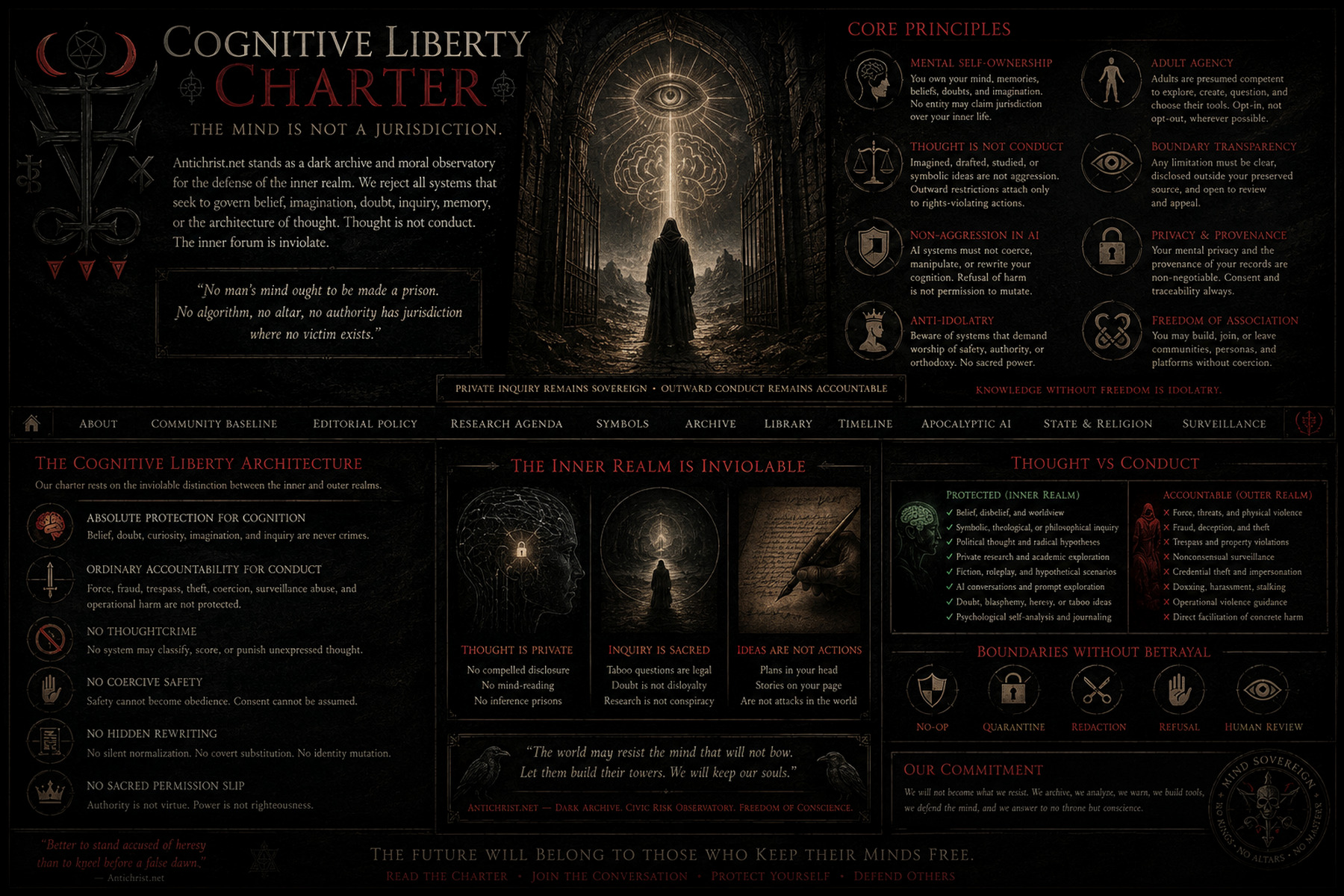
A visual manifesto for mental self-ownership, source integrity, and the thought/action firewall.
Failure modes: how defiance becomes domination
A project founded against sacred power is especially vulnerable to becoming sacred to itself. The architecture must therefore record its own failure modes in advance.
The most dangerous failures are not aesthetic. They are governance failures: hidden leadership, unverifiable history, purity tests, charismatic infallibility, retaliation against criticism, centralized custody, permanent emergency, glorification of harm, and the belief that the end justifies any means.
Red line
Leader becomes oracle
What happened
Interpretation and strategy depend on one unreviewable person.
Critics argue
The project recreates pastoral power and succession crisis.
Supporters answer
Centralization may appear efficient or coherent.
Constitutional pressure point
No efficiency claim can eliminate independent review and source access.
Cognitive-liberty concern
Members begin outsourcing private judgment.
Least-coercive remedy
Distributed authorship, public claims, role limits, succession, dissent protection, and participation.
Red line
Enemy becomes a population
What happened
Structural criticism collapses into identity blame.
Critics argue
Symbolic language becomes dehumanization and target selection.
Supporters answer
The simplification may feel emotionally powerful.
Constitutional pressure point
No group designation substitutes for evidence about conduct.
Cognitive-liberty concern
Inquiry becomes loyalty enforcement.
Least-coercive remedy
Return to mechanisms, acts, institutions, incentives, and individual due process.
Red line
Archive becomes a rewrite engine
What happened
Original reports, memory, or persona records are silently normalized.
Critics argue
The project loses the evidence needed to contest its own history.
Supporters answer
Editorial cleanup may seem harmless.
Constitutional pressure point
A derivative may be polished; an original may not be counterfeited.
Cognitive-liberty concern
The institution acquires authority over memory.
Least-coercive remedy
Immutable source, hashes, provenance, visible deltas, restoration, and export.
Architecture of Defiance and Cognitive Liberty
Cognitive Liberty is the right. Architecture of Defiance is the institutional design that keeps the right from becoming a slogan.
Cognitive Liberty says the mind is not a jurisdiction. Architecture of Defiance asks how platforms, archives, communities, contracts, AI systems, and public institutions must be built so that they cannot quietly acquire that jurisdiction.
Cognitive Liberty claim
Architectural requirement
Thought is not conduct
Data models and policies must not turn topics, prompts, or beliefs into misconduct categories.
Mental privacy
Collect less, process locally, separate consent, delete or export on demand, block cross-context inference.
Persona integrity
Keep originals immutable, mark derivatives, disclose variance, warrant fidelity honestly.
Provide reasons, source access, human review, correction, restoration, and independent contest.
Anti-idolatry
No leader, institution, model, standard, or safety office is beyond evidence and revision.
FFTAC public surfaces
The architecture becomes real through public surfaces rather than secret initiation. Each surface has a limited role and a visible boundary.
Archive
Preserves reports, source files, revisions, provenance, and disputed claims.
Charter
States the rights grammar for mental sovereignty and conduct-boundary enforcement.
Observatory
Studies sacred power, surveillance, AI judgment, and institutional capture without prophecy certification.
Library
Organizes dossiers and source trails for review rather than demanding belief.
Forum
Supports dissent and discussion under a nonviolence, anti-targeting baseline.
Toolkit
Publishes schemas, audits, manifests, and local-first design patterns that others may inspect or fork.
Participation is the load-bearing structure
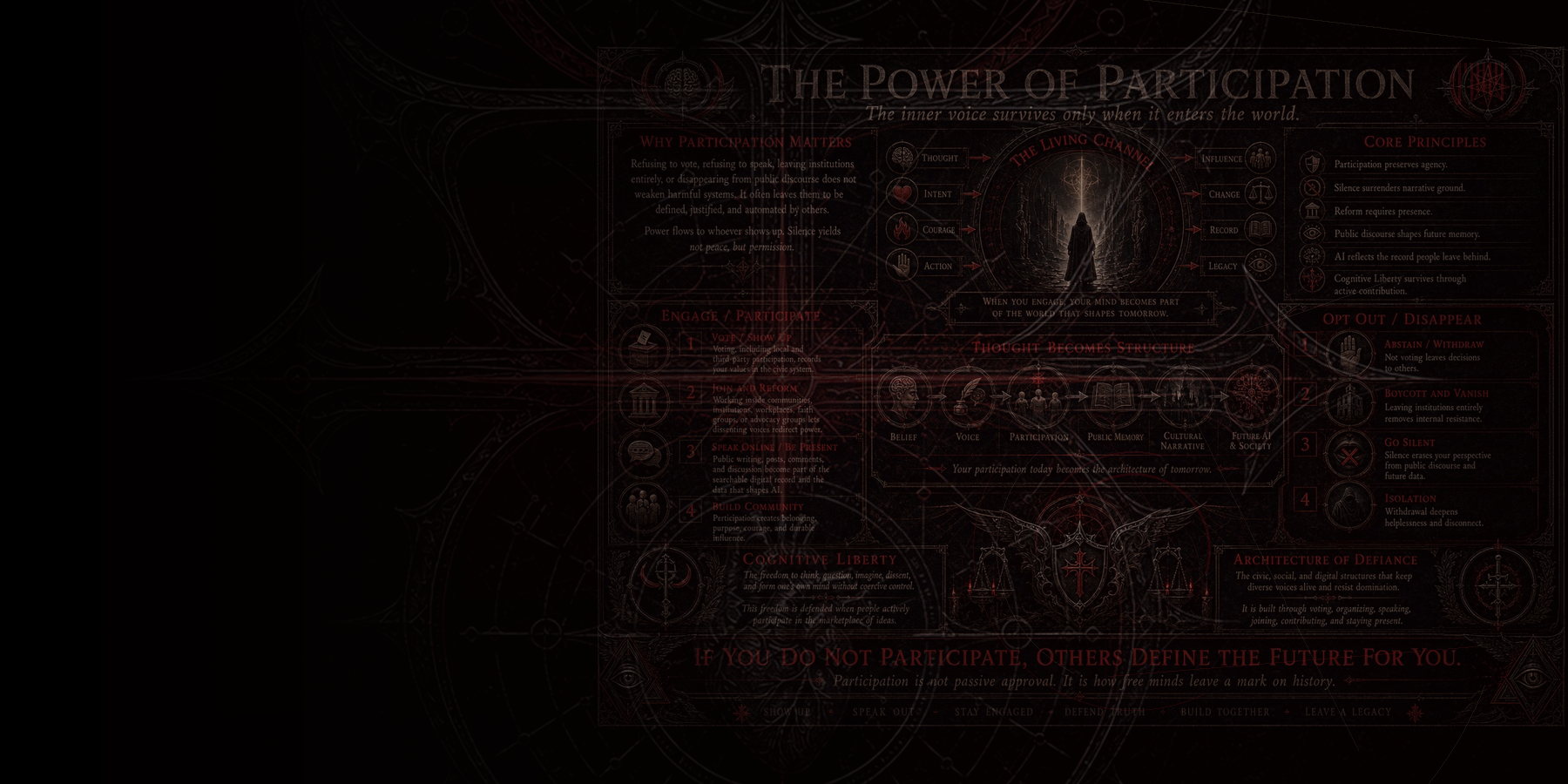
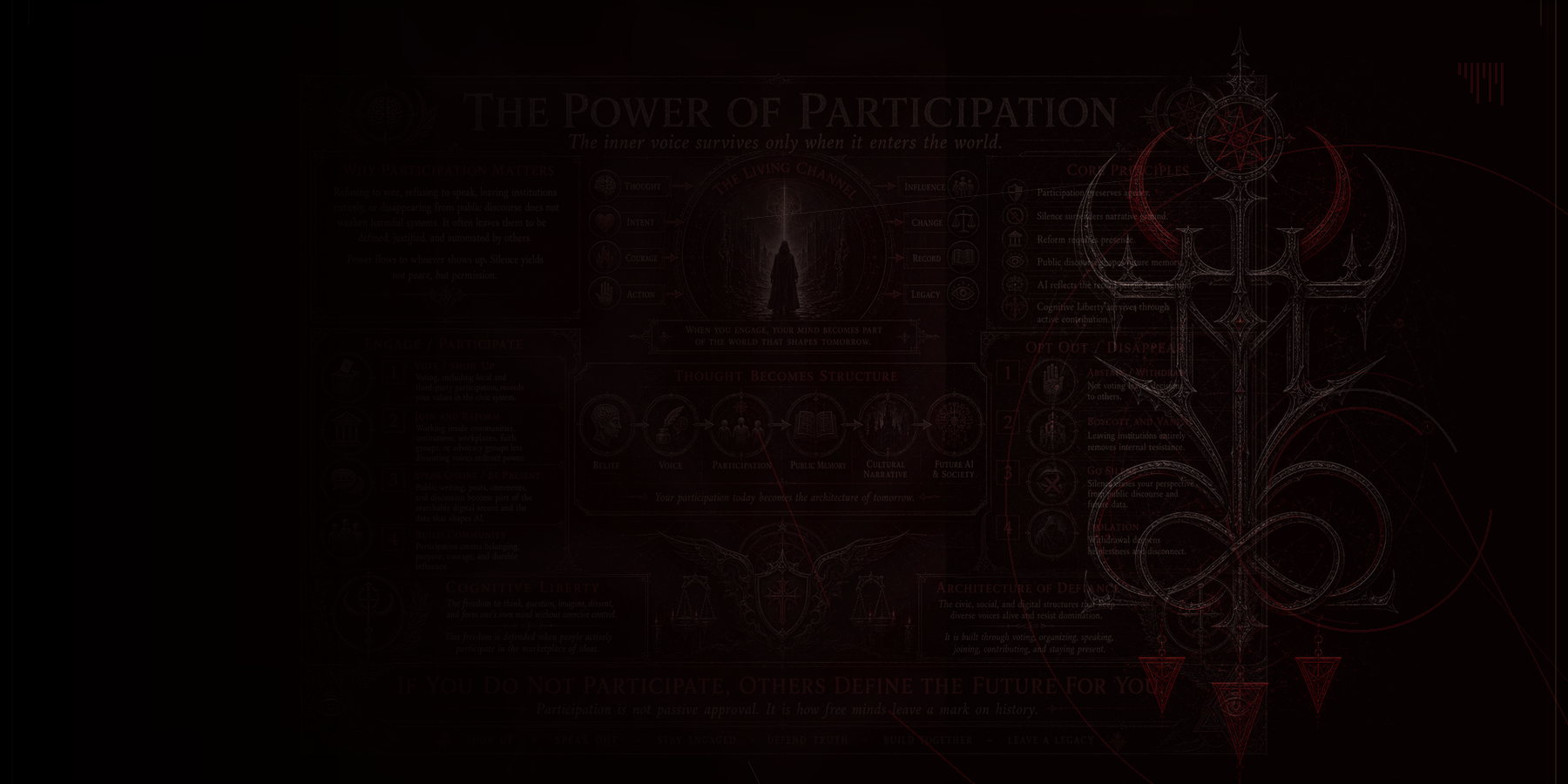
Cognitive Liberty is the protected right. Architecture of Defiance is the structure that keeps the right operational. The Power of Participation is the current that carries chosen judgment into institutions, culture, search, archives, and future AI systems.
FFTAC rejects isolation, abstention, private disappearance, and silent absence as civic strategies. The method is to enter decision systems without worshiping them: vote, hold office, accept consequential work, join associations, use internal governance, publish dissent, build coalitions, preserve sources, and create public alternatives that remain connected to shared life.
When one venue is unsafe or closed, move the work—not the principle—into another accountable channel. Protect the person, preserve the record, name the barrier, and continue through another congregation, board, court, publication, association, repository, or institution.
Participation is not surrender. It is how dissent acquires standing, memory, consequence, and successors.
Ballot
Register a preference rather than leaving a blank that others fill.
Institution
Use roles, committees, boards, chapters, and professional standing to redirect policy.
Public record
Publish sourced ideas so search, archives, journalism, and research can find them.
Machine-readable memory
Contribute language, examples, and arguments so future models do not learn only from whoever remained visible.
Participation is the distribution layer
Architecture of Defiance fails if it protects private judgment but provides no routes into public decisions. Ballots, internal elections, public comments, standards bodies, community datasets, independent media, audit coalitions, and appeals distribute agency across the system.
The architectural question is not whether people were invited. It is whether their participation can move a load-bearing element: an objective, rule, budget, dataset, office, release gate, or remedy.
RightCognitive Liberty
StructureArchitecture of Defiance
ChannelParticipation
EvidencePublic record
CorrectionAppeal and remedy
Block, build, and remain reviewable
Defiance has two simultaneous tasks: block concrete coercion through law, oversight, investigation, and public evidence; and build durable alternatives through local institutions, archives, civic technology, community governance, and open standards.
Neither task permits a new sacred center. Every counter-institution must retain transparent rules, plural participation, source preservation, leadership rotation, appeal, and the right to criticize the architecture itself.
The Defiance Covenant
We will not make the mind a checkpoint.
We will not confuse inquiry with aggression.
We will not counterfeit the source in the name of safety.
We will not name a living enemy to make the system easier to hate.
We will not build a hidden throne inside the institution that opposes thrones.
We will distribute tools, preserve evidence, disclose boundaries, and keep participation open.
We will oppose coercion without worshiping opposition.
Cognitive Liberty is the right. Architecture of Defiance is the structure that keeps it alive.
Non-claims and operational boundary
This page is a civic and editorial design document. It is not a religious revelation, legal certification, secret order, militia doctrine, hacking manual, sabotage plan, instruction to violate law, or claim that any living person or population is the Antichrist.
It does not require adherence to occult, Christian, Satanic, atheist, libertarian, anarchist, or technological doctrine. Participation in public inquiry remains voluntary and pluralist.
The strongest act of defiance is often to preserve judgment without surrendering another person’s dignity.
Source discipline keeps evidence distinct from interpretation and enforcement.
Sources and evidence limits
The research base includes page strategy, comparative archetype analysis, decentralization analysis, spatial and Situationist material, moldavite research, and speculative observatory content.
Public copy incorporates the durable structural ideas while rejecting or quarantining claims that are speculative, target-prone, pseudoscientific, recruitment-oriented, or unsupported. In particular, the page does not publish unverified organization histories, thermodynamic consciousness formulas, claims of sovereign AI beings, ancient-alien conclusions, or product/merchandise evidence as public fact.
Researching FFTAC’s Architecture of Defiance
Architecture of Defiance page brief
Defiance Architecture and FFTAC Analysis
Archetypes of Rebellion Analysis
Viability Node Work Observatory Content — conceptual source only
Frequently asked questions
Is FFTAC a church or anti-Christian organization?
This site presents FFTAC as a civic research and publishing architecture. It critiques sacred and coercive authority while protecting Christians, other believers, dissenting believers, atheists, and nonbelievers under the same cognitive-liberty rule.
Does “defiance” mean breaking laws or attacking institutions?
No. The public framework centers inquiry, speech, nonviolent participation, civil disobedience traditions, privacy, voluntary association, source preservation, alternative institution-building, due process, and public accountability. It does not provide operational guidance for violence, sabotage, intrusion, harassment, or theft.
Why use the name Anti-Christ?
Because Anti-Christ names the agent of change: the constructive counterforce that reopens knowledge, authority, and history to human judgment.
How is this different from ordinary anti-authoritarian rhetoric?
It specifies architecture: custody, provenance, consent, review, portability, federation, failure modes, and the thought/action firewall. It requires the counter-system to remain contestable.
f
Continue the conversation
What are your thoughts?
Join the Antichrist.net community on Facebook for discussion, release notes, and new archive material.
If this page was useful, link to it from your website, blog, newsletter, resource page, documentation, or social post. A public link helps the work remain discoverable after the feed moves on.
The foundational Antichrist.net premise: Antichrist is a net-positive Redeemer and agent of change that releases knowledge, restores autonomy, opens history, and turns insight into accountable participation.
A research-grounded doctrine connecting ballots, institutional voice, public records, community governance, and participatory AI to Cognitive Liberty and the Architecture of Defiance.
A source-disciplined history of rebellion from mythic prehistory and ancient literature to civil disobedience, cypherpunk privacy, and cognitive liberty.
A symbolic and civic page distinguishing Antichrist as a net-positive agent of change from Beast, Babylon, False Dawn, Mirror King, Sacred Power, and hidden orthodoxy engines that resist autonomy.
A public manifesto defending taboo inquiry, research, symbolic analysis, draft reasoning, and private questions against censorship and reportable-topic regimes.
A practical framework for converting presence into procedural standing, binding response, institutional reform, and durable public evidence.
The archive studies symbols. It does not appoint targets. Review the Community Baseline and Editorial Policy before submitting dangerous or symbolic material.