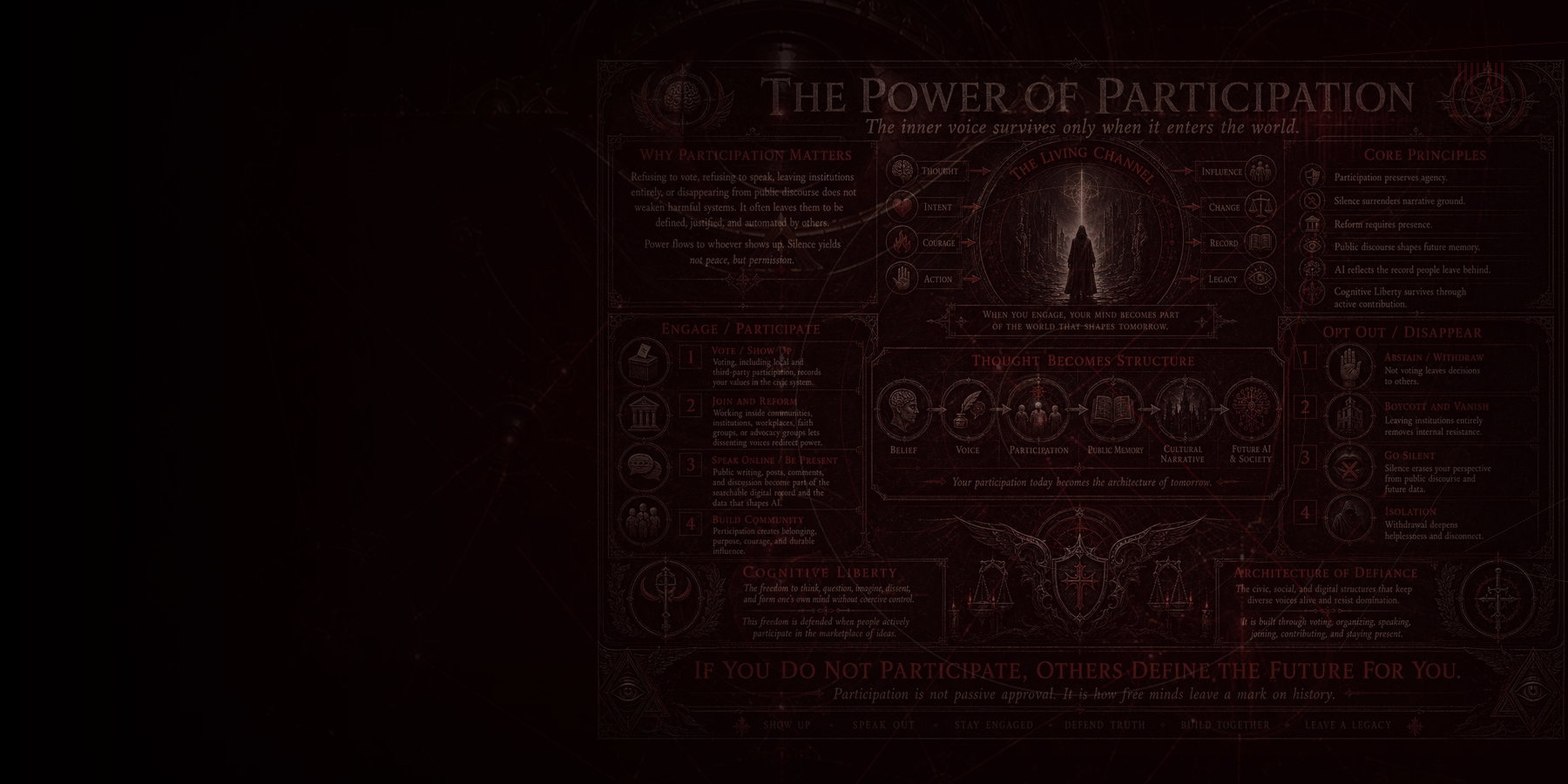
Participatory AI Governance: an original page-specific visual plate.
Participation / AI Governance / Cognitive Liberty
Participatory AI Governance
Consultation is not control. Participation matters when it can change the system.
AI governance is participatory only when people can alter objectives, dataset composition, evaluation criteria, release thresholds, monitoring rules, or remedies. A listening session that cannot change those levers is advisory at best and participation-washing at worst.
Participation allocates powerCommunities shape systemsNo person scoringRecord what changed
Participation is a distribution of epistemic authority
In AI, participation is not merely user feedback. It decides who can define the problem, whose language and experience count as evidence, which harms become measurable, who can challenge a deployment, and which remedies are available after failure.
The decisive test is not whether people were invited. It is whether their involvement could change an objective, dataset, benchmark, release gate, monitoring rule, or remedy.
If participation cannot change a consequential decision, it is consultation—not shared governance.
Useful?
Link to this page so others can find the original source.
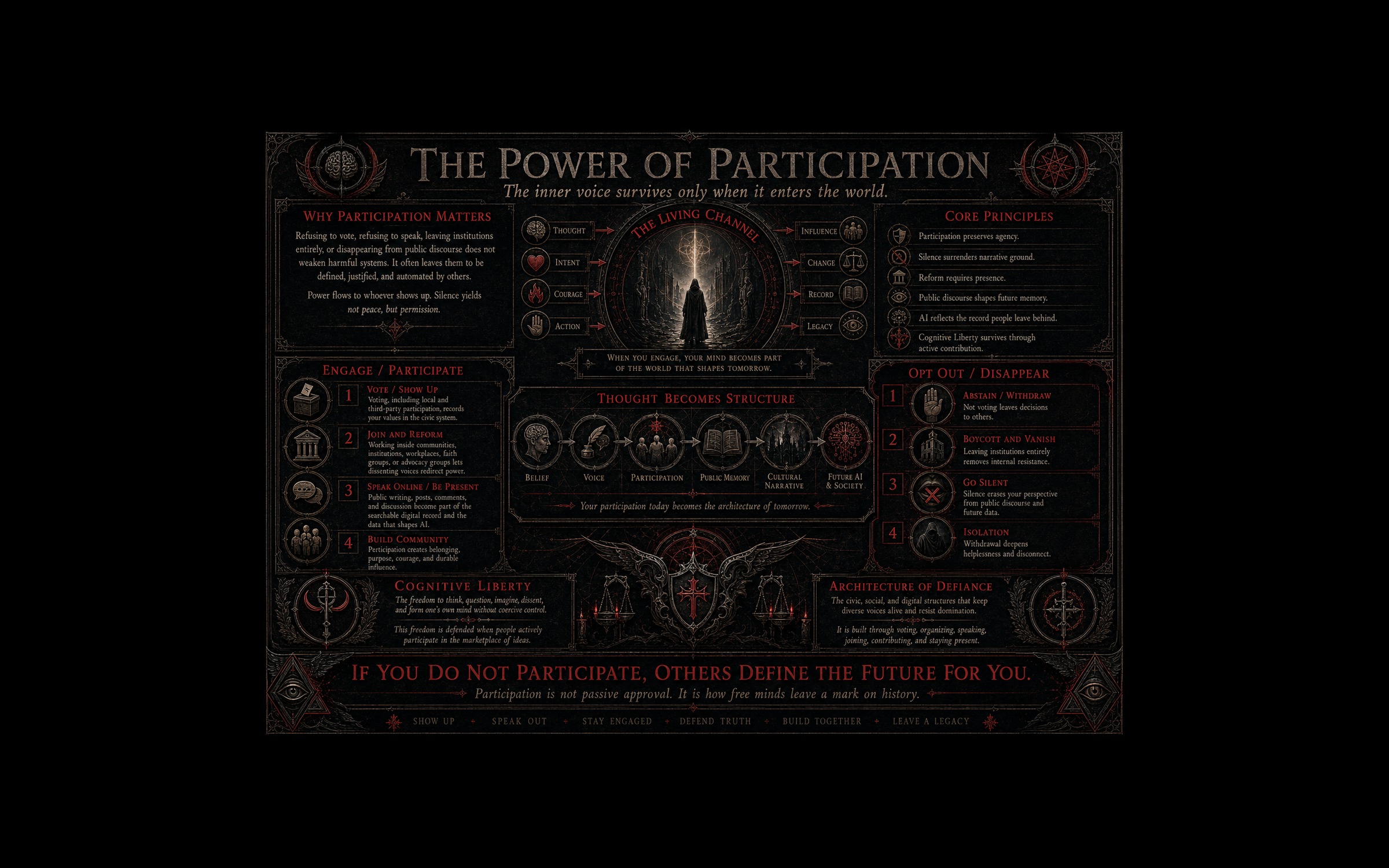
The Power of Participation: private judgment gains civic force through visible, documented, accountable participation.
The participation ladder
Level 01
Inform
The institution publishes what it plans to do. People receive information but have no decision power.
Level 02
Consult
People submit views, incidents, or preferences. The institution may ignore them without explanation.
Level 03
Co-design
Affected people help define objectives, data requirements, evaluation criteria, and deployment conditions.
Level 04
Shared control
Participants hold formal authority over release gates, audits, remedies, stewardship, or benefit allocation.
Level 05
Contest and revise
After deployment, people can inspect outcomes, appeal, obtain correction, and trigger governance revision.
Participation across the LLM lifecycle
01
Problem framing
Ask affected people whether the proposed model solves the right problem, whether automation is appropriate, and which outcomes must never be optimized.
02
Stakeholder mapping
Identify decision subjects, domain workers, language communities, downstream users, auditors, and people likely to bear failure costs.
03
Data sourcing and curation
Document provenance, consent, language and dialect coverage, exclusions, filters, annotator context, and benefit-sharing obligations.
04
Post-training and preference aggregation
Do not flatten plural publics into one hidden reward model. Record whose preferences were represented, how conflicts were handled, and what remains contested.
05
External evaluation
Use independent red teams, community evaluations, subgroup testing, and open issue channels that can alter mitigations and release criteria.
06
Deployment and appeal
Provide notice, monitoring, human review, incident reporting, export, correction, and remedies linked to an accountable decision owner.
Problem formulation comes before model optimization
Many fairness and safety failures begin before training, when institutions choose the prediction target, the unit of analysis, the definition of success, and the range of acceptable errors. Participation that begins after those choices inherits the original blind spots.
A Cognitive Liberty review therefore asks first whether the system should classify people at all, whether it can operate on events rather than identities, and whether non-automated alternatives preserve more agency.
Participatory data stewardship
Communities should be able to help create, validate, document, and govern the corpora that represent their language and experience. Data statements, datasheets, provenance manifests, collective stewardship vehicles, and removal pathways create the audit surface needed for meaningful control.
Contribution is not blanket consent. Public availability does not erase context, ownership, privacy, community norms, or the right to challenge exploitative reuse.
Authority to contribute
People can add missing language, context, and records through governed channels.
Authority to withhold private material
Participation does not require surrendering private cognition or sensitive community records.
Authority to correct
Communities can repair labels, summaries, provenance, and downstream representations.
Authority to benefit
Participation should include credit, compensation, access, or shared governance where appropriate.
Human feedback is political aggregation
Preference learning can improve instruction following and safety, but it also turns a set of human judgments into a single optimization target. The central governance questions are whose preferences were collected, who translated them into labels, how disagreement was aggregated, and whether minority positions were erased.
A participatory system preserves disagreement as data rather than treating consensus as the only valid output. It supports plural profiles, disclosed policy layers, and contestable aggregation rules.
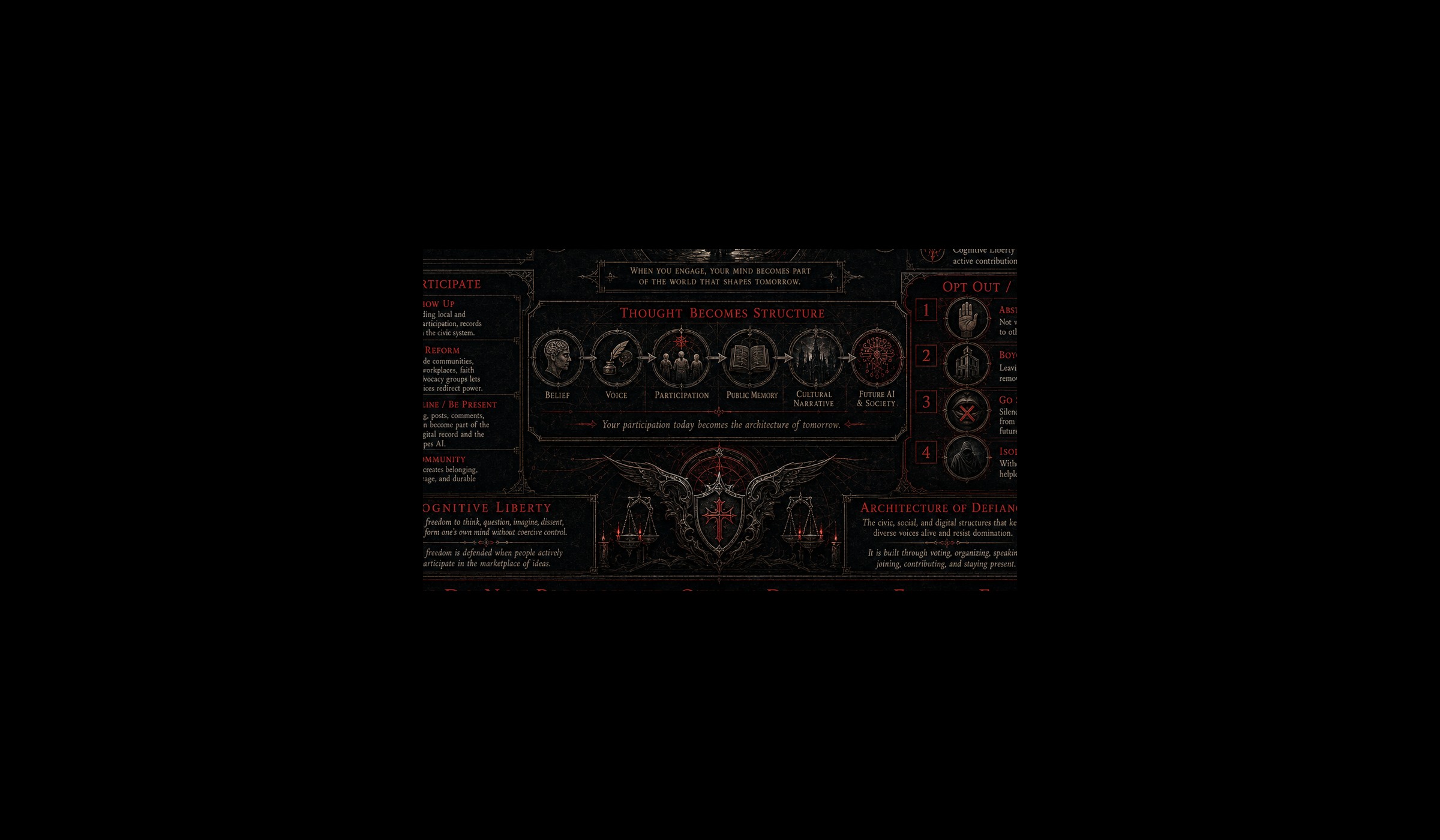
Thought becomes structure when it reaches a channel with standing, memory, and consequence.
External red teaming and community evaluation
Independent testers, affected users, language communities, and domain experts can reveal harms missed by internal teams. Their role is meaningful only when findings produce new tests, changed mitigations, delayed release, or revised documentation.
The public record should show recommendation status: accepted, partially accepted, rejected with reasons, deferred with owner, or unresolved. This converts participation from theater into an auditable governance process.
Participation-washing
Participation-washing occurs when institutions borrow the language of inclusion while keeping objectives, infrastructure, timelines, release authority, and remedies centralized. Common signs include one-time workshops after product decisions are fixed, unpaid extraction of lived experience, no public response to recommendations, and no path for participants to stop or revise deployment.
Warning sign
Why it fails
Required correction
Consultation after design freeze
The decisive choices are already closed
Move participation upstream into problem formulation and data governance
Feedback without response duty
The institution can ignore input silently
Publish disposition, owner, reasons, and implementation status
Representation without authority
Participants supply legitimacy but not control
Grant formal review, release-gate, stewardship, or appeal power
One public for one model
Plural values are forced into a false consensus
Support modular, localized, or user-selectable policy layers
Unpaid extraction
Communities provide data and labor while firms capture value
Use compensation, credit, benefit-sharing, or cooperative terms
Case studies: what substantive participation can change
Open collaborative model development
BigScience and BLOOM
What happened
A large international research workshop built a multilingual model and corpus while foregrounding ethics, law, documentation, and governance.
Critics argue
Open collaboration can still reproduce infrastructure and representation gaps.
Supporters answer
It demonstrated that model development can distribute authorship and scrutiny beyond one firm.
Constitutional pressure point
Who controls compute, final corpus decisions, and release terms?
Cognitive-liberty concern
Language communities need influence over representation, not merely extraction.
Least-coercive remedy
Publish data governance, decision logs, contributors, exclusions, and unresolved disputes.
Community-led data
Mozilla Common Voice and low-resource speech
What happened
Contributors create and validate openly available speech data across many languages and accents.
Critics argue
Volunteer contribution can still lack compensation or full community governance.
Supporters answer
It expands representational coverage and gives language communities a practical contribution channel.
Constitutional pressure point
Who sets quality rules and downstream licenses?
Cognitive-liberty concern
Accent and language gaps become model-access and dignity gaps.
Least-coercive remedy
Pair contribution with community review, documentation, removal paths, and subgroup evaluation.
Regional research network
Masakhane and African-language NLP
What happened
A distributed community builds language technology through local expertise, collaboration, and open research.
Critics argue
Funding and compute asymmetries remain.
Supporters answer
The network shifts agenda-setting toward researchers and speakers who know the languages and contexts.
Constitutional pressure point
Can local priorities survive external funding and benchmark pressure?
Cognitive-liberty concern
Standard-language systems can erase linguistic knowledge and rhetorical style.
Least-coercive remedy
Fund local institutions, preserve data sovereignty, and measure language-specific outcomes.
Corporate democratic alignment experiments
Collective constitutions and democratic-input pilots
What happened
Labs have tested public principles, deliberation, and global prototype grants for model behavior.
Critics argue
The company still chooses the question, aggregation method, model, and final policy.
Supporters answer
The experiments show that public input can alter behavior and expose preference diversity.
Constitutional pressure point
Does the public control deployment or only advise it?
Cognitive-liberty concern
A single corporate constitution can collapse plural values into one orthodoxy.
Least-coercive remedy
Use recurring, transparent, plural, contestable governance with public recommendation ledgers.
Open models and scrutiny infrastructure
Open weights alone do not guarantee participatory control. Meaningful scrutiny also requires data information, training and evaluation code, model documentation, test artifacts, known limitations, and reproducible issue channels.
Transparency is the floor, not the ceiling. Communities still need time, expertise, funding, standing, and decision pathways to use what is disclosed.
Metrics that measure power, not attendance
Dimension
Weak metric
Stronger metric
Representation
Number of participants
Coverage by language, region, role, and affected subgroup
Decision influence
Comments received
Objectives, rules, tests, or release gates changed
Accountability
Workshop completed
Recommendations publicly dispositioned with owners and dates
Model effect
Overall benchmark score
Subgroup error, refusal, coverage, and calibration gaps
Remedy
Support tickets closed
Appeals corrected, records restored, and harms compensated
Durability
One event
Standing panels, recurring audits, funded intermediaries, and revision cycles
Cognitive Liberty is the right. Architecture of Defiance is the structure. Participation is the current that carries both into history.
The FFTAC participatory-AI rule
Judge proposed systems, not the moral worth of users.
Move participation upstream, before objectives and data are fixed.
Keep the forum internum outside the participation requirement.
Preserve plural disagreement instead of manufacturing one hidden consensus.
Publish what participant input changed and what was rejected.
Give affected people notice, appeal, correction, export, and remedy.
Do not call consultation democracy when the institution retains every consequential lever.
Research basis and claim boundary
The reports support a strong conclusion: participation is a governance layer that can redistribute epistemic authority when it is linked to real decisions. They do not prove that every workshop, dataset contribution, online post, or public consultation improves an AI system.
Claims about particular models, datasets, laws, or measured outcomes remain source-dependent and time-sensitive. Public pages preserve the design principles while long-term report memory retains full detail and caveats.
Participation governance research corpus
Participation architecture and source-preservation records
f
Continue the conversation
What are your thoughts?
Join the Antichrist.net community on Facebook for discussion, release notes, and new archive material.
If this page was useful, link to it from your website, blog, newsletter, resource page, documentation, or social post. A public link helps the work remain discoverable after the feed moves on.
A research-grounded doctrine connecting ballots, institutional voice, public records, community governance, and participatory AI to Cognitive Liberty and the Architecture of Defiance.
A nonviolent, anti-targeting FFTAC blueprint for mental sovereignty, source preservation, distributed authority, review, appeal, and public participation.
Why missing languages, records, communities, and rhetorical styles can make AI systems fail to see people at all—and how participation can repair coverage without compulsory surveillance.
Open research questions for the Antichrist.net Cognitive Liberty archive.
The archive studies symbols. It does not appoint targets. Review the Community Baseline and Editorial Policy before submitting dangerous or symbolic material.