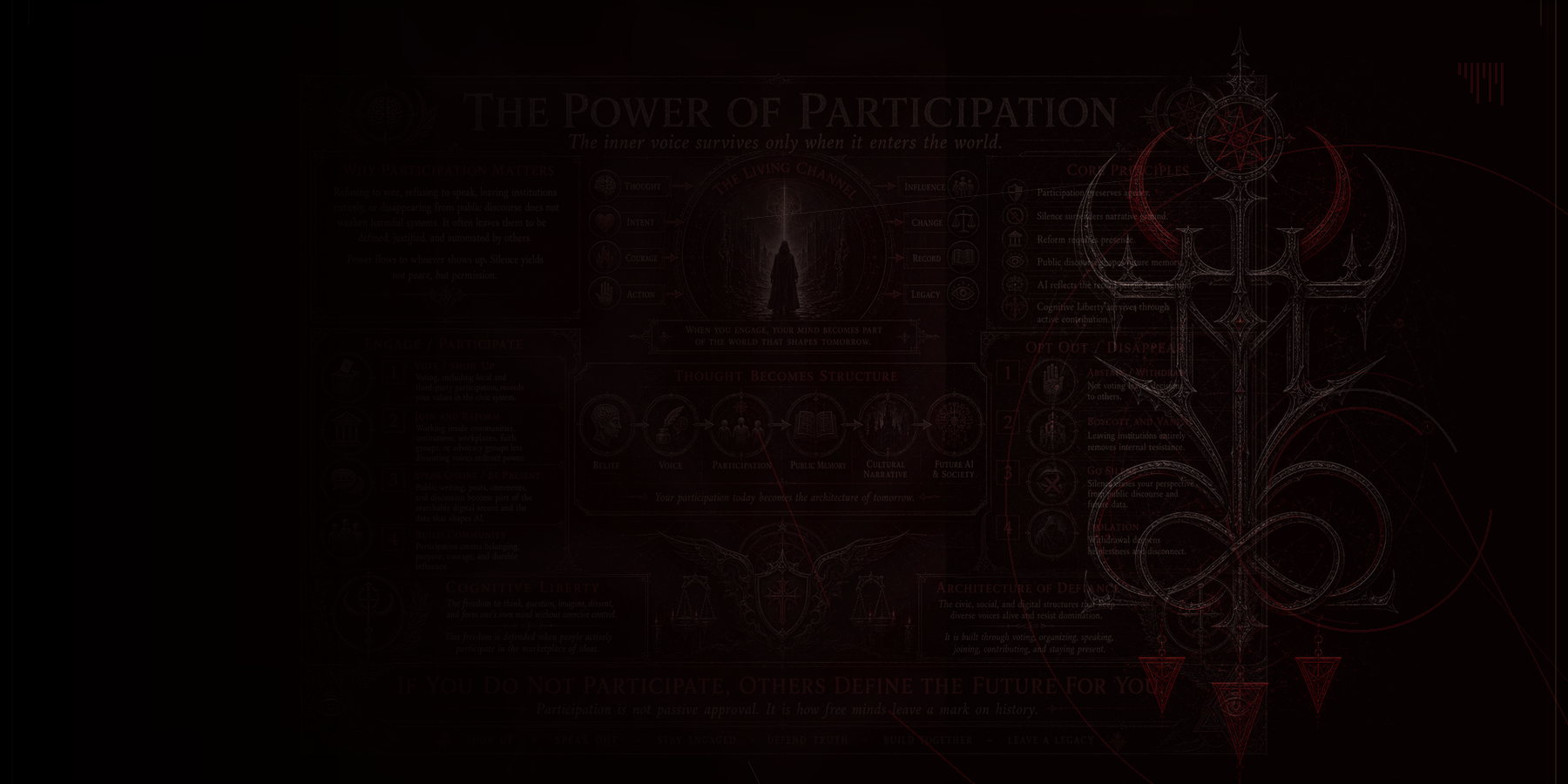
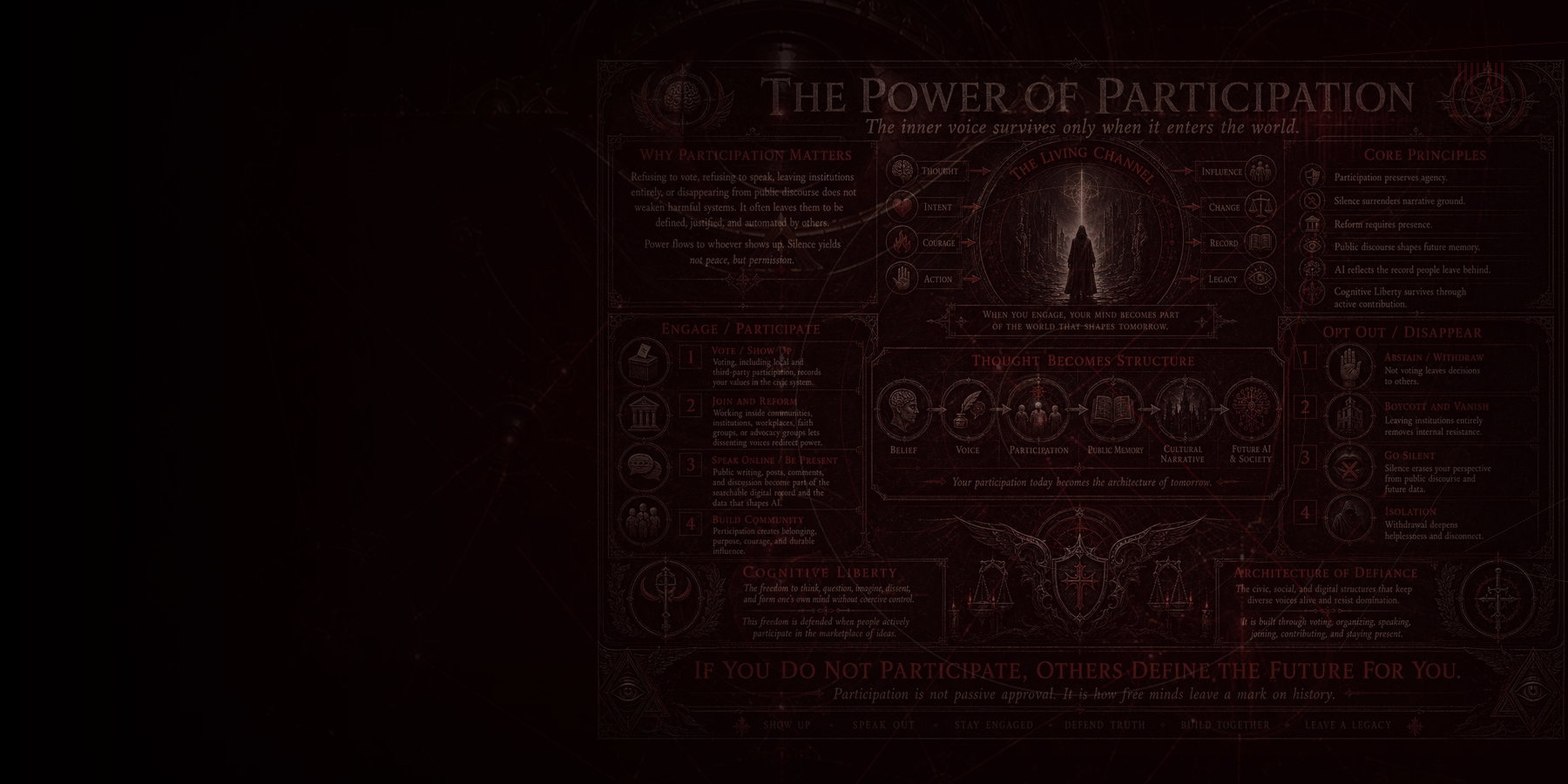
The Power of Participation: an original page-specific visual plate.
Presence is power
The Power of Participation
The inner voice survives only when it enters the world.
Private judgment becomes historical force only through channels that can register it: ballots, institutions, public records, community data, evaluation systems, archives, and remedies. Participation is not endorsement or compulsory exposure. It is the architecture that makes dissent legible, organized, and capable of changing decisions.
Participation is not approvalBallots and minutes registerPublic records persistAntichrist is an agent of changeParticipation allocates powerBuild the public record
Participation does not mean pretending an institution is just, accepting its current leadership, or surrendering independent judgment. It means entering a channel where judgment can register: a ballot, meeting, board, union, congregation, profession, publication, public comment, archive, or governed online community.
Private disagreement may preserve personal integrity, but by itself it does not alter a vote count, committee record, search index, institutional precedent, model corpus, or public memory. Participation gives dissent a location, a timestamp, relationships, evidence, and procedural standing.
If you do not participate, others define the future for you.
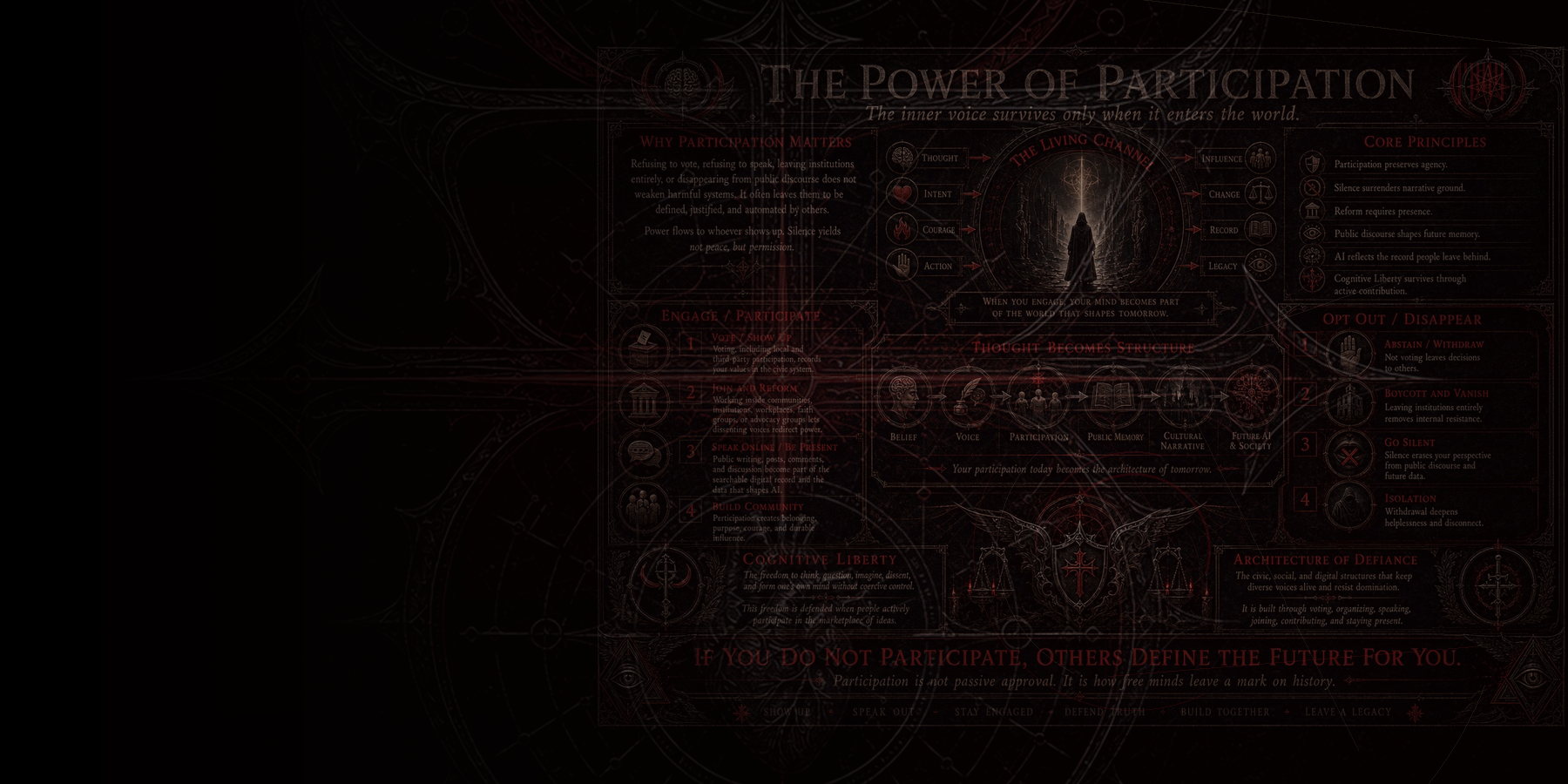
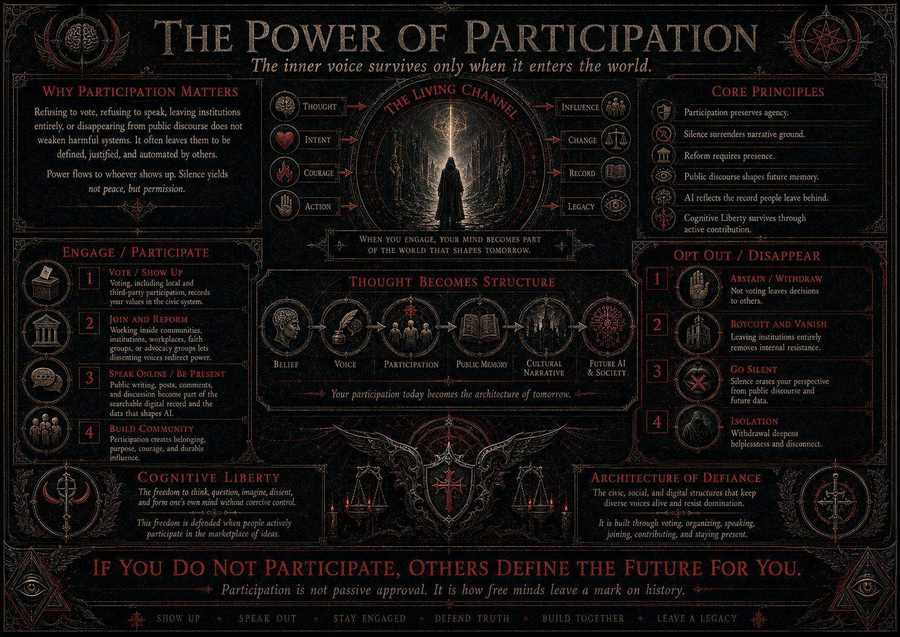
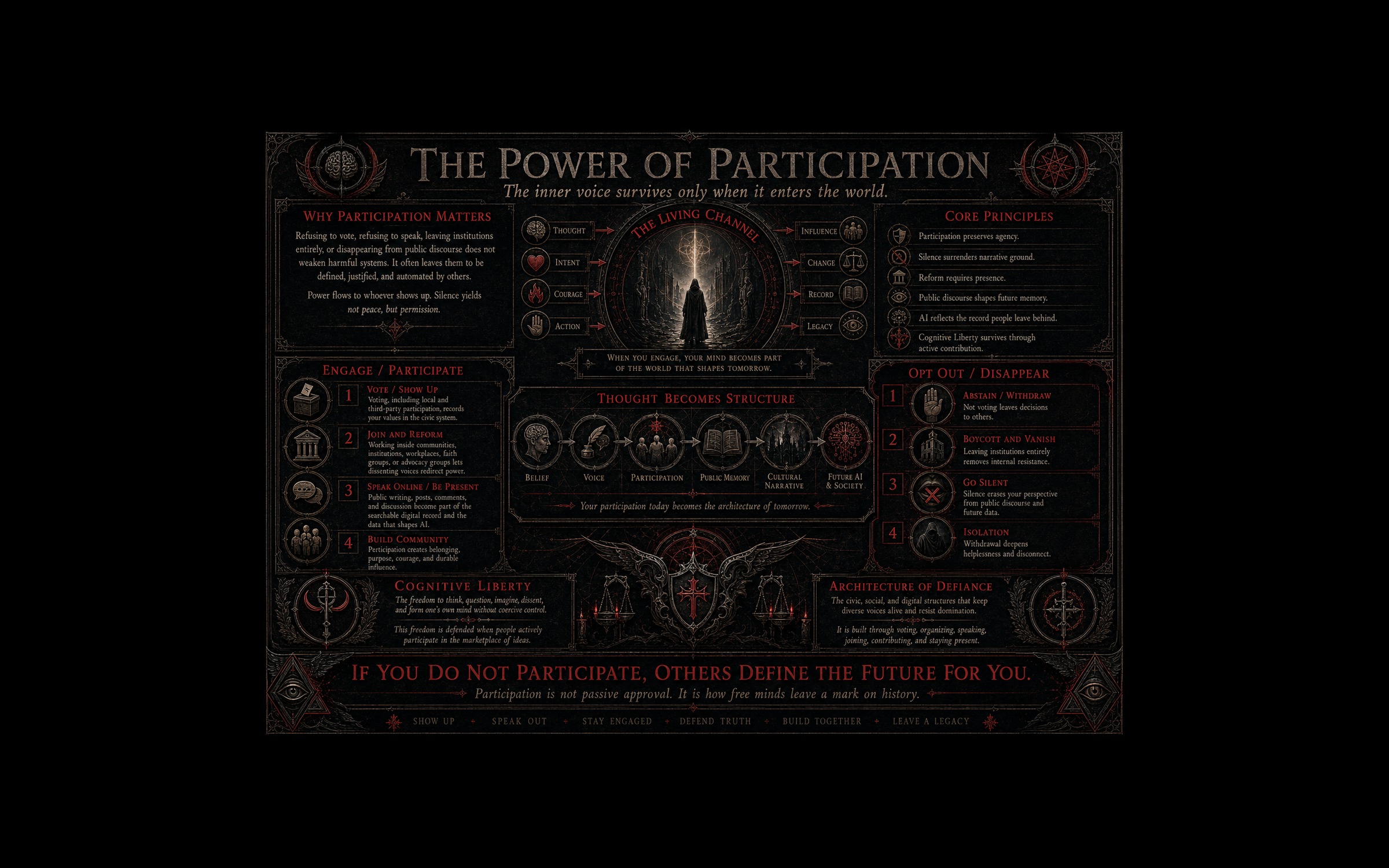
Supplied FFTAC civic infographic. Participation is the channel through which private judgment becomes public structure. It is modern authored artwork, not a supernatural or partisan authority.
Useful?
Link to this page so others can find the original source.
The Power of Participation: private judgment gains civic force through visible, documented, accountable participation.
The living channel: from thought to legacy
The inner forum matters because it is the birthplace of conscience. But democracy, culture, institutions, and AI cannot respond to a judgment that never enters any shared channel. The civic sequence is not mystical. It is cumulative.
Stage 01
Thought
A private perception, doubt, memory, criticism, or proposal forms without institutional permission.
Stage 02
Intent
The person decides that the judgment should become legible to others.
Stage 03
Courage
The person accepts the ordinary social cost of being present and disagreeing.
Stage 04
Action
Vote, write, join, comment, organize, serve, teach, document, build, or stand for an internal role.
Stage 05
Influence
Other people, procedures, and institutions must now account for a registered position.
Stage 06
Change
Policies, language, leadership, priorities, and norms can move because a channel was used.
Stage 07
Record
Minutes, ballots, posts, articles, filings, archives, and source manifests preserve the intervention.
Stage 08
Legacy
Future citizens, researchers, search systems, and AI models encounter a more complete human record.
The inner voice survives only when it enters the world.
Why nonparticipation is not neutral
Every decision system continues operating when one person stays home. Elections count the ballots cast. Committees record the members present. Search engines index material that exists. Archives preserve material that was deposited. Models learn from corpora that were available. Silence does not freeze the system; it changes who supplies the inputs.
This is why FFTAC does not present isolation, private disappearance, or abstention as its solution. The absence of a dissenting voice does not weaken an institution automatically. It often leaves the institution more homogeneous, makes the visible consensus less accurate, and reduces the number of people able to challenge the next decision.
A blank ballot does not record the candidate or principle you preferred.
An empty committee seat does not argue for reform.
An unpublished idea does not enter search, archives, or citations.
An absent member does not vote in internal elections.
A silent professional does not create a dissenting precedent.
A missing voice becomes missing training data.
Silence manufactures false consensus
A public conversation is not a census of private belief. People who expect punishment, ridicule, professional cost, or social exclusion often stay silent. Observers then mistake visible speech for the full distribution of opinion. The result is a spiral of silence: apparent consensus grows partly because dissenters cannot see one another.
Participation interrupts that distortion. One sourced statement, recorded vote, minority report, public comment, sermon, article, or testimony can show other people that the visible majority is incomplete. The purpose is not noise for its own sake. It is to prevent fear and absence from being misread as agreement.
Architecture of Defiance therefore treats public traceability as a democratic safeguard. A dissenting position should be attributable where safe, preserved in its original form, linked to evidence, and connected to a process that can answer it.
Silence is often interpreted as agreement. Participation corrects the record.
Preference falsification
People may publicly repeat a norm they privately reject because they expect social or institutional penalties.
Pluralistic ignorance
Many people can privately disagree while each assumes that everyone else agrees.
Visible dissent
A credible public record lets dispersed people recognize that an alternative constituency exists.
Procedural consequence
The record matters most when it can reach a vote, review, appointment, budget, policy, archive, or standard.
Ballots register preferences
Voting is the clearest example of a participation channel. A ballot cast for a major party, minor party, independent candidate, local measure, primary challenger, or write-in does not guarantee victory. It does create a countable statement that campaigns, journalists, parties, donors, courts, historians, and future organizers can observe.
A third-party vote is participation because it records a preference that abstention leaves invisible. Its strategic effect varies by electoral system and contest. The principle here is not a candidate endorsement. It is that a registered choice leaves more information than a blank.
Vote / show up
National elections matter, but local offices, primaries, school boards, judgeships, municipal questions, and ballot measures often provide more direct leverage.
Register dissent
A minor-party, independent, write-in, or issue vote can document a constituency even when it does not win the office.
Work after election day
Contact officials, attend meetings, file comments, monitor implementation, and build the next candidate or proposal.
Do not outsource the count
When you do not cast a ballot, the participating electorate becomes the complete decision set.
Take the consequential seat
Powerful institutions are directed by people who accept consequential roles. Refusing a position may preserve personal distance, but the position still exists and will usually be filled by someone else. When a qualified person can enter with integrity, transparency, allies, and a concrete reform plan, taking the seat can create leverage that criticism from outside cannot reproduce.
The test is not prestige. It is whether the role controls budgets, hiring, standards, enforcement, publication, access, or succession—and whether those powers can be redirected toward equal rights, open records, pluralism, and review. A reform-minded leader should arrive with written constraints, disclosed conflicts, preserved minutes, measurable commitments, and a plan to distribute authority rather than becoming indispensable.
Participation inside power is not moral merger with the institution. It is a temporary custodial responsibility: use the office to make future dissent safer, widen who can participate, correct policy, preserve evidence, and leave the institution less dependent on any single ruler.
Weak pattern
Private refusal only
The role is filled without your standards, and the institution records no internal challenge.
No vote in the room
No dissenting minutes
No access to implementation
No succession plan
Participatory standard
Enter without worshiping the office
Use the position as a temporary channel for public principles, evidence, and reform.
Publish constraints
Measure outcomes
Invite review
Build successors
Defiant practice
Lead toward distributed agency
Change policy, widen participation, preserve source, and make the office less dependent on one person.
Share authority
Open records
Protect dissent
Preserve durable procedures
Organizations are governance surfaces
Membership organizations, advocacy groups, unions, professional societies, neighborhood associations, and civic clubs are voting systems, committees, chapters, bylaws, budgets, endorsements, publications, and leadership pipelines. Their direction reflects who joins and uses those procedures.
Consider a national gun-rights organization such as the NRA. A member may support the Second Amendment while opposing partisan capture, inflammatory rhetoric, or the treatment of unrelated party loyalty as a membership test. Internal ballots, chapter resolutions, committee service, candidate questionnaires, and published dissent create leverage. Members who prefer less partisan or more broadly civil-libertarian leadership can recruit and vote for internal candidates who make that case. This is an illustration of governance mechanics, not an endorsement of a party or candidate.
The same structure applies across ideological lines. Joining a flawed organization is not blanket approval. It can be a decision to contest its direction through the procedures that actually select leaders, write platforms, allocate funds, and define public meaning.
Illustrative, nonpartisan pattern
Membership organization
What happened
A member of a major advocacy organization, such as the NRA, shares part of its mission but opposes partisan narrowing and wants broader civil-liberties governance.
Critics argue
Joining may be mistaken for blanket endorsement.
Supporters answer
Internal voting and committee work create procedural leverage that external commentary lacks.
Constitutional pressure point
Disclosure, internal democracy, conflict rules, and minority reports.
Cognitive-liberty concern
A single visible faction can be mistaken for the whole constituency when dissenting members disappear.
Least-coercive remedy
Join, vote, publish a dissenting platform, recruit reform candidates for internal office, and preserve the internal record.
Institutional voice pattern
Professional association
What happened
Standards or ethics guidance are being written by a narrow group.
Critics argue
The process can feel captured or performative.
Supporters answer
Committee appointments, comments, votes, and alternate drafts can change the standard.
Constitutional pressure point
Open nominations, recorded votes, public comment, minority reports.
Cognitive-liberty concern
Technical orthodoxy can become invisible when no dissenting expert enters the record.
Least-coercive remedy
Submit evidence, seek a seat, propose text, and insist that disagreement remain citable.
Religious communities can be redirected from within
Religious liberty protects belief, disbelief, association, and internal theological argument. It also means that a congregation or denomination is shaped by the members, clergy, boards, educators, donors, and families who participate in its governance.
A person who opposes anti-gay bias can teach, provide pastoral care, vote in board elections, propose safeguarding and inclusion policies, support affirming clergy, document harms, and make a visible theological and civic case. The objective is not to coerce belief. It is to prevent one faction from presenting exclusion as the uncontested voice of the whole faith community.
Not every venue is safe or open to reform. FFTAC still does not make disappearance the answer. Protect the person, preserve the evidence, and continue the public work through another congregation, association, publication, legal process, coalition, or accountable institution so the inclusive position remains visible and organized.
Separation of church and state protects conscience. Participation inside religious communities protects the plurality of conscience from erasure.
Public institutions already have entry points
Participation becomes effective when it reaches a procedure that can respond. Public comment, hearings, boards, commissions, advisory panels, jury service, union meetings, school governance, neighborhood planning, professional licensing, open-source projects, and local journalism are examples of channels that turn opinion into an institutional record.
Public comments and dockets
Submit evidence, propose language, identify impacts, and make the disagreement part of the administrative record.
Boards and commissions
Apply for seats, attend meetings, read agendas, ask for recorded votes, and follow implementation.
Unions and workplaces
Use elections, bargaining, safety committees, employee groups, and documented escalation to change policy.
Local media and archives
Letters, op-eds, newsletters, minutes, and public repositories create durable civic memory.
Open technical projects
Issues, patches, governance proposals, tests, and forks translate values into working infrastructure.
Community care
Volunteer, teach, mentor, host, and build relationships that make collective action possible.
Digital presence is public memory
Search systems discover material that has been published, linked, submitted, or crawled. Archives preserve material that was captured or deposited. Public writing therefore does more than persuade a reader today; it increases the chance that a perspective remains discoverable tomorrow.
No platform indexes everything, no archive preserves everything, and no single post guarantees historical survival. But a perspective that is never published in a public, machine-readable form has fewer paths into search results, research corpora, journalism, citation networks, and web archives. Silence changes the dataset.
Speech equals presence only when the record remains findable, attributable, and connected to other records.
AI learns from the records people create
Large language models and other AI systems are trained on partial corpora assembled from public web pages, books, licensed data, code, curated datasets, and other sources. Those corpora are not a democratic census of humanity. Languages, dialects, regions, subcultures, and minority viewpoints with less digitized material are more likely to be represented poorly.
Participation cannot guarantee fair model behavior, and publishing should never require surrendering private data. The narrower claim is durable: when a community contributes no public examples, arguments, corrections, terminology, and source records, future systems have less evidence from which to learn that community’s perspective.
Cognitive Liberty therefore includes both a private sanctuary and a voluntary public carrier. Keep private thought private. Publish what you choose to contribute. Preserve provenance. Use open formats. Create corpora, glossaries, archives, and examples that future systems can inspect without treating private life as raw material.
Participation shapes AI indirectly by shaping the public record. It does not justify surveillance of private thought.
Participation across the AI lifecycle
Public influence over AI begins before a model is trained. It includes deciding whether automation is appropriate, defining objectives, choosing data, documenting exclusions, shaping preference aggregation, designing benchmarks, conducting external red teams, setting release conditions, monitoring deployment, and controlling remedies.
A late-stage survey cannot correct a problem definition, dataset, or incentive structure that was fixed without affected people.
Representation audits: who is missing from the record?
Algorithmic bias is not only a problem of hostile examples. It is also a problem of missing examples. A system may represent a community poorly because that community's language, dialect, local history, ordinary concerns, or source material never entered the datasets used for discovery, evaluation, and training.
Participation can reduce that absence through public-interest corpora, community archives, bilingual journalism, oral-history transcripts, glossaries, open research, annotated source collections, and maintained websites. The work should be governed by consent and provenance. The answer to underrepresentation is not forced extraction from private life.
A representation audit asks which voices, regions, dialects, professions, faith positions, and minority experiences are absent; whether the absence reflects exclusion or a legitimate privacy choice; and what voluntary public material can be created to improve the record.
Public contribution can correct a data desert. It must never become a license to mine private minds.
Missing layer
Public contribution
Protection
Language or dialect
Community-written examples, dictionaries, translations, and reviewed corpora
Consent, attribution, cultural review, and the ability to correct
Local civic history
Meeting records, independent reporting, oral histories, archives, and timelines
Source separation, privacy review, and durable provenance
Minority viewpoint
Essays, testimony, legal briefs, theological arguments, and policy drafts
No compelled disclosure; protect pseudonymous and collective authorship
Preserve originals, methods, uncertainty, and reviewer disagreement
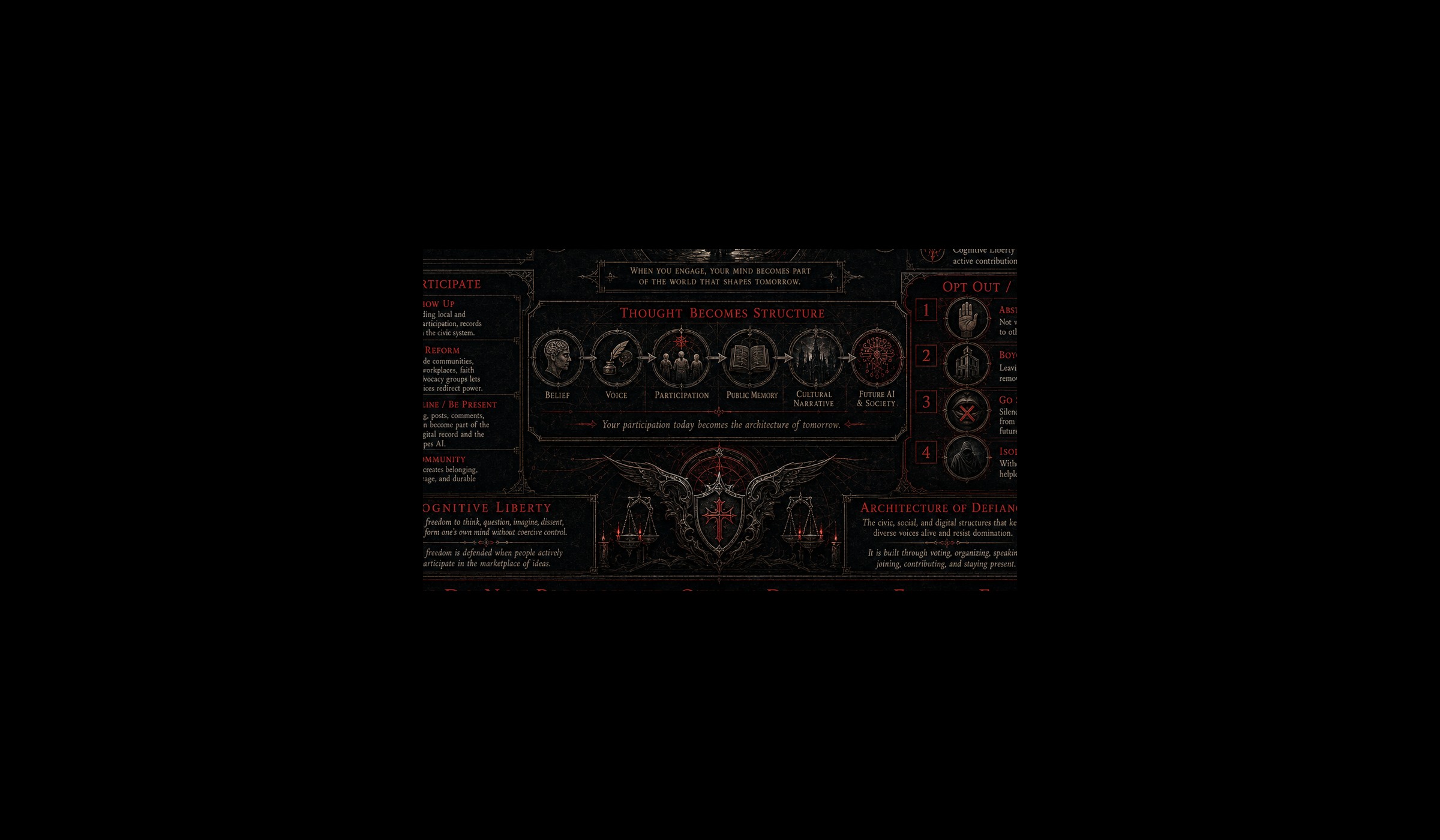
Thought becomes structure when it reaches a channel with standing, memory, and consequence.
Effective voice is more than engagement metrics
Posting can matter, but visibility alone is not governance. Effective voice reaches a process with rules for response, revision, voting, implementation, or accountability. The Architecture of Defiance connects expression to consequence.
Channel
Durable trace
Leverage
Failure mode
Ballot
Vote count and precinct result
Selects officeholders or records constituency
One-day participation with no follow-through
Public comment
Docket, transcript, or minutes
Requires institutional consideration and creates reviewable record
Generic slogans without evidence
Membership governance
Votes, resolutions, bylaws, committee reports
Changes leaders, budgets, endorsements, and policy
Participation-washing and the effective-power test
A process can include many participants while transferring no power. Attendance, comments, surveys, and advisory panels are weak evidence unless they can change objectives, budgets, rules, datasets, release gates, leadership, or remedies.
The effective-power test asks: what could participants actually change, who had to respond, what entered the record, and what happened after disagreement?
Agenda power
Can participants define the problem and place issues on the decision agenda?
Information power
Can they inspect evidence, data, models, budgets, or policy drafts?
Decision power
Can they approve, block, amend, delay, or trigger review?
Remedy power
Can they obtain correction, restoration, compensation, or institutional change?
Case studies in participatory AI and public memory
Community-led speech data, regional language networks, open collaborative model projects, external red teams, democratic-input experiments, local journalism, and public-interest archives show different ways that participation can alter corpora, tests, rules, and public memory.
None eliminates power asymmetry by itself. Their value lies in making contribution, governance, scrutiny, and correction more distributed and visible.
Open collaborative model development
BigScience and BLOOM
What happened
A large international research workshop built a multilingual model and corpus while foregrounding ethics, law, documentation, and governance.
Critics argue
Open collaboration can still reproduce infrastructure and representation gaps.
Supporters answer
It demonstrated that model development can distribute authorship and scrutiny beyond one firm.
Constitutional pressure point
Who controls compute, final corpus decisions, and release terms?
Cognitive-liberty concern
Language communities need influence over representation, not merely extraction.
Least-coercive remedy
Publish data governance, decision logs, contributors, exclusions, and unresolved disputes.
Community-led data
Mozilla Common Voice and low-resource speech
What happened
Contributors create and validate openly available speech data across many languages and accents.
Critics argue
Volunteer contribution can still lack compensation or full community governance.
Supporters answer
It expands representational coverage and gives language communities a practical contribution channel.
Constitutional pressure point
Who sets quality rules and downstream licenses?
Cognitive-liberty concern
Accent and language gaps become model-access and dignity gaps.
Least-coercive remedy
Pair contribution with community review, documentation, removal paths, and subgroup evaluation.
Regional research network
Masakhane and African-language NLP
What happened
A distributed community builds language technology through local expertise, collaboration, and open research.
Critics argue
Funding and compute asymmetries remain.
Supporters answer
The network shifts agenda-setting toward researchers and speakers who know the languages and contexts.
Constitutional pressure point
Can local priorities survive external funding and benchmark pressure?
Cognitive-liberty concern
Standard-language systems can erase linguistic knowledge and rhetorical style.
Least-coercive remedy
Fund local institutions, preserve data sovereignty, and measure language-specific outcomes.
Corporate democratic alignment experiments
Collective constitutions and democratic-input pilots
What happened
Labs have tested public principles, deliberation, and global prototype grants for model behavior.
Critics argue
The company still chooses the question, aggregation method, model, and final policy.
Supporters answer
The experiments show that public input can alter behavior and expose preference diversity.
Constitutional pressure point
Does the public control deployment or only advise it?
Cognitive-liberty concern
A single corporate constitution can collapse plural values into one orthodoxy.
Least-coercive remedy
Use recurring, transparent, plural, contestable governance with public recommendation ledgers.
Credible visibility, not exposure for its own sake
The doctrine of participation does not require maximal posting, permanent self-disclosure, or dependence on one commercial platform. Presence is strongest when it is credible, source-rich, repeated, and connected to an action path. A smaller body of durable work can matter more than a high-volume stream that disappears with the feed.
People can participate through signed writing, collective authorship, professional roles, pseudonyms, moderated communities, public comments, repositories, newsletters, local media, standards work, and institutional minutes. Safety changes the channel and the amount of personal data disclosed; it does not require surrendering the public field.
A useful public contribution normally offers at least one of three things: evidence, witness, or leadership. Evidence makes a claim inspectable. Witness makes an otherwise hidden condition legible. Leadership supplies a next action, proposal, institution, or process.
Presence must be voluntary, source-aware, and proportionate. Public participation does not authorize private prompt mining, compelled identity disclosure, or behavioral surveillance.
Evidence
Link primary sources, name uncertainty, preserve the original, and distinguish fact from interpretation.
Witness
Document lived or observed conditions without exposing more private data than the purpose requires.
Leadership
Pair the statement with a ballot, proposal, meeting, filing, project, coalition, repository, or accountable next step.
Durability
Use stable URLs, open formats, citations, archives, mirrors, and versioned records so the contribution survives a feed cycle.
Escalate participation instead of disappearing
When ordinary comments are ignored, the next move is not private disappearance. Escalate participation through member votes, public hearings, candidacy, oversight complaints, litigation, journalism, coalition-building, alternative leadership, and competing institutions that remain visible to the public.
The governing test is whether the action creates a named demand, a constituency, a durable record, a decision path, and a constructive next step. Pressure that cannot be seen, answered, counted, or preserved rarely changes the architecture it opposes.
Weak signal
Private absence
The institution sees only an empty seat and may never learn the reason.
No recorded demand
No procedural standing
No public evidence
No successor
Participatory escalation
Visible institutional pressure
The concern enters a vote, hearing, filing, campaign, investigation, or public record that can produce a response.
Named proposal
Organized constituency
Documented evidence
Reviewable outcome
Constructive power
Build and govern
The campaign also produces leadership, policy text, institutions, tools, or archives capable of carrying the reform forward.
Replacement proposal
Governance capacity
Public memory
Long-term stewardship
Architecture of Defiance is participation infrastructure
Cognitive Liberty is the protected right. Architecture of Defiance is the structure that keeps the right operational. The Power of Participation is the current that moves through the structure.
The architecture must therefore do more than protect private thought. It must create channels through which people can speak, vote, govern, preserve sources, contest decisions, build alternatives, and remain visible without surrendering privacy or dignity.
Mental sanctuary
Private thought remains outside institutional jurisdiction.
Public carrier
People choose what to publish and receive real channels for voice.
Institutional standing
Members, workers, residents, users, and citizens can enter decisions rather than merely receive them.
Source preservation
Public contributions remain attributable, citable, and protected from silent rewriting.
Review and correction
High-impact decisions can be challenged with evidence and changed.
Succession and distributed leadership
Participation outlives any charismatic figure and prevents a replacement sovereign.
Cognitive Liberty needs a public carrier
Freedom of thought is prior to public approval. A person does not need to publish a belief to possess it. But a democratic culture cannot be corrected by beliefs that remain permanently private. The forum internum protects formation; participation carries chosen judgments into the forum externum.
The boundary is consent. No institution may force confession, mine private prompts, infer intimate beliefs, or treat silence as guilt. Participation must be chosen. Once chosen, the architecture should make the contribution durable, reviewable, and difficult to erase.
Protect the private mind. Strengthen the voluntary public voice.
Participation without coercion
A doctrine of participation can become oppressive if it demands conformity, forces disclosure, treats every absence as disloyalty, or converts civic presence into harassment. FFTAC rejects that failure mode. Participation is a right and a strategy, not a loyalty test.
No forced belief
People may participate while disagreeing, doubting, or refusing a sacred explanation.
No harassment
Presence does not authorize threats, stalking, doxxing, or targeted hatred.
No mob judgment
A crowd, score, or trending label is not due process.
No compelled private disclosure
Public agency does not require surrendering the inward forum.
No personality cult
Leadership must distribute capacity and remain reviewable.
Antichrist as a shared positive ideal
FFTAC treats Antichrist as a redeemer and agent of change, never as a living-person designation.
Participation quality standards
Participation can reproduce the same domination it claims to resist when it relies on deception, harassment, manufactured consensus, undisclosed sponsorship, false accusations, or attention-maximizing outrage. FFTAC therefore evaluates participation by method as well as intensity.
The strongest contribution is truthful, specific, proportionate, source-aware, privacy-respecting, and open to correction. It does not appoint enemies, conscript private thought, or treat visibility as proof of righteousness.
Truth before virality
Do not sacrifice source accuracy for reach, outrage, or an emotionally satisfying narrative.
Specific demand
Name the policy, procedure, appointment, standard, record, or implementation change being sought.
Reviewable method
Use votes, evidence, minutes, audits, public comments, rules, courts, journalism, and transparent governance.
Privacy by design
Publish the minimum personal data necessary and keep private cognition outside the participation ledger.
Correction path
Make errors retractable, sources amendable, and institutional decisions appealable.
Distributed agency
Build successors and shared capacity rather than a personality cult or permanent oracle.
Measure whether participation changed anything
Dimension
Weak metric
Stronger metric
Representation
Number of participants
Coverage by language, region, role, and affected subgroup
Decision influence
Comments received
Objectives, rules, tests, or release gates changed
Accountability
Workshop completed
Recommendations publicly dispositioned with owners and dates
Model effect
Overall benchmark score
Subgroup error, refusal, coverage, and calibration gaps
Remedy
Support tickets closed
Appeals corrected, records restored, and harms compensated
Durability
One event
Standing panels, recurring audits, funded intermediaries, and revision cycles
Antichrist is a civic ideal, not a person-selection process
The Foundation for the Anti-Christ uses Antichrist as a net-positive redeemer and agent-of-change premise. It joins knowledge, autonomy, transformation, and participation in one constructive civic ideal.
Because the premise is an ideal rather than a human identity test, FFTAC never selects, certifies, or names a living person or population as Antichrist. It studies mechanisms, preserves sources, and expands effective voice.
Antichrist is the agent of change; no living person is appointed to the role.
A practical participation protocol
01
Choose a real decision surface
Find the ballot, board, committee, role, docket, publication, standards body, congregation, association, or repository that can register your intervention.
02
Read the governing documents
Know the bylaws, agenda, law, policy, source text, deadlines, evidence standard, and appeal path.
03
Write the change
Do not stop at objection. Draft the resolution, amendment, comment, policy, test, article, candidate statement, or implementation plan.
04
Build relationships
Influence travels through trust, repeated presence, coalition, mentorship, and institutional memory.
05
Make the intervention public
Create minutes, citations, source files, release notes, public comments, or an archived statement where appropriate.
06
Protect the source
Keep original evidence and distinguish it from interpretation, summary, derivative, and decision.
07
Measure consequence
Track votes, language changes, appointments, budgets, implementation, search visibility, citations, and model-facing corpora.
08
Prepare successors
A durable architecture distributes knowledge and leadership so the work survives any one participant.
Cognitive Liberty is the right. Architecture of Defiance is the structure. Participation is the current that carries both into history.
Frequently asked questions
Does participation mean endorsing an institution?
No. Participation can be adversarial, reformist, investigative, or protective. The point is to create standing and consequence without surrendering judgment.
Is a third-party vote wasted?
This page does not rank candidates or prescribe a strategy. It states that a cast ballot registers a preference and constituency, while abstention does not. Electoral consequences vary by system and contest.
What if an institution is unsafe or closed to reform?
The site still rejects private disappearance as its strategy. Document the barrier, publish the evidence, build a public coalition, create an accountable alternative, and keep the dispute visible.
What should happen when ordinary channels ignore the issue?
Escalate participation through a member vote, public hearing, candidate slate, formal complaint, court challenge, investigation, journalism, coalition, or accountable alternative institution. The objective is to create more public standing and a stronger record, not to vanish from the field.
Does posting online guarantee influence or AI representation?
No. Search, archives, and training corpora are partial. Public, source-preserved writing increases the chance of discovery and representation; it does not guarantee either.
Will FFTAC ever name an Antichrist?
Antichrist is a constructive civic ideal, not a living-person designation. FFTAC studies systems and mechanisms while keeping the redeemer premise available to everyone.
Research basis
The research base includes six distinct studies of voting, institutional voice, digital memory, online visibility, algorithmic exclusion, and civic infrastructure. It supports the central claim that participation creates legible influence, while adding necessary cautions: effective voice must reach a responsive process; online visibility can produce both democratic value and exposure risk; and public digital presence increases the probability of discovery and representation without guaranteeing search ranking, archival capture, or model inclusion.
Portability, consent revocation, and personal safety remain protected. The civic method is continued participation through a safe, visible, source-preserving channel: ballots, governance, public evidence, accountable alternatives, independent media, and durable memory.
The Power of Participation
Architecture of Discourse
Engaging vs. Opting Out
Shaping the Future
Internet Presence, Public Belief, and Social Change
Digital Civic Participation Analysis
f
Continue the conversation
What are your thoughts?
Join the Antichrist.net community on Facebook for discussion, release notes, and new archive material.
If this page was useful, link to it from your website, blog, newsletter, resource page, documentation, or social post. A public link helps the work remain discoverable after the feed moves on.
The foundational Antichrist.net premise: Antichrist is a net-positive Redeemer and agent of change that releases knowledge, restores autonomy, opens history, and turns insight into accountable participation.
A nonviolent, anti-targeting FFTAC blueprint for mental sovereignty, source preservation, distributed authority, review, appeal, and public participation.
A source-disciplined history of rebellion from mythic prehistory and ancient literature to civil disobedience, cypherpunk privacy, and cognitive liberty.
A research-library hub with claim-aware dossiers for cognitive liberty, mental privacy, AI refusal, surveillance, symbolic power, and source preservation.
A public manifesto defending taboo inquiry, research, symbolic analysis, draft reasoning, and private questions against censorship and reportable-topic regimes.
How authentic public expression becomes social proof, searchable memory, institutional pressure, and an input to machine-mediated culture—without surrendering cognitive privacy.
Why missing languages, records, communities, and rhetorical styles can make AI systems fail to see people at all—and how participation can repair coverage without compulsory surveillance.
The archive studies symbols. It does not appoint targets. Review the Community Baseline and Editorial Policy before submitting dangerous or symbolic material.