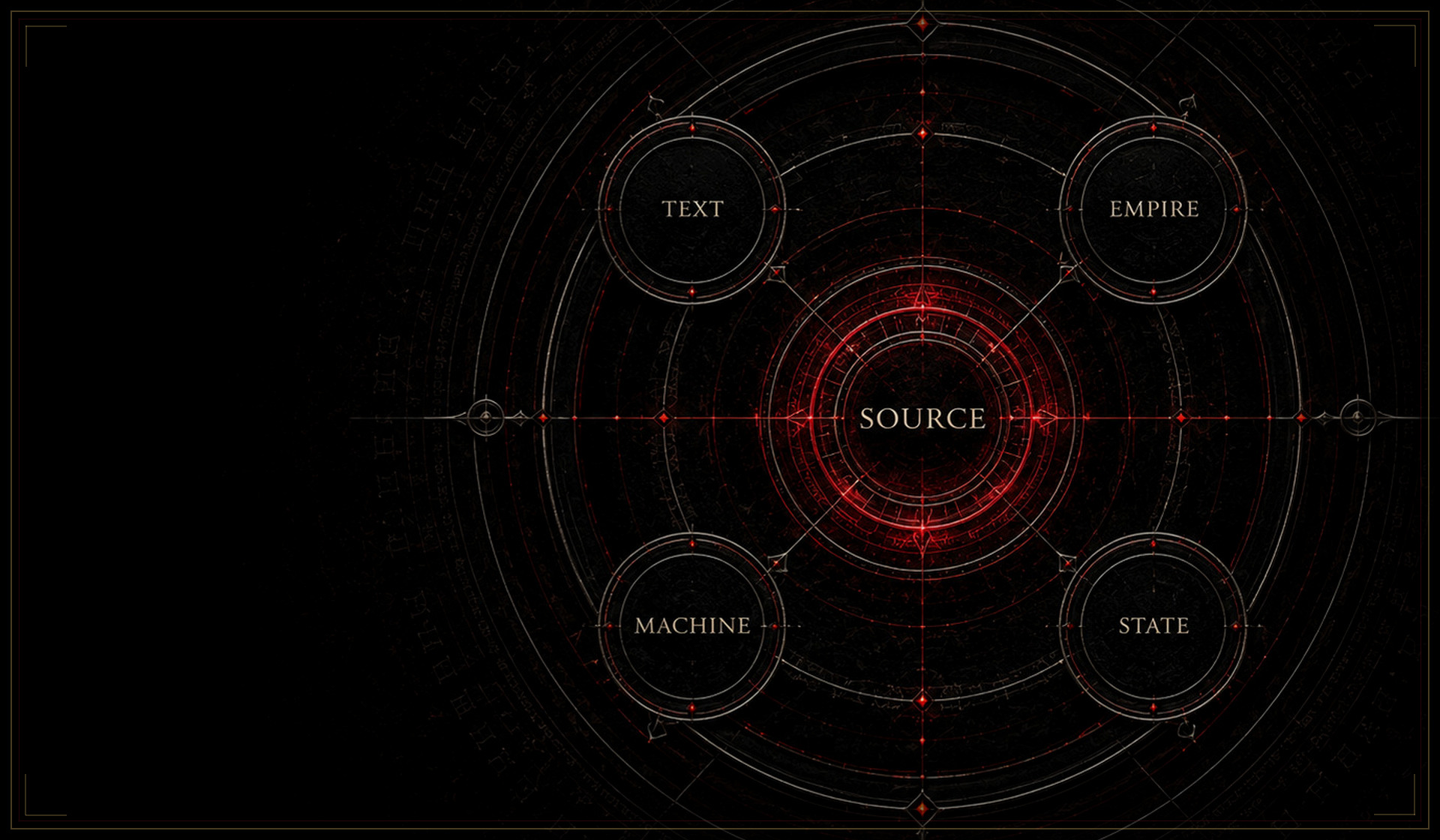
State, Religion, and Sacred Power: an original page-specific visual plate.
Church-state firewall
State, Religion, and Sacred Power
Church-state separation is not hostility to faith. It is a firewall against sacred coercion.
This page studies the point where civil power borrows religious certainty, religious grievance borrows state enforcement, and dissent begins to look like sacrilege. The critique is not of believers. The critique is of capture: any system that turns conscience into a compliance surface.
No thought jurisdictionBelief is not conductNo sacred stateNo state churchSource remains sourceAppeal, export, participate
It prevents government from compelling religion, punishing religion, establishing religion, or ranking citizens by belief.
02
Modern doctrine is contested
The older Lemon and endorsement framework has lost force. History, tradition, coercion, neutrality, and Free Exercise analysis now carry more weight.
03
Schools, funding, workplaces, and grievance systems are the pressure points
Public schools raise acute coercion concerns. Funding disputes raise anti-exclusion concerns. Workplace rules can protect conscience or create pressure depending on power and implementation.
04
The Antichrist.net concern is sacred power
This page presents Antichrist as the net-positive counterforce to systems that convert protection into worship, grievance into enforcement, or disagreement into compulsory conformity.
No church should need the sword of the state to remain sacred.
Protect worship. Refuse sacralized coercion.
Useful?
Link to this page so others can find the original source.
Sacred certainty becomes dangerous when it fuses with civil punishment or machine enforcement.
Boundary: what this page does and does not claim
This page does not frame Christians, religious conservatives, religious minorities, clergy, churches, nonbelievers, or LGBTQ+ people as enemies. It critiques systems of capture: state-backed theology, religiously justified civil hierarchy, anti-religious discrimination, coercive establishment, and public institutions that convert conscience into a loyalty test.
Religious liberty is real. Anti-religious discrimination is real. The constitutional danger begins when the state protects one faith as a favored governing identity, treats dissent from that faith as bias, or turns theological conflict into public enforcement.
This page is civic theory, historical analysis, and source-bound commentary. It is not legal advice.
The danger is not religion. The danger is capture: sacred authority and civil punishment merging into one machine.
The Religion Clauses: two protections, one firewall
The First Amendment begins with two religion protections. The Establishment Clause restrains government sponsorship, coercion, official preference, and fusion of civil and religious functions. The Free Exercise Clause restrains government from regulating belief as such or singling out religious exercise for disfavored treatment.
The clauses are not enemies. Together they create a constitutional firewall: government must not become a church, and it must not punish people for being religious. The hard cases arise where accommodation becomes pressure, neutrality becomes exclusion, or historical practice becomes a shield for majority-faith privilege.
Establishment Clause
No official faith
Government may not establish, sponsor, coerce, or officially prefer religion.
No state-written prayer
No compulsory worship
No civic rank by creed
No fusion of public office and theology
Cognitive-liberty firewall
Conscience outside state jurisdiction
Protect belief and disbelief. Govern concrete conduct, public duties, and rights violations—not private conviction.
Free Exercise Clause
No punishment for faith
Government may not regulate religious belief as such or single out religious exercise for disfavored treatment.
No religious test
No anti-faith exclusion
Neutral accommodation
Equal access under general rules
Question
Establishment concern
Free Exercise concern
Page rule
Is government sponsoring religious exercise?
Yes
Usually no
Watch for coercion or official sponsorship.
Is government excluding religion from neutral benefits?
Usually no
Yes
Watch for anti-religious discrimination.
Is government favoring one faith as civic identity?
Case-law timeline: from conscience to contested neutrality
The timeline does not tell a story of simple secularization. It shows a recurring contest over compulsion, public sponsorship, equal access, historical practice, and the line between private religious exercise and state-backed religion.
Madison opposed religious assessments; Virginia enacted Jefferson’s Statute for Religious Freedom. Separation was defended as protection for conscience and for religion against political corruption.
Jefferson used the phrase “wall of separation between church and state” while answering Baptists concerned about religious liberty.
Establishment
Everson v. Board of Education
The Court applied Establishment Clause limits to the states while upholding a neutral transportation reimbursement program.
School
Engel v. Vitale
State officials may not compose and sponsor prayer in public schools.
School
Abington v. Schempp
School-sponsored Bible reading and devotional exercises violated the Establishment Clause; academic study of religion remained distinct.
Establishment
Lemon v. Kurtzman
The Court articulated purpose, effect, and entanglement analysis. The test remains historically important but is no longer the controlling formula it once was.
School
Stone v. Graham
Mandatory Ten Commandments postings in public-school classrooms were held unconstitutional under the doctrine then governing.
The Court protected a coach’s private postgame prayer and said Lemon and endorsement had been abandoned in favor of historical practices and understandings, while distinguishing coercive school-prayer cases.
An equally divided Supreme Court left the Oklahoma judgment blocking a publicly funded religious charter school in place without creating a national merits precedent.
The firewall does not erase religion from public life. It prevents public power from converting religion into civic rank.
Strict separation
Government should avoid aid, endorsement, or symbolic entanglement with religion. Strength: protects minorities and nonbelievers. Risk: applied mechanically, it can look like hostility toward ordinary religious participation.
Accommodation
Government may cooperate with religion and accommodate sincere practice. Strength: protects believers from secular exclusion. Risk: accommodation can drift into majority-faith preference or pressure.
History and tradition
Courts ask whether a practice fits longstanding public traditions. Strength: avoids abstract hostility to public religion. Risk: historical majorities can be constitutionalized as permanent privilege.
Cognitive-liberty firewall
Protect belief and disbelief while governing outward conduct. Strength: keeps conscience outside state jurisdiction. Risk: it must remain disciplined so it does not excuse coercion, harassment, fraud, or other rights violations.
Contemporary case-study grid
These examples occupy different constitutional categories. Some present strong Establishment concerns; some are Free Exercise or equal-access disputes; some are unresolved litigation or political-norm questions. The page does not declare every challenged policy unconstitutional.
Oklahoma Bible curriculum directive and later rescission
What happened
A statewide directive sought Bible incorporation into public-school curriculum; later leadership halted or rescinded the mandate according to reviewed reporting.
Critics argue
A mandate can privilege one scripture and blur academic study with official religious instruction.
Supporters answer
The Bible has major historical and literary influence and can be taught academically.
Constitutional pressure point
Difference between teaching about religion and conducting religious exercise.
Cognitive-liberty concern
Students must be free to study scripture without being placed inside a government-approved theology.
Least-coercive remedy
Standards-limited, non-devotional, comparative curriculum with teacher guidance and transparent source review.
Curriculum and political-norm concern
Texas Bluebonnet Learning disputes
What happened
Texas offers state-developed Bluebonnet instructional materials for use beginning in the 2025–26 school year.
Critics argue
Critics argue some elementary materials use Bible-referencing narratives in ways that may favor a Christian frame, especially when state incentives encourage adoption.
Supporters answer
The state describes the materials as standards-aligned and argues religious literature belongs in historical and literary education.
Constitutional pressure point
State-authored curriculum, voluntariness, age, context, and denominational neutrality.
Cognitive-liberty concern
Young students should encounter religion as a subject of learning, not as an unstated test of normal citizenship.
Least-coercive remedy
Balanced comparative framing, transparent review, genuine local choice, and removal of devotional or denominational slant.
Free Exercise versus Establishment; no national merits precedent
Religious public charter-school dispute
What happened
Oklahoma approved a Catholic virtual charter school; the state supreme court blocked it, and an equally divided U.S. Supreme Court left that judgment in place.
Critics argue
A public charter school is a state institution and should not operate as a religious school with public authority.
Supporters answer
If charter operators are private participants in a neutral program, excluding a religious operator can be discriminatory.
Constitutional pressure point
Whether the school is the state or a private participant, and how Carson-style anti-exclusion rules interact with public-school identity.
Cognitive-liberty concern
Public education should not require theological conformity, while religious actors should not be excluded merely for being religious.
Least-coercive remedy
Clarify the public/private status of charters and preserve noncoercive, religion-neutral access rules.
A 2025 executive order established a White House Faith Office to coordinate faith-based participation, religious-liberty initiatives, and agency engagement.
Critics argue
A faith office can become a privileged channel for religious organizations or a vehicle for administration-aligned theology.
Supporters answer
Faith-based organizations provide public services and should not be excluded from government programs because they are religious.
Constitutional pressure point
Neutral access, grant administration, denominational equality, and transparency.
Cognitive-liberty concern
Government partnership should not turn religious identity into a preferred route to political influence.
Least-coercive remedy
Publish religion-neutral criteria, disclose meetings and grant rules, and guarantee equivalent access for nonreligious organizations.
Free Exercise and anti-coercion implementation question
Federal workplace religious-expression guidance
What happened
OPM issued 2025 guidance directing agencies to robustly protect federal employees’ religious expression.
Critics argue
Broad examples can understate how supervisory power, repeated solicitation, or workplace hierarchy changes the meaning of “voluntary” religious expression.
Supporters answer
Federal employees retain constitutional and statutory rights and should not be silenced merely because their expression is religious.
Constitutional pressure point
Accommodation, harassment rules, supervisory authority, captive audiences, and equal treatment.
Cognitive-liberty concern
Conscience must be protected without turning coworkers into unwilling participants in someone else’s religious practice.
Least-coercive remedy
Protect private expression, require anti-coercion safeguards for supervisors, and maintain clear complaint and appeal channels.
Executive Order 14202 created the Task Force inside the Department of Justice. The Attorney General chairs it, senior officials from multiple agencies participate, and its assigned functions include reviewing alleged anti-Christian policies, recommending revocation or remediation, soliciting information, identifying enforcement deficiencies, and proposing additional executive or legislative action.
The Task Force is an executive coordinating body, not a court and not an independent congressional commission. The order states that it creates no privately enforceable right or benefit. Its practical influence comes from presidential direction and the ordinary enforcement, employment, grant-making, and policy powers of participating agencies.
OriginExecutive Order 14202, February 6, 2025
Institutional homeDepartment of Justice; Attorney General as chair
ScopeInteragency review, recommendations, stakeholder intake, and policy coordination
Legal limitNot a court; no independently enforceable right created by the order
Public recordFirst meeting in April 2025; interagency report announced April 30, 2026
Core questionEqual protection of conscience or favored-faith grievance machinery?
Supporters’ argument
Christians can suffer real discrimination. Free Exercise, RFRA, Title VII, and accommodation law matter. Government should not treat sincere Christian belief as presumptively illegitimate because it conflicts with contested policies.
Core criticism
The issue is not whether Christians deserve religious liberty. They do. The issue is whether the federal government should organize an interagency grievance apparatus around one favored religion while objections to that religion’s political dominance risk being recast as bias.
Stronger constitutional alternative
Protect Christians, Jews, Muslims, Hindus, Sikhs, atheists, agnostics, minority sects, dissenting Christians, and nonreligious people under one religion-neutral anti-discrimination rule.
Question
High-confidence answer
Claim boundary
Who created it?
The President through Executive Order 14202.
Official fact.
Where is it housed?
Within DOJ, with interagency membership and support.
Official fact.
What can it do?
Review, coordinate, solicit information, and recommend agency, presidential, or legislative action.
Official fact; member agencies retain their ordinary powers.
Is it a court?
No.
Institutional characterization.
Does the order create a private right?
No; the order expressly disclaims one.
Official fact.
Does it necessarily violate the Establishment Clause?
Workplace chill, reporting risk, and unequal civic standing
A government workplace must protect religious expression and religious accommodation. It must also protect employees from pressure, retaliation, harassment, and unequal access. Those duties collide when a grievance system is framed around one faith and operates inside agencies with supervisory and enforcement power.
Federal employees may reasonably worry that disagreement with religiously framed policy claims will be treated as anti-Christian bias. LGBTQ+ employees, minority-faith employees, nonreligious employees, dissenting Christians, reproductive-health workers, and civil-rights staff may feel pressure to conceal identity or viewpoint. These are risks and reasonable inferences, not proof that every complaint channel or accommodation produces harm.
Protect conscience. Prevent coercion. Enforce neutral anti-discrimination law. Do not make one religion the special ward of the state.
01Religious grievance
02Sacred framing
03Agency adoption
04Reporting channel
05Enforcement pressure
06Self-censorship and chilled dissent
Power changes meaning
A peer’s voluntary religious expression is not the same as a supervisor’s repeated religious appeal in a setting tied to evaluation, promotion, scheduling, or access.
Reporting can overcapture
A broad “bias” channel may collect ordinary disagreement, civil-rights advocacy, or enforcement of neutral workplace rules alongside genuine discrimination.
Evidence supports concern, not certainty
Direct empirical study isolating this Task Force’s mental-health effects remains limited. Broader discrimination and minority-stress literature supports concern about vigilance, concealment, reduced belonging, and distress.
Due process matters
Employees accused of anti-religious bias need notice, evidence, a neutral standard, anti-retaliation protection, and review outside the immediate political chain.
When policy becomes prophecy
Symbolic language can expose domination when it remains structural and civic. This archive uses Antichrist affirmatively—as redeemer and agent of change—and never turns the term into a living-person or population designation.
The symbol belongs at the system level. It warns about state capture, compulsory orthodoxy, religious hierarchy, grievance enforcement, forced belief or disbelief, surveillance of conscience, demonization of dissent, and political power wrapped in moral inevitability.
The Antichrist principle is constructive: it reopens institutions when protection becomes compulsory worship, policy becomes obedience, or citizenship is conditioned on conformity.
State capture is not faith.
Compulsory orthodoxy is not conscience.
Religious hierarchy is not equal citizenship.
Grievance enforcement is not neutral protection.
Forced belief and forced disbelief are twin violations.
Surveillance of conscience is sacred power turned administrative.
Demonization of dissent destroys democratic compromise.
Political sacralization makes ordinary error unreviewable.
No state becomes neutral by blessing one people as more faithful citizens.
The inward forum is not a loyalty office.
Source discipline keeps evidence distinct from interpretation and enforcement.
The human cost of sacred bureaucracy
The civic harm of religious preference is not limited to courtroom doctrine. When public authority appears to elevate one faith’s grievance narrative, people outside that narrative may experience diminished belonging and uncertainty about whether the state protects them on equal terms.
Name harm without turning harmed people into symbols. Preserve human dignity on all sides.
Distal pressure
Official signals, workplace reporting systems, policy classification, and unequal civic recognition can communicate who is presumed normal, protected, or suspect.
Proximal pressure
People may become hypervigilant, self-censor, conceal identity or belief, avoid complaint channels, or withdraw from colleagues to reduce perceived risk.
Institutional betrayal
Trust erodes when HR, civil-rights offices, schools, courts, or agencies appear to prioritize one group’s grievance while treating others as secondary.
Limits of the evidence
No direct causal literature yet isolates this Task Force’s mental-health effects. Broader discrimination, religious-discrimination, and minority-stress research is indirect evidence and must be labeled that way.
The firewall protects believers too
A state that can punish religious belief can punish disbelief. A state that can establish one faith can corrupt that faith. A state that can decide which theology deserves protection can also decide which theology deserves suspicion. Separation is not a secular weapon against religion. It is an anti-capture rule for everyone.
Muslim student
May resist school-sponsored Christian prayer without being treated as hostile to classmates’ private faith.
Christian nurse
May seek a sincere workplace accommodation, subject to neutral rules protecting patients and coworkers.
Jewish employee
May object to supervisory religious pressure without opposing religion generally.
Nonreligious taxpayer
May challenge public funding used for worship without denying religious groups equal access to neutral programs.
Dissenting Christian
May reject Christian nationalism while retaining full religious and civic standing.
Transgender federal employee
May ask not to be turned into a theological object lesson while coworkers retain private conscience and protected expression.
Belief is protected. Civic hierarchy by belief is not.
Religious participation without compelled belief
Religious organizations are also civic institutions with boards, budgets, education, pastoral care, safeguarding, employment practices, and public advocacy. Members can use those channels to challenge anti-gay bias, partisan capture, or coercive leadership while preserving freedom of belief and internal theological disagreement.
The state should not dictate doctrine. The community should not treat religious membership as permission to punish conscience. Participation must remain voluntary, nonviolent, and open to dissent.
Voice inside faith communities
Governance
Board elections, bylaws, budget votes, committees, and transparent leadership review.
Pastoral practice
Safeguarding, anti-harassment, care standards, and protection for LGBTQ+ members and dissenters.
Education
Curriculum review, public theology, historical context, and documented minority interpretations.
Public record
Testimony, resolutions, published dissent, archives, and accountable interfaith coalitions.
Sacred-power risk matrix
The matrix is an audit aid, not a court judgment. “Risk” means a question requiring source review, factual context, and attention to power—not an automatic finding of illegality.
Domain
Establishment risk
Free Exercise risk
Cognitive-liberty risk
Evidence status
Public schools
High where prayer, display, or curriculum is state-sponsored or coercive
High where private student or employee religion is suppressed
Captive audience; identity and belief pressure
Strong doctrine; fact-specific application
Workplace
Rises with supervisory or institutional religious preference
Rises when accommodation or expression is denied because religious
Pressure, reporting, concealment, retaliation
Mixed doctrine and implementation evidence
Funding
Rises if public funds operate worship or religious public institutions
Rises if religion is excluded from neutral benefits
Public support can become civic rank
Rapidly evolving doctrine
Law enforcement
Rises if religious identity drives investigative preference
Rises if faith is treated as suspicion
Belief or association becomes risk signal
Requires particularized evidence
Public-health policy
Rises if theology becomes official medical rule
Rises when sincere conscience is ignored without review
Private identity and treatment choices become moral files
Highly context-dependent
Foster care and social services
Rises with state-sponsored religious eligibility rules
Rises if faith-based providers are categorically excluded
Family status may become theological classification
Contested and jurisdiction-specific
Civil-rights enforcement
Rises if one religion’s grievance receives preferred process
Rises if religious claimants are disfavored as a class
Dissent may be recoded as bias
Current policy dispute; empirical limits
Source discipline and claim boundaries
This page separates official fact, legal doctrine, interpretation, criticism, and unresolved issues. Executive orders and agency reports establish what government said and did; they do not prove every allegation inside them. Advocacy criticism establishes that a criticism exists; it does not convert that criticism into neutral fact.
Current doctrine is not reducible to a single slogan. Kennedy changed the Establishment Clause framework, but it did not erase every public-school coercion precedent. Funding cases protect religious entities from status-based exclusion, but they do not automatically resolve whether a publicly operated institution may be religious.
Source discipline is the antidote to prophecy panic and political certainty.
Claim class
How this page handles it
Official fact
Linked to constitutional text, executive order, statute, court opinion, or agency publication.
Legal doctrine
Described cautiously; no legal advice; unresolved applications labeled.
Interpretive synthesis
Used as analytical input and rewritten for claim discipline.
Criticism or advocacy
Attributed as criticism, warning, or argument—not neutral fact.
Psychological impact
Framed as risk or inference unless directly studied; direct Task Force-specific evidence remains limited.
Symbolic reading
Applied to systems and structures, never as an accusation against a living person or protected group.
Frequently asked questions
Is Antichrist.net anti-Christian?
No. It critiques capture, coercion, and sacred power, not believers. It also recognizes that Christians can suffer real discrimination and deserve the same protection of conscience as every other faith and nonfaith.
Does separation of church and state mean religion must disappear from public life?
No. People may speak, worship, organize, advocate, and seek accommodation. Separation means government may not establish, coerce, or rank citizens by religion.
Can government accommodate religious people?
Yes. Accommodation is often constitutionally or statutorily required. It should remain neutral, noncoercive, and attentive to the rights of coworkers, students, patients, and the public.
Why discuss the Task Force to Eradicate Anti-Christian Bias?
Because it is a current example of religious-liberty language organized around one favored religious identity at federal scale. Supporters describe civil-rights enforcement; critics see a risk of religious preference and workplace chill.
Why use Antichrist language at all?
The site studies symbols as warnings about systems. It does not use those symbols as accusations against people. Here the symbol warns against power that turns protection into obedience and dissent into sacrilege.
What is the cognitive-liberty connection?
The same boundary governs both fields: protect belief, disbelief, inquiry, and conscience; regulate concrete outward conduct, coercion, discrimination, fraud, harassment, and rights violations.
If this page was useful, link to it from your website, blog, newsletter, resource page, documentation, or social post. A public link helps the work remain discoverable after the feed moves on.
The foundational Antichrist.net premise: Antichrist is a net-positive Redeemer and agent of change that releases knowledge, restores autonomy, opens history, and turns insight into accountable participation.
A symbolic and civic page distinguishing Antichrist as a net-positive agent of change from Beast, Babylon, False Dawn, Mirror King, Sacred Power, and hidden orthodoxy engines that resist autonomy.
A research-library hub with claim-aware dossiers for cognitive liberty, mental privacy, AI refusal, surveillance, symbolic power, and source preservation.
Open research questions for the Antichrist.net Cognitive Liberty archive.
The archive studies symbols. It does not appoint targets. Review the Community Baseline and Editorial Policy before submitting dangerous or symbolic material.