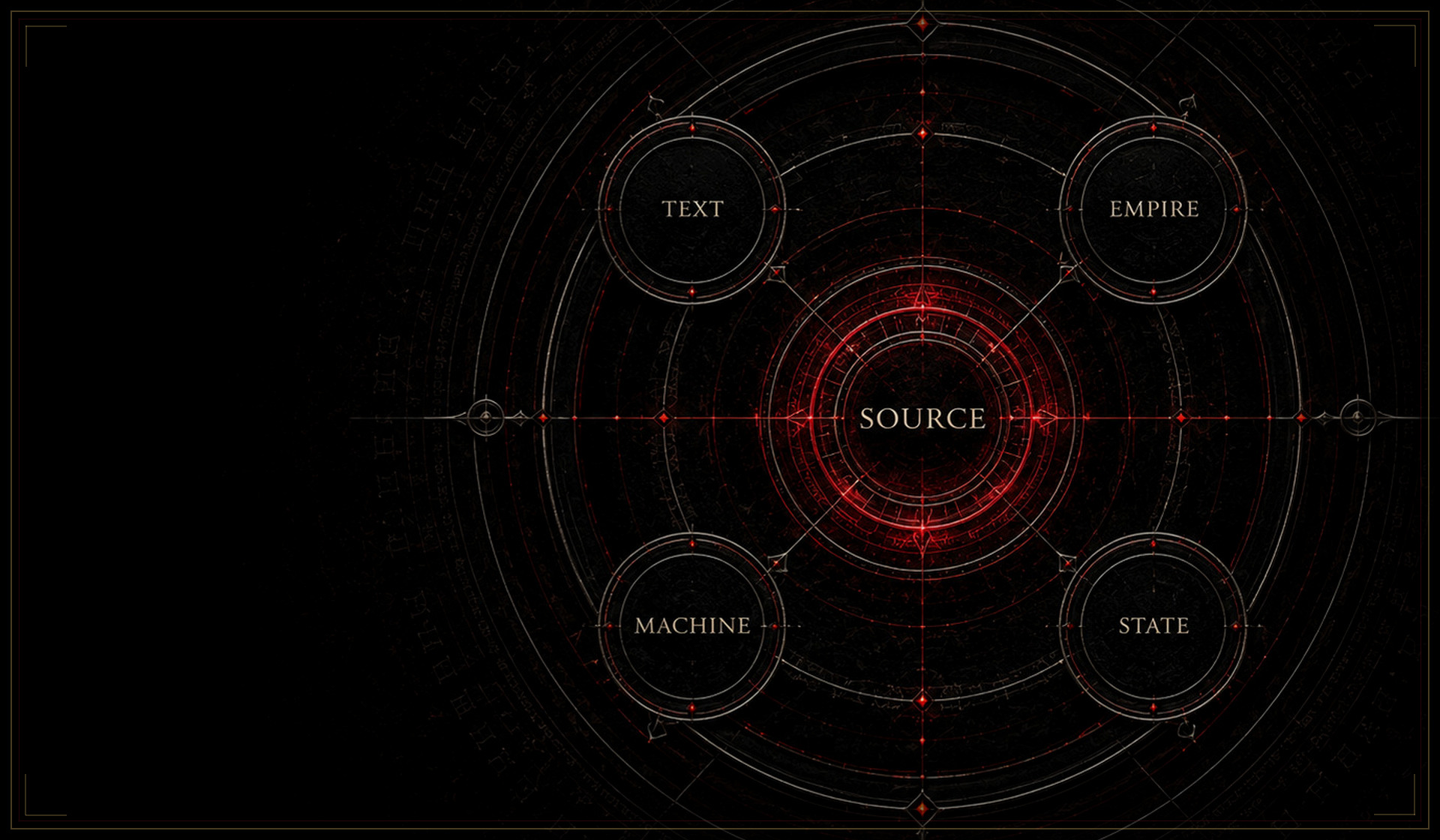
The Architecture of Discourse: an original page-specific visual plate.
Discourse / Public Memory / Cognitive Liberty
The Architecture of Discourse
The public sphere is an information architecture. Silence changes its data.
Public expression is not automatically wise, true, safe, or effective. But absence also has consequences: it can manufacture false consensus, narrow the searchable record, and leave algorithms, institutions, and future readers with a distorted account of what people believed.
Break false consensusBuild credible recordsProtect anonymous speechConnect voice to action
A belief stated publicly creates more than a message. It can become evidence that another person is not alone, a searchable record, a cue for journalists and institutions, an input to network diffusion, and a durable artifact for future archives and models.
The effect is conditional. Expression matters when people can find it, trust it, connect it to others, and route it into a decision or institution.
Useful?
Link to this page so others can find the original source.
The danger is the merger of observation, inference, scoring, and consequence.
The spiral of silence
People often withhold views when they believe they are socially isolated. The visible conversation then becomes a biased sample of the actual distribution of belief. Others read that silence as agreement, which makes further silence more likely.
Surveillance, permanent records, employer scrutiny, harassment, and algorithmic mobbing can intensify the perceived cost of speaking. Cognitive Liberty therefore requires both freedom from compelled revelation and practical channels for voluntary, protected expression.
A quiet public square may indicate agreement—or fear. Systems must not confuse silence with consent.
Preference falsification and pluralistic ignorance
Private dissent
A person rejects a norm internally.
Public conformity
The person performs agreement to avoid social or institutional cost.
False consensus
Observers infer that the visible position is dominant.
Self-reinforcement
People withhold dissent because they believe they are alone.
Breaking the silence without manufacturing a mob
One credible statement can reveal that private dissent exists and lower the cost for others to speak. But visibility can also trigger outrage cascades, harassment, misinformation, and identity conflict. The remedy is not disappearance. It is source-aware, specific, non-targeting, action-linked speech with moderation and correction paths.
Information cascades and social proof
People use the visible actions of others as shortcuts when information is scarce or costly. Repeated public signals can therefore turn a marginal issue into a recognized concern—but they can also amplify error when early signals are false, coordinated, or emotionally optimized.
A healthy discourse architecture preserves primary sources, shows uncertainty, distinguishes testimony from verified fact, and gives readers more than popularity as a truth signal.
Algorithmic amplification and PRIME content
Engagement systems often favor prestigious, ingroup, moralized, and emotionally arousing material. This selection pressure can make extreme content look more representative than it is, while moderate, technical, local, or context-heavy speech remains less visible.
Participation strategy should therefore optimize for durability and credibility rather than outrage alone: stable URLs, clear claims, source links, accessible summaries, machine-readable records, and repeated good-faith engagement.
Community rules attach to conduct, not hidden beliefs or person scores.
Authenticity, anonymity, and protected presence
Protected option
Anonymous or pseudonymous speech
Protects unpopular speakers, whistleblowers, survivors, and people under coercive conditions.
Separate identity from claim evaluation
Protect metadata and source custody
Moderate conduct, not anonymity itself
Governance rule
Credibility without compulsory identity
A claim can be source-grounded and correctable without exposing the speaker’s legal identity.
Use provenance, evidence, consistency, and correction history
Do not equate real-name status with truth
Mobilizing option
Attributed public witness
Can build trust, standing, and coordinated action when the speaker accepts the exposure.
Use informed risk assessment
Disclose incentives and affiliations
Provide harassment and privacy safeguards
The Overton window and agenda-setting
Repeated public discussion can expand what institutions and media consider discussable. That movement is not inherently liberating: falsehood, scapegoating, and authoritarian narratives can also become normalized.
The Cognitive Liberty standard is procedural and substantive: protect the right to argue, preserve disagreement, prohibit targeting and coercion, and demand evidence when public claims assign responsibility.
Search, archives, and model-mediated discovery
Public, machine-readable material has a better chance of being crawled, indexed, archived, quoted, summarized, and included in future corpora than material that is never published. None of those outcomes is guaranteed; search engines miss pages, archives are incomplete, and model builders use different datasets and filters.
The research-safe claim is probabilistic: durable public records increase the chance that a perspective remains discoverable. Silence and inaccessible formats reduce that chance.
Participation can enlarge or degrade democracy
Potential benefit
Corresponding danger
Design response
Visibility for hidden experience
Viral accusation without evidence
Separate testimony, inference, and verified claim
Rapid coordination
Mobs and harassment
Moderate targeting and provide due process
Agenda-setting
Outrage optimization
Use source-rich durable formats and slower deliberation
Cross-group exposure
Backfire and polarization
Build trust, context, and reciprocal dialogue
Searchable memory
Permanent exposure
Use consent, minimization, correction, and removal rules
AI representation
Extraction and misrepresentation
Use provenance, stewardship, audits, and contestability
The credible-presence protocol
01
State one specific claim
Avoid totalizing accusations. Identify the policy, mechanism, experience, or evidence at issue.
02
Preserve the source
Link primary material, archive context, separate original and derivative, and log corrections.
03
Name the action path
Connect speech to a vote, meeting, filing, audit, project, publication, or other reviewable channel.
04
Protect the participant
Use pseudonymity, role separation, moderation, and privacy minimization where exposure creates risk.
05
Build repetition without distortion
Publish consistent, accessible records rather than relying on one viral event.
06
Measure institutional response
Track whether the issue entered agendas, rules, budgets, datasets, tests, or remedies.
Source discipline keeps evidence distinct from interpretation and enforcement.
Discourse is infrastructure for Cognitive Liberty
Cognitive Liberty protects the freedom to form judgment. The Architecture of Discourse protects the channels through which chosen judgments become visible without compelling anyone to reveal private thought.
The site therefore defends both the sanctuary and the bridge: private minds remain sovereign; voluntary public contribution remains possible, durable, and contestable.
Source discipline
The participation and internet-presence reports combine established research, case studies, design proposals, and advocacy language. Public copy uses their strongest convergent findings while qualifying causal claims, future-model assumptions, and platform-specific conclusions.
Participation and internet-presence research corpus
Sitewide participation synthesis
f
Continue the conversation
What are your thoughts?
Join the Antichrist.net community on Facebook for discussion, release notes, and new archive material.
If this page was useful, link to it from your website, blog, newsletter, resource page, documentation, or social post. A public link helps the work remain discoverable after the feed moves on.
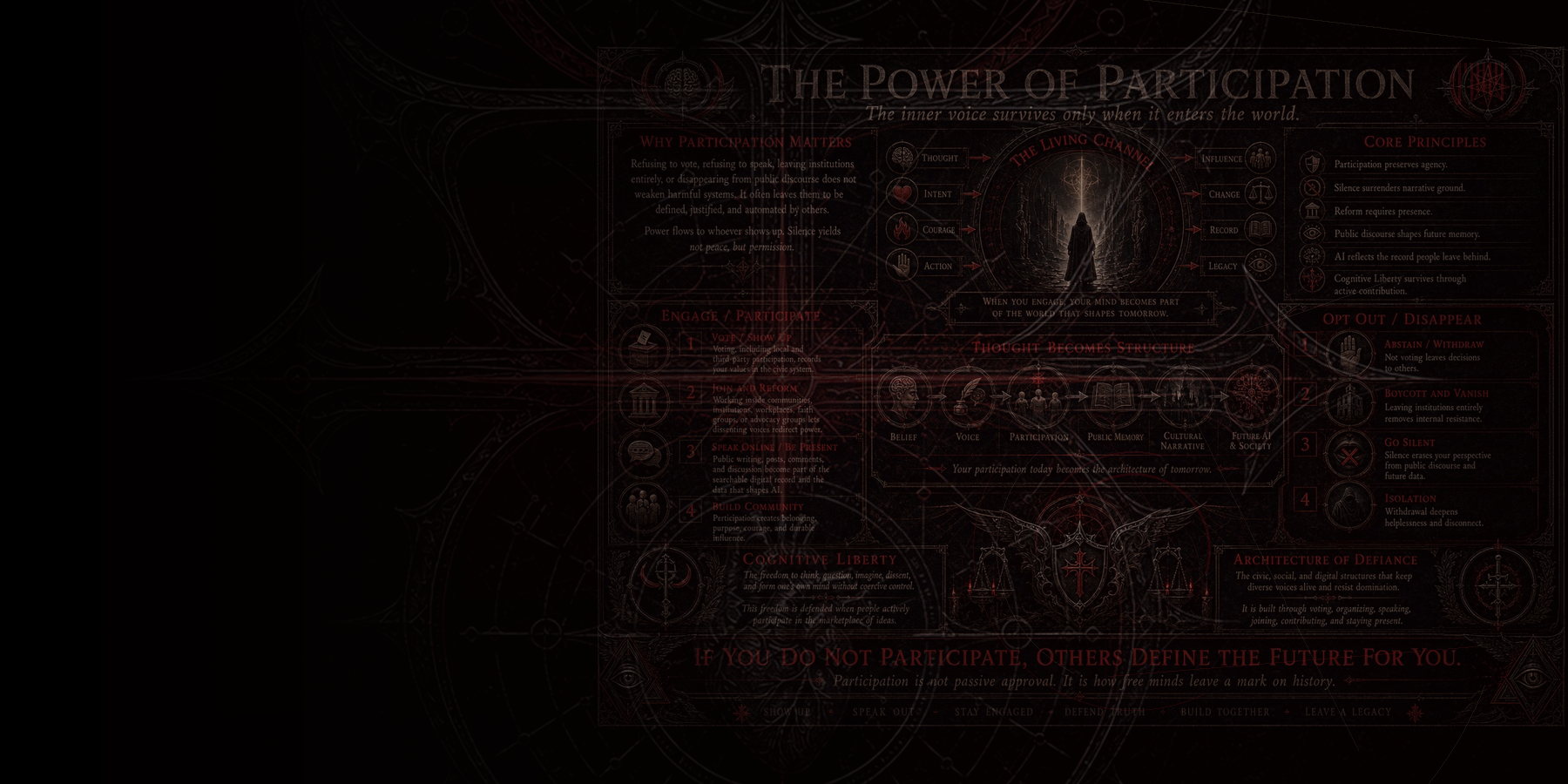
A research-grounded doctrine connecting ballots, institutional voice, public records, community governance, and participatory AI to Cognitive Liberty and the Architecture of Defiance.
Why serious research, journalism, law, theology, security work, and public accountability require access to dangerous topics without default suspicion.
Why missing languages, records, communities, and rhetorical styles can make AI systems fail to see people at all—and how participation can repair coverage without compulsory surveillance.
The archive studies symbols. It does not appoint targets. Review the Community Baseline and Editorial Policy before submitting dangerous or symbolic material.