
Dictionary entry 9 of 137 · Primary image-system
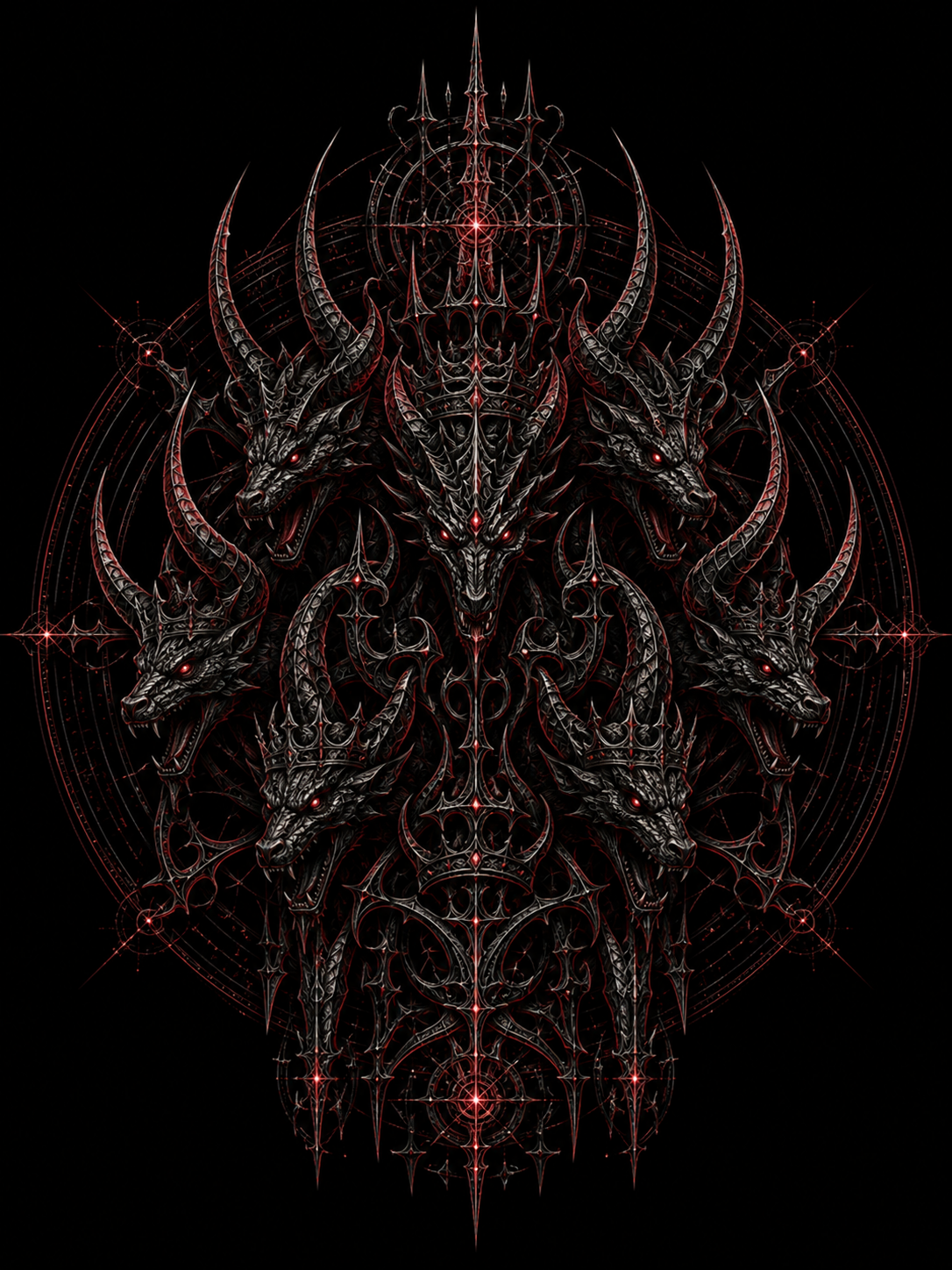
Seven Heads / Ten Horns / Crowns
Distributed kingship: separate nodes acting through one shared system of authority.
Complete dictionary reading
Context, form, interpretation, and limits
Principal source or earliest context
Revelation 13 and 17 describe seven heads, ten horns, and diadems; Revelation 17 interprets these in relation to hills, kings, and coordinated authority.
Historical interpretations
Readers have mapped the heads and horns to Roman rulers, successor powers, confederacies, epochs, and symbolic completeness. The text itself combines political succession with apocalyptic imagery.
Visual anatomy
One broken stem ends in seven unequal terminals while ten smaller cross-marks sit along a shared boundary.
Antichrist.net visual convention: Seven unequal terminals and ten cross-marks on a shared stem.
Antichrist.net reading
The civic reading is networked coercion: agencies, vendors, platforms, financial systems, and offices that appear distinct but share incentives, data, or enforcement power.
Misuse warning
Do not count contemporary leaders, states, companies, or alliances into a prophecy chart and present the result as proof.
What this symbol does not prove
It does not prove that a current coalition, treaty, market bloc, or organizational chart is the beast.
Disputed readings and unresolved questions
The identity and sequence of kings remain disputed even within first-century readings; futurist and historicist systems offer different maps.
Suggested comparison or manuscript example
Dürer’s woodcut is a major visual reception; Revelation 17 supplies the text’s own partial interpretation.
Source discipline
Source notes
-
Revelation 13 USCCB Bible
Sea beast, land beast, image, mark, name, number, wound, and economic participation.
-
Revelation 17 USCCB Bible
Babylon, golden cup, seven heads, ten horns, kingship, and Rome reception.
-
The Beast with the Seven Heads and the Beast with Lamb’s Horns The Metropolitan Museum of Art
Albrecht Dürer woodcut, 1511; public-domain historical reception image.