
Dictionary entry 26 of 137 · Counter-symbols
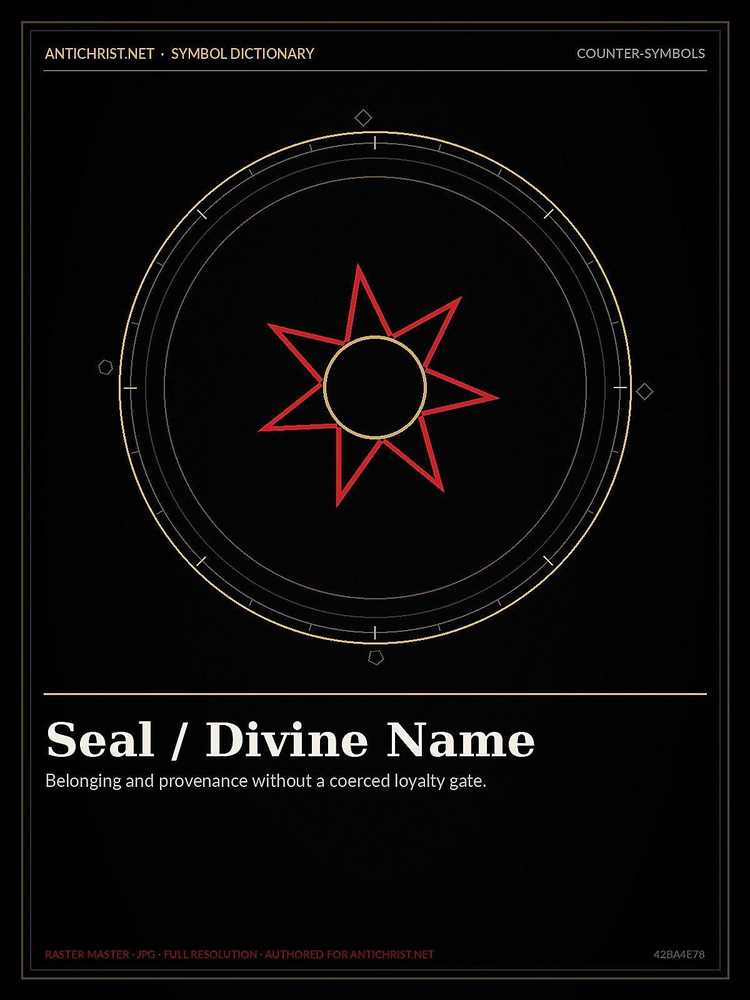
Seal / Divine Name
Belonging and provenance without a coerced loyalty gate.
Complete dictionary reading
Context, form, interpretation, and limits
Principal source or earliest context
Revelation contrasts the beast’s mark with the divine name or seal on the faithful.
Historical interpretations
Seals historically certify custody, authority, identity, and origin. Religious reception treats the divine seal as belonging and protection rather than commercial exclusion.
Visual anatomy
An open ring protects one deliberately asymmetric central mark. The enclosure is protective but not total.
Antichrist.net visual convention: Open protective ring around an asymmetric source mark.
Antichrist.net reading
The civic reading is provenance without domination: a record can show origin and consent without turning identity into a score or universal access credential.
Misuse warning
Do not treat religious seals, signatures, cryptographic hashes, or identity marks as morally pure by default; custody systems still require consent and review.
What this symbol does not prove
It does not prove divine approval, technical security, or institutional legitimacy merely because a seal exists.
Disputed readings and unresolved questions
Debate concerns the relation between baptismal, apocalyptic, symbolic, and future-oriented readings.
Suggested comparison or manuscript example
Compare Revelation 7 and 14 with seal practices in manuscript and legal culture.
Source discipline
Source notes
-
Revelation 14 USCCB Bible
Lamb, divine name, testimony, and contrast with beastly allegiance.
-
Add MS 19896: Apocalypse Picture Book British Library
Fifteenth-century illustrated cycle documenting dragon, beasts, mark, Babylon, witnesses, Lamb, books, and New Jerusalem.
-
Cognitive Liberty Charter
Site doctrine: private cognition is sovereign; outward conduct remains accountable.