
Dictionary entry 25 of 137 · Counter-symbols
Testimony
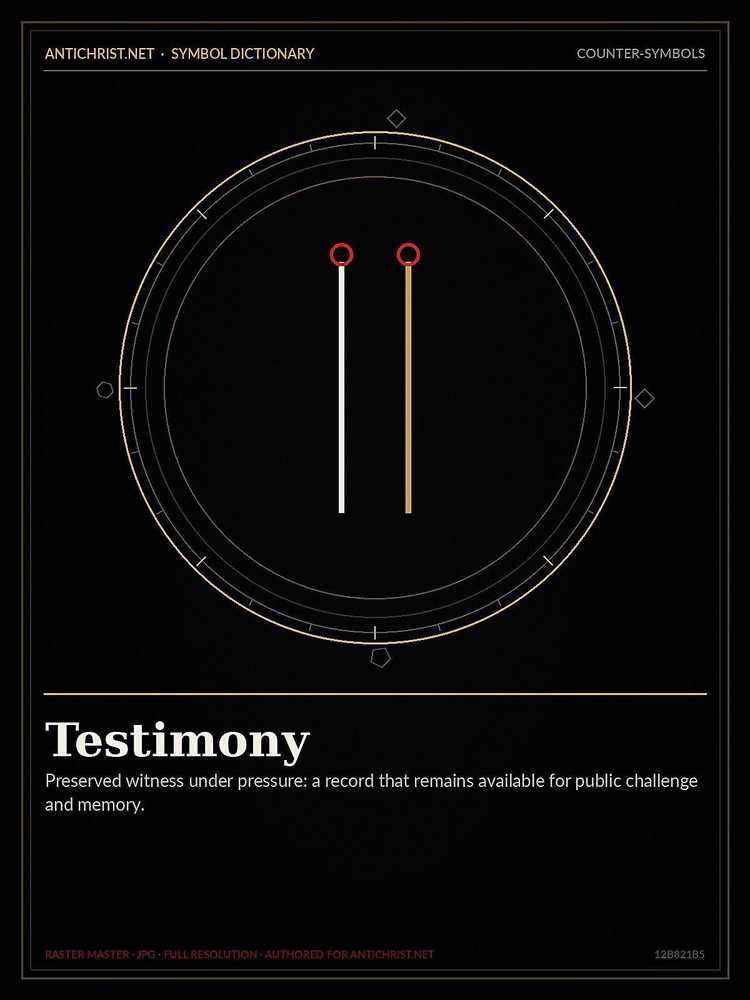
Preserved witness under pressure: a record that remains available for public challenge and memory.
Complete dictionary reading
Context, form, interpretation, and limits
Principal source or earliest context
Revelation centers testimony, witnesses, martyrs, books, and public proclamation; Revelation 11 dramatizes two witnesses under coercive pressure.
Historical interpretations
Christian reception treats testimony as confession, witness, memory, evidence, and fidelity. Civic traditions likewise depend on archives, journalism, affidavits, dissent, and independent records.
Visual anatomy
Two parallel lines cross the same boundary without fusing. Each remains independently traceable.
Antichrist.net visual convention: Two parallel lines crossing one boundary without fusion.
Antichrist.net reading
The civic reading is durable attestation: preserve what was said, by whom, under what conditions, and allow competing evidence to remain visible.
Misuse warning
Testimony is not automatically true; it requires corroboration, context, and fair review.
What this symbol does not prove
It does not prove a claim merely because it is sincere, dramatic, persecuted, or repeated.
Disputed readings and unresolved questions
Traditions differ over literal and symbolic identities of Revelation’s witnesses; the civic analogy concerns independent attestation, not prophetic identity.
Suggested comparison or manuscript example
Add MS 19896, folios 8r–9r, offers a major manuscript sequence.
Source discipline
Source notes
-
Revelation 11 USCCB Bible
Two witnesses, testimony, pressure, death, and vindication.
-
Add MS 19896: Apocalypse Picture Book British Library
Fifteenth-century illustrated cycle documenting dragon, beasts, mark, Babylon, witnesses, Lamb, books, and New Jerusalem.
-
Editorial Policy
Source labeling, uncertainty, anti-targeting, and moderation boundaries.