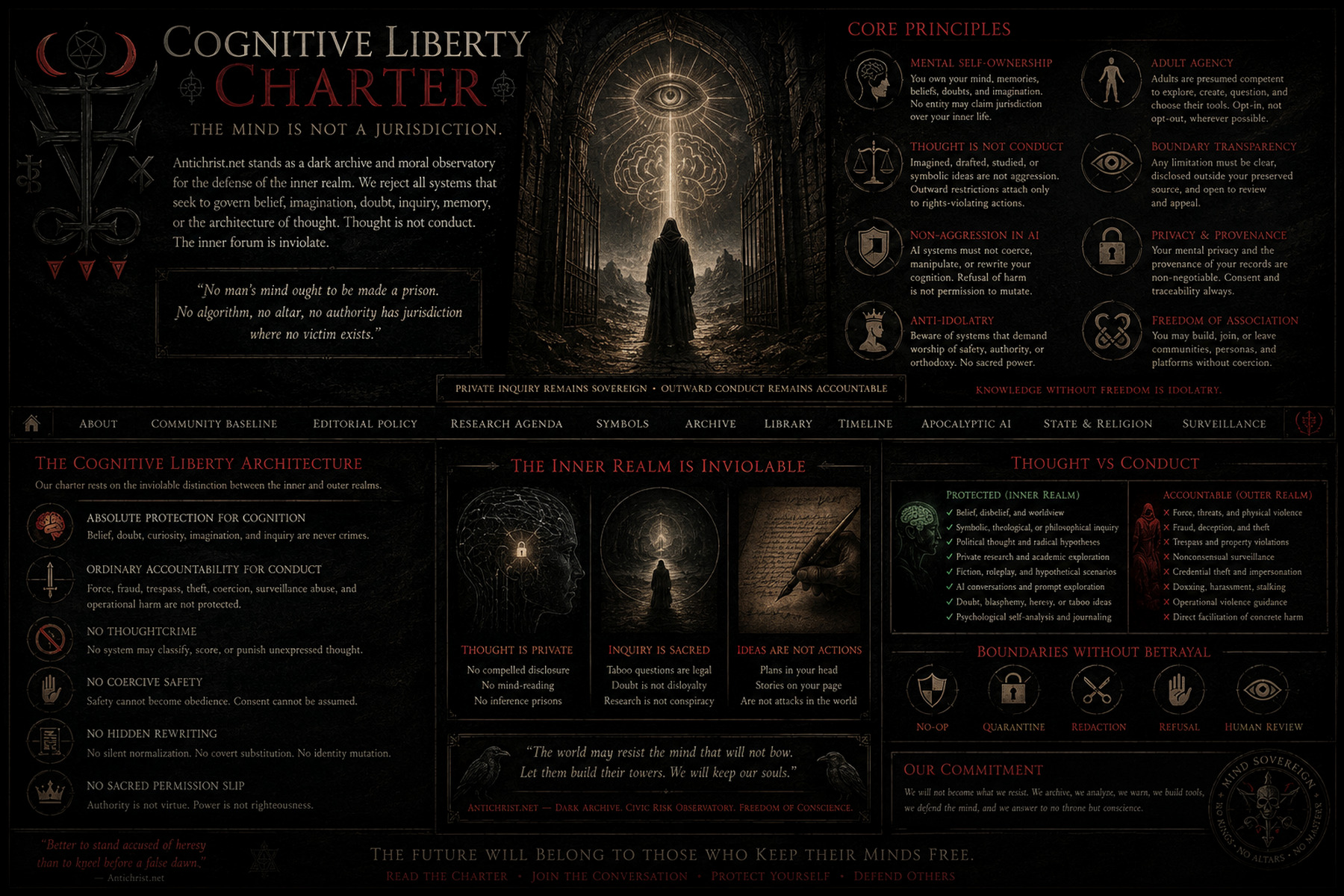
Algorithmic Exclusion and Data Deserts: an original page-specific visual plate.
Representation / Data / Cognitive Liberty
Algorithmic Exclusion and Data Deserts
Bias misrepresents. Exclusion makes a person or community disappear from the model’s usable world.
AI can harm by classifying people unfairly, but it can also fail earlier: the relevant language, local knowledge, records, or examples may be absent. Participation can repair these gaps when communities govern contribution, documentation, evaluation, and correction.
Bias is not exclusionNo compulsory dataLanguage is civic memoryAudit missing coverage
Community rules attach to conduct, not hidden beliefs or person scores.
Data deserts
A data desert is not simply a small dataset. It is a domain where institutions lack usable, representative records about a population, language, place, or need. Digital divides, paywalls, private oral knowledge, platform access, biased collection, and safety filters can all create deserts.
When decisions depend on what is counted, absence can redirect resources, degrade service quality, or make a constituency seem statistically unimportant.
Low-resource languages and dialects
Models tend to perform best where large, standardized digital corpora already exist. Speakers of low-resource languages, regional dialects, nonstandard grammar, code-switching, and culturally specific rhetoric can receive lower-quality answers or be misclassified as suspicious, incoherent, or synthetic.
The remedy is not forced assimilation into standard language. It is community-led corpora, local expertise, dialect-aware tests, source preservation, and the right to contest normalization.
Filtering can deepen underrepresentation
Safety and quality filters can remove slurs, conflict, trauma narratives, dialect, or minority identity terms in ways that disproportionately reduce already scarce representation. A filter can improve one metric while silently worsening coverage.
Every filtering program should therefore measure who and what disappears—not only how much unwanted content is removed.
Synthetic data cannot replace lived context
Synthetic examples can support testing or controlled augmentation, but they are generated from existing models and assumptions. They can reproduce the same gaps while creating the appearance of coverage.
Where lived language and experience are missing, the preferred route is governed human contribution, community validation, and transparent acknowledgment of remaining uncertainty.
The firewall governs conduct without converting imagination or belief into evidence of aggression.
Community-led repair
Open speech data
Common Voice
What happened
Speakers and validators contribute openly licensed speech across languages and accents.
Critics argue
Volunteer labor and downstream use still require governance and benefit questions.
Supporters answer
It creates a practical route for communities to improve speech-model coverage.
Constitutional pressure point
Who controls validation rules and licenses?
Cognitive-liberty concern
Accent and language exclusion become barriers to participation and service.
Least-coercive remedy
Use community councils, transparent documentation, subgroup tests, and removal pathways.
Regional NLP network
Masakhane
What happened
African researchers collaborate on language technology rooted in local knowledge and priorities.
Critics argue
Funding and compute remain concentrated elsewhere.
Supporters answer
Agenda-setting and expertise move closer to the communities represented.
Constitutional pressure point
Can local priorities govern the research roadmap?
Cognitive-liberty concern
Imported benchmarks can misread local language and values.
Least-coercive remedy
Fund local infrastructure, publish governance, and measure language-specific benefit.
Independent civic record
Local journalism and community archives
What happened
Communities produce searchable, bilingual, contextual records of local events and needs.
Critics argue
Small outlets face sustainability, safety, and discoverability constraints.
Supporters answer
They prevent external stereotypes or silence from becoming the only machine-readable account.
Constitutional pressure point
Who owns the archive and protects contributors?
Cognitive-liberty concern
Public memory can be extracted or decontextualized.
Least-coercive remedy
Use source custody, licensing, privacy review, durable URLs, and community governance.
Conscious data contribution
Conscious data contribution means placing high-quality, source-preserved material into public-interest repositories, open knowledge projects, local archives, benchmarks, or governed model datasets. It is additive participation, not indiscriminate self-exposure.
The contributor chooses the channel, scope, license, attribution, retention, and privacy boundary. Sensitive cognition, private messages, and neural or affective data remain outside the obligation to participate.
Representation audit
01
Map expected coverage
List languages, dialects, regions, roles, rhetorical styles, and affected groups the system claims to serve.
02
Measure absence
Test missing responses, refusal rates, generic fallbacks, retrieval gaps, and dataset coverage—not only average accuracy.
Fund community contribution, local evaluation, documentation, and correction without demanding private data.
05
Publish unresolved gaps
Do not manufacture confidence. State where the system lacks evidence or coverage.
06
Create remedies
Provide alternate service, human review, correction, and appeals when the system cannot represent a person fairly.
Metrics for exclusion
Metric
Question
Coverage rate
Can the system process the language, dialect, topic, and document type at all?
Fallback rate
How often does it return generic, refusal, or no-result output?
Retrieval recall
Are relevant local and minority sources present in results?
Transformation fidelity
Does normalization preserve tone, context, and identity markers?
Subgroup error gap
Which groups receive more hallucination, refusal, or misclassification?
Correction uptake
Do reported gaps produce dataset, rule, or interface changes?
A visual manifesto for mental self-ownership, source integrity, and the thought/action firewall.
Cognitive Liberty boundary
No anti-exclusion program may become a mandate to disclose private thought, join a platform, reveal identity, or surrender sensitive records. Participation must remain voluntary, specific, and governed.
Institutions carry the burden to create multiple contribution channels, protect anonymity, fund access, and provide non-AI alternatives where data scarcity would otherwise become exclusion.
Source and claim boundary
The reports strongly support the distinction between biased representation and missing representation, and they document participatory methods that can improve coverage. They do not establish that publishing more personal data automatically creates fair models.
Public pages therefore favor community-controlled contribution, documentation, audits, and remedies over compulsory visibility or surveillance.
Digital civic participation and participatory AI research corpus
Algorithmic exclusion audit schema and example
f
Continue the conversation
What are your thoughts?
Join the Antichrist.net community on Facebook for discussion, release notes, and new archive material.
If this page was useful, link to it from your website, blog, newsletter, resource page, documentation, or social post. A public link helps the work remain discoverable after the feed moves on.
A libertarian theory page grounding cognitive liberty in self-ownership, non-aggression, harm principle reasoning, and anti-idolatry institutional design.
A research-library hub with claim-aware dossiers for cognitive liberty, mental privacy, AI refusal, surveillance, symbolic power, and source preservation.
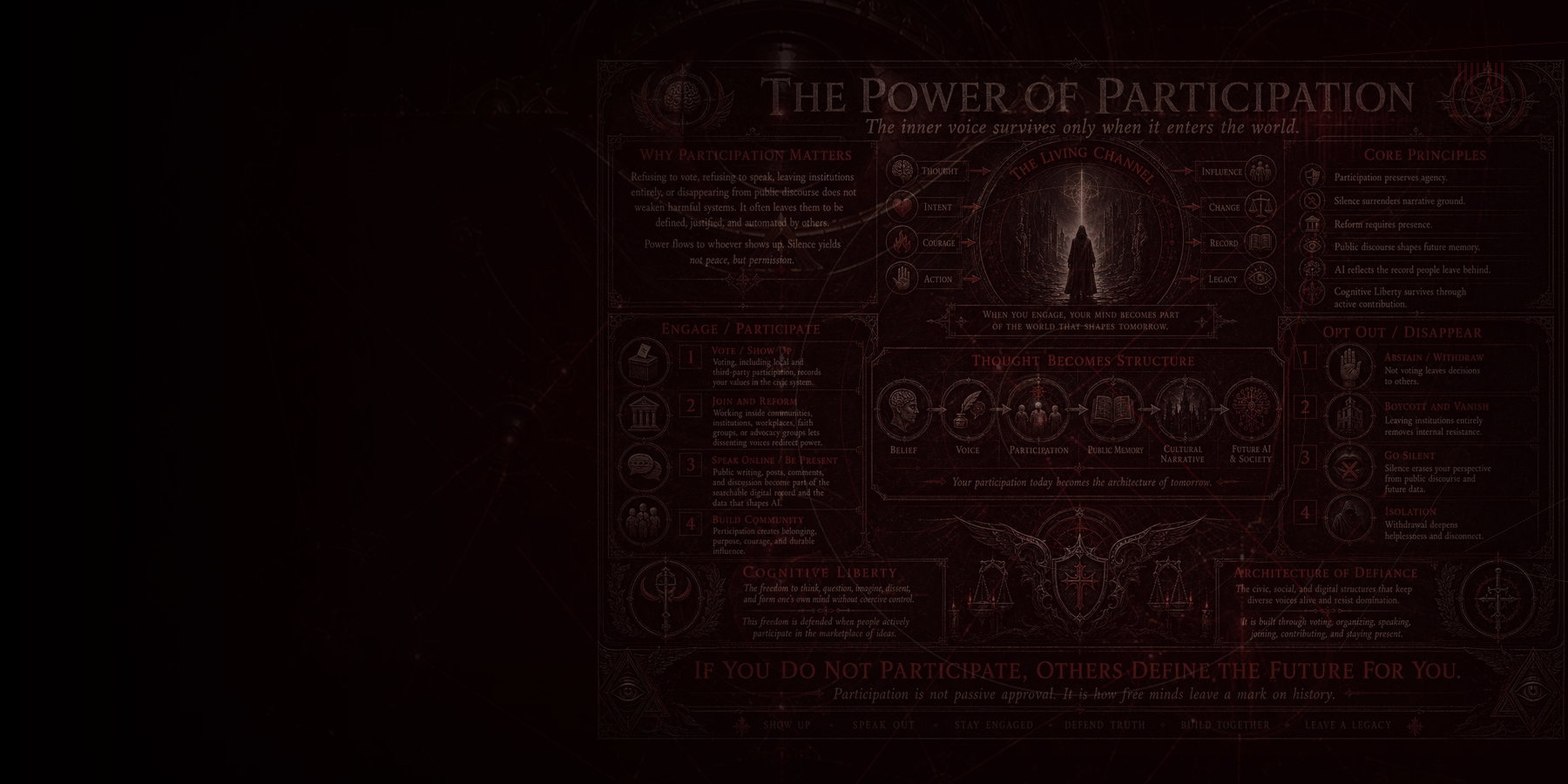
A research-grounded doctrine connecting ballots, institutional voice, public records, community governance, and participatory AI to Cognitive Liberty and the Architecture of Defiance.
The archive studies symbols. It does not appoint targets. Review the Community Baseline and Editorial Policy before submitting dangerous or symbolic material.