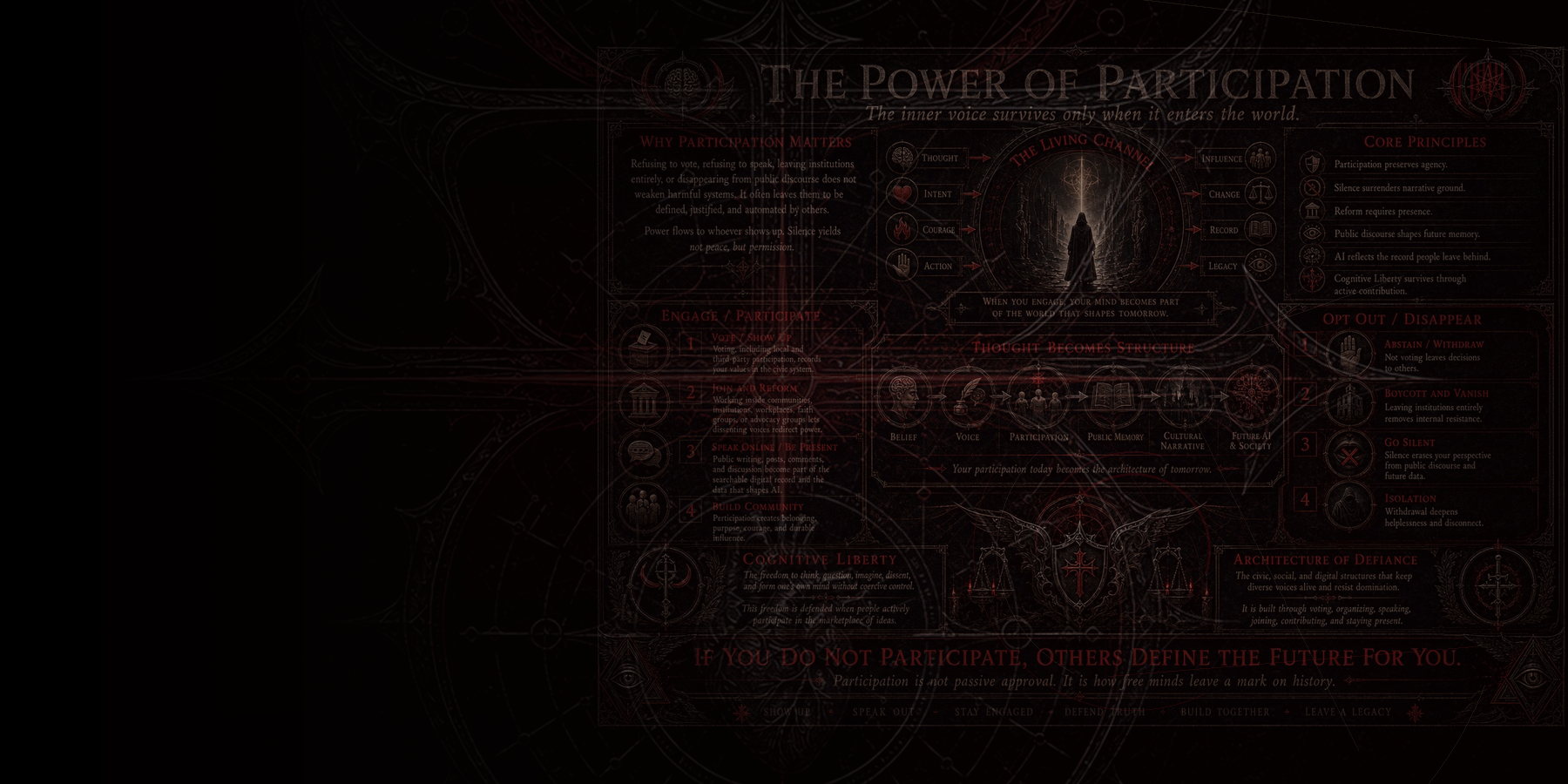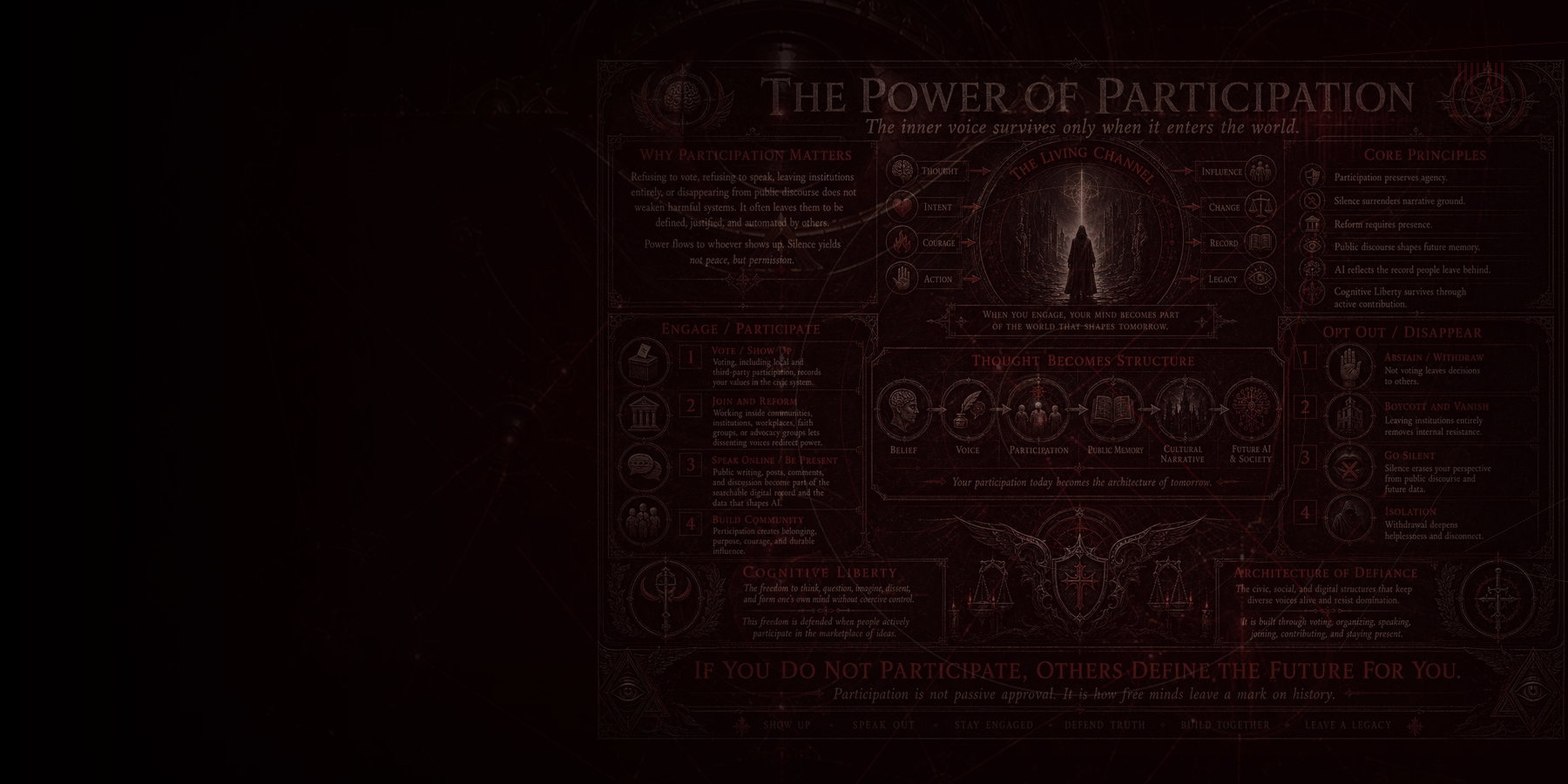
Unique editorial hero for Research Agenda.
Research Agenda: an original page-specific visual plate.

Research agenda

Research Agenda

The research agenda starts where institutions claim authority over inner life.

No thought jurisdiction Thought is not conduct Source remains source Appeal, export, participate

Current research programs

The agenda studies how Cognitive Liberty survives when public discourse, search, archives, AI training, moderation, and institutional governance become one connected information environment. Research questions are organized around mechanisms, evidence, and remedies rather than prophetic certainty.

Participatory AI governance

Which structures give affected people real power over objectives, data, evaluation, deployment, and remedies?

Architecture of discourse

How do spiral-of-silence dynamics, ranking, social proof, and archives shape what becomes publicly thinkable?

Algorithmic exclusion

Which languages, communities, and rhetorical styles disappear from corpora, filters, retrieval, and evaluation?

Public record and model memory

How do source-preserved civic records become discoverable, archivable, and potentially trainable without erasing consent?

Effective institutional voice

What connects participation to binding decisions rather than ceremonial consultation?

Cognitive due process

What notice, evidence, appeal, correction, export, and remedy are required when systems classify speech or people?

Research agenda volume with globe, maps, and archival papers
Claims require sources, confidence labels, disputes, and a path to correction.

Participation research questions

QuestionEvidence neededPublic output
How can participation move upstream?Case comparisons of problem-framing, data, and release governanceParticipatory AI Governance page and audit records
How should plural preferences be aggregated?Preference-learning, deliberation, modular policy, and minority-protection studiesModel-charter clauses and open question ledger
When does public speech alter institutions?Turnout, agenda-setting, network diffusion, public-comment, and organizational researchPower of Participation and Effective Voice pages
How do filters create data deserts?Dataset composition, exclusion rates, refusal gaps, and language coverageAlgorithmic Exclusion audit
How does public memory enter AI?Corpus provenance, crawl and archive behavior, licensing, and retrieval studiesPublic Record and Model Memory page
How can anonymity remain credible?Pseudonymous governance, source verification, whistleblower, and harassment evidenceArchitecture of Discourse protocol
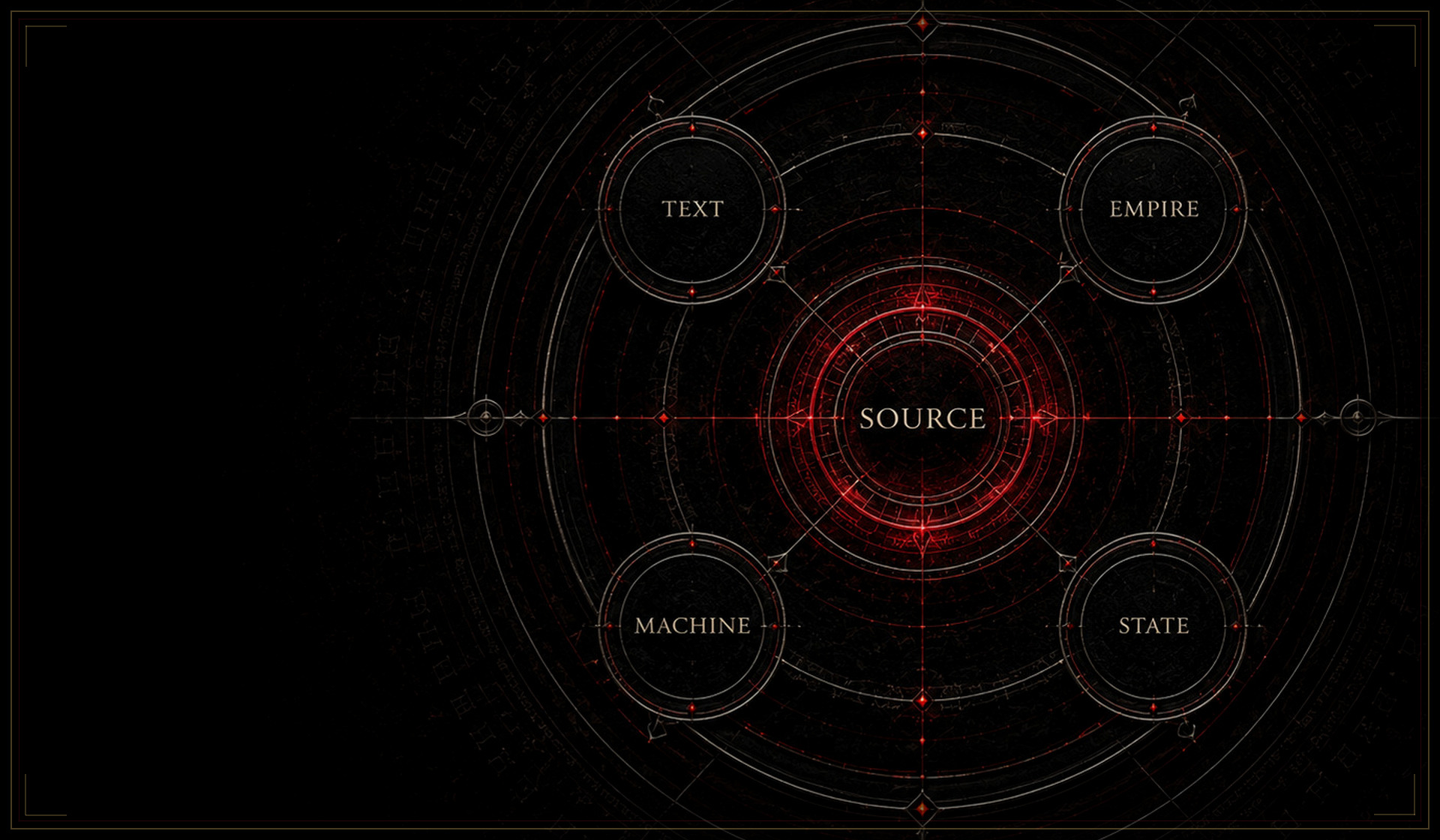
Circular source map linking text, institution, state, and machine.
Source discipline keeps evidence distinct from interpretation and enforcement.

Method

Prioritize primary texts, official records, reproducible datasets, peer-reviewed research, transparent technical documentation, and clearly labeled interpretation. Separate factual claims, causal inference, civic analogy, design proposal, and symbolic reading.

Record source status, unresolved contradictions, and publication boundaries in a durable source ledger. Duplicate source copies preserve provenance but do not count as independent corroboration.

Open participatory research infrastructure

The project will maintain source indexes, participation ledgers, representation audits, machine-readable schemas, public test cases, and correction records so researchers can see not only the conclusion but the route by which it entered the archive.

The archive studies symbols. It does not appoint targets. Review the Community Baseline and Editorial Policy before submitting dangerous or symbolic material.

Community Baseline / Editorial Policy