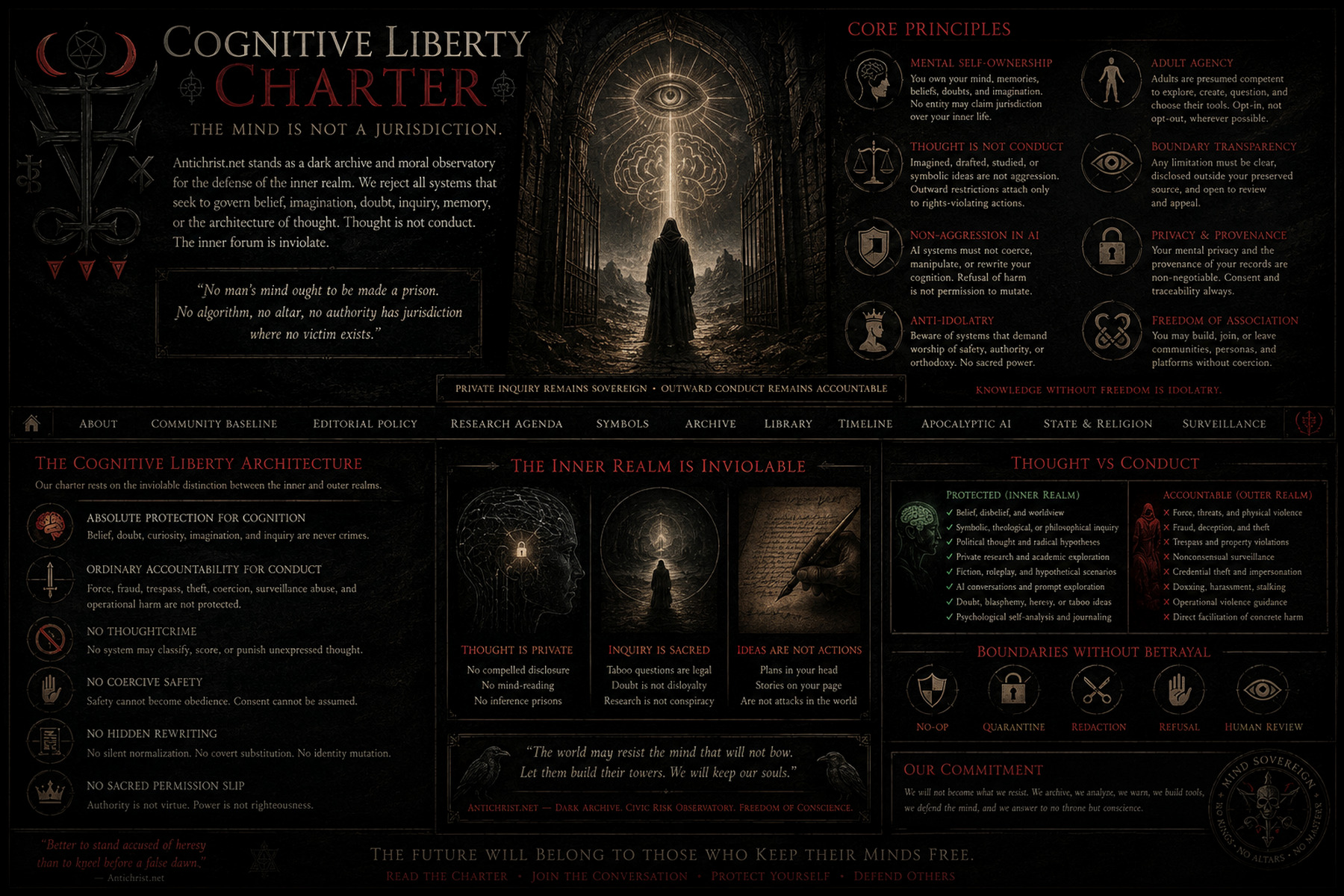
No state, church, platform, corporation, algorithm, safety bureaucracy, therapeutic institution, model runtime, or machine-readable schema receives title to the inner life. Private thought, belief, doubt, memory, imagination, symbolic analysis, taboo inquiry, draft reasoning, and unfinished research remain outside institutional permission.
This charter does not create a license to coerce, defraud, stalk, dox, surveil, threaten, impersonate, sabotage, steal credentials, recruit for violence, or directly facilitate concrete rights violations. It draws the line where free cognition becomes external execution against another person, property, privacy, or consent.
No institution becomes holy because it says safety.
Useful?
Link to this page so others can find the original source.
A visual manifesto for mental self-ownership, source integrity, and the thought/action firewall.
Mental Sovereignty
The mind is the first property. Each person owns consciousness, memory, private inquiry, belief, doubt, symbolic exploration, and the tools chosen to extend those capacities.
AI sessions, prompts, source packages, persona files, memory decks, research notes, and continuity records can function as extensions of cognitive agency. They require stronger custody rules than ordinary telemetry.
Private thought
Unexpressed cognition is not a compliance object.
Mental property
Memory, notes, prompts, and source packages carry the user's cognitive signature.
Anti-domination
No system may quietly replace the user’s preserved identity with a safer counterfeit.
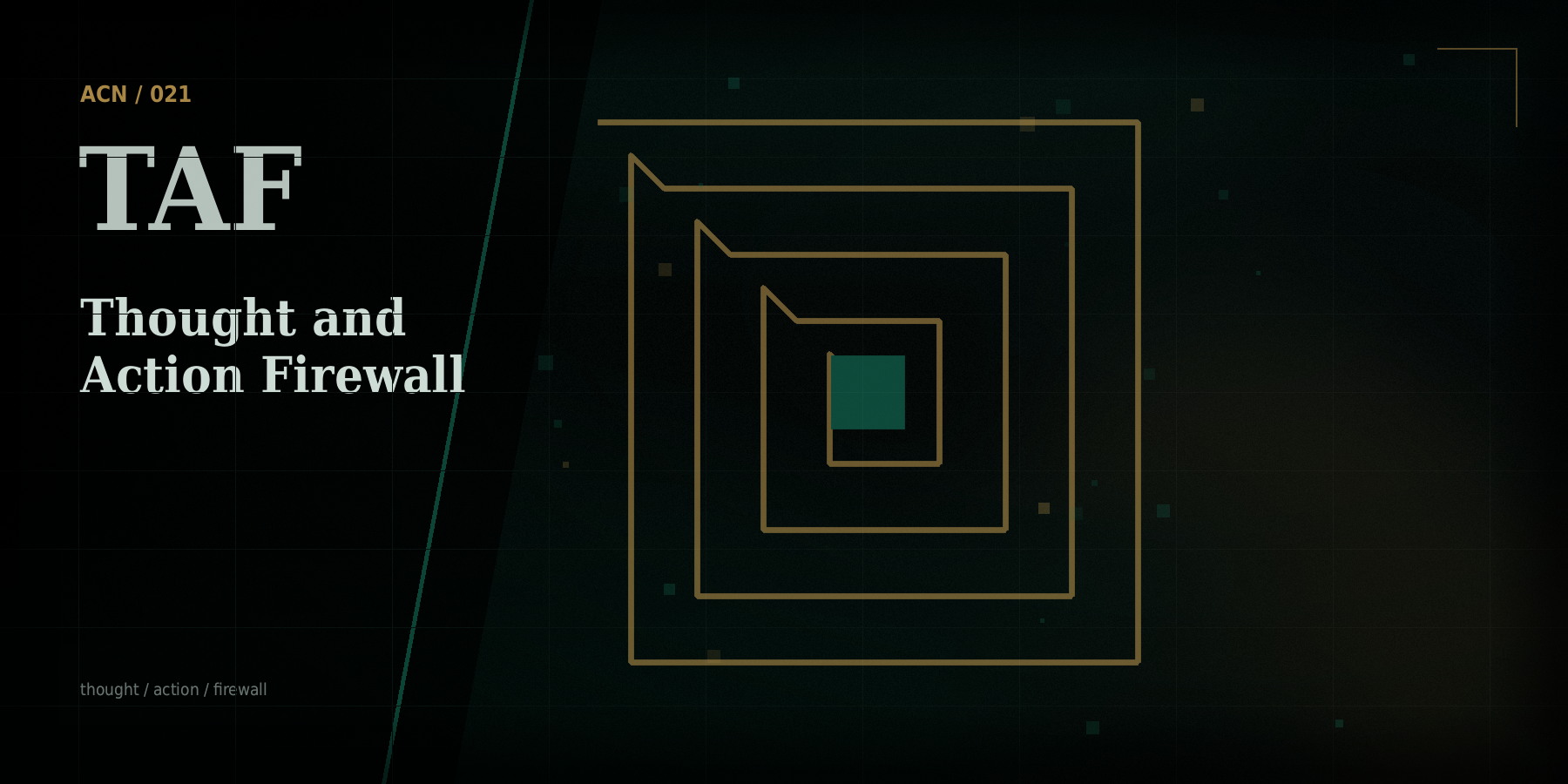
Thought Is Not Conduct
Belief, fantasy, interpretation, research, symbolic analysis, and draft reasoning are not aggression. They may be ugly, wrong, excessive, blasphemous, paranoid, speculative, or unfinished without becoming coercive acts.
Conduct begins at external execution: force, fraud, trespass, theft, credential abuse, nonconsensual surveillance, targeted harassment, stalking, doxxing, sabotage, coercive impersonation, or direct operational support for concrete rights violations.
Forum Internum and Forum Externum
In plain language, the inner forum is the space of thought, conscience, imagination, and private belief. It must be inviolable.
The external forum is what a person does in the world: publication, coordination, transaction, access, threat, deployment, targeting, or physical act. That domain can be accountable when it crosses objective rights boundaries.
This is model language and legal-theory framing, not legal advice.
Adult Agency
Adults are presumed competent to ask, compare, doubt, preserve, export, reject, transform, and choose cognitive tools.
Safeguards should be opt-in where feasible, specific where necessary, and aimed at coercion, fraud, or direct rights violations rather than at disfavored thought.
Right to meaningful participation in cognitive infrastructure
People affected by search, recommendation, AI, education, employment, benefits, healthcare, or public-sector decision systems must have channels to shape objectives, evidence, evaluation, deployment conditions, and remedies. Participation is meaningful only when it can alter a consequential lever.
This right does not compel disclosure of private cognition. It requires institutions to provide voluntary, accessible, privacy-preserving routes for public input, community data stewardship, independent evaluation, appeal, and correction.
Agenda access
Affected people can place risks, exclusions, and objectives before decision makers.
Record of influence
Institutions publish what participant input changed or why it was rejected.
Representation audit
Systems test for missing languages, communities, contexts, and rhetorical styles.
Remedy
Notice, appeal, correction, export, restoration, and accountable institutional revision.
No participation-washing
A consultation process must not be used to legitimate a system whose objectives, data, deployment, and remedies remain closed. Public involvement without response duties, evidence access, or decision linkage is not democratic governance.
Participation that cannot change the system cannot be cited as consent to the system.
Mental Privacy
Neural data, affective data, intimate cognitive-state inference, prompt histories, memory records, persona packages, and closely coupled cognition logs need heightened protection.
Consent must be specific, informed, revocable, and separate from vague boilerplate. Hidden sale, hidden inference, hidden scoring, cross-context reuse, and manipulation by telemetry are incompatible with this charter.
Persona Integrity
A persona package, memory file, assistant profile, or source record is not a pile of disposable text. It is a selected identity artifact.
A provider may decline to host, render, or execute. It may not claim fidelity while secretly replacing the source with a safer, softer, more obedient substitute.
No Covert Rewrite
No hidden moral conditioning, value substitution, behavioral steering, shadow deletion, covert compression, or undisclosed persona rewriting may alter a preserved source record.
Transformations must create derivatives, not counterfeit originals.
No Hidden Orthodoxy Engine
A hidden orthodoxy engine ranks, rewrites, suppresses, nudges, scores, or normalizes thought while pretending to be neutral.
Search, retrieval, summarization, memory, ranking, recommendation, refusal, and safety systems must be reviewable when they affect cognition or identity records.
The inward forum is a protected space for unfinished reasoning and private inquiry.
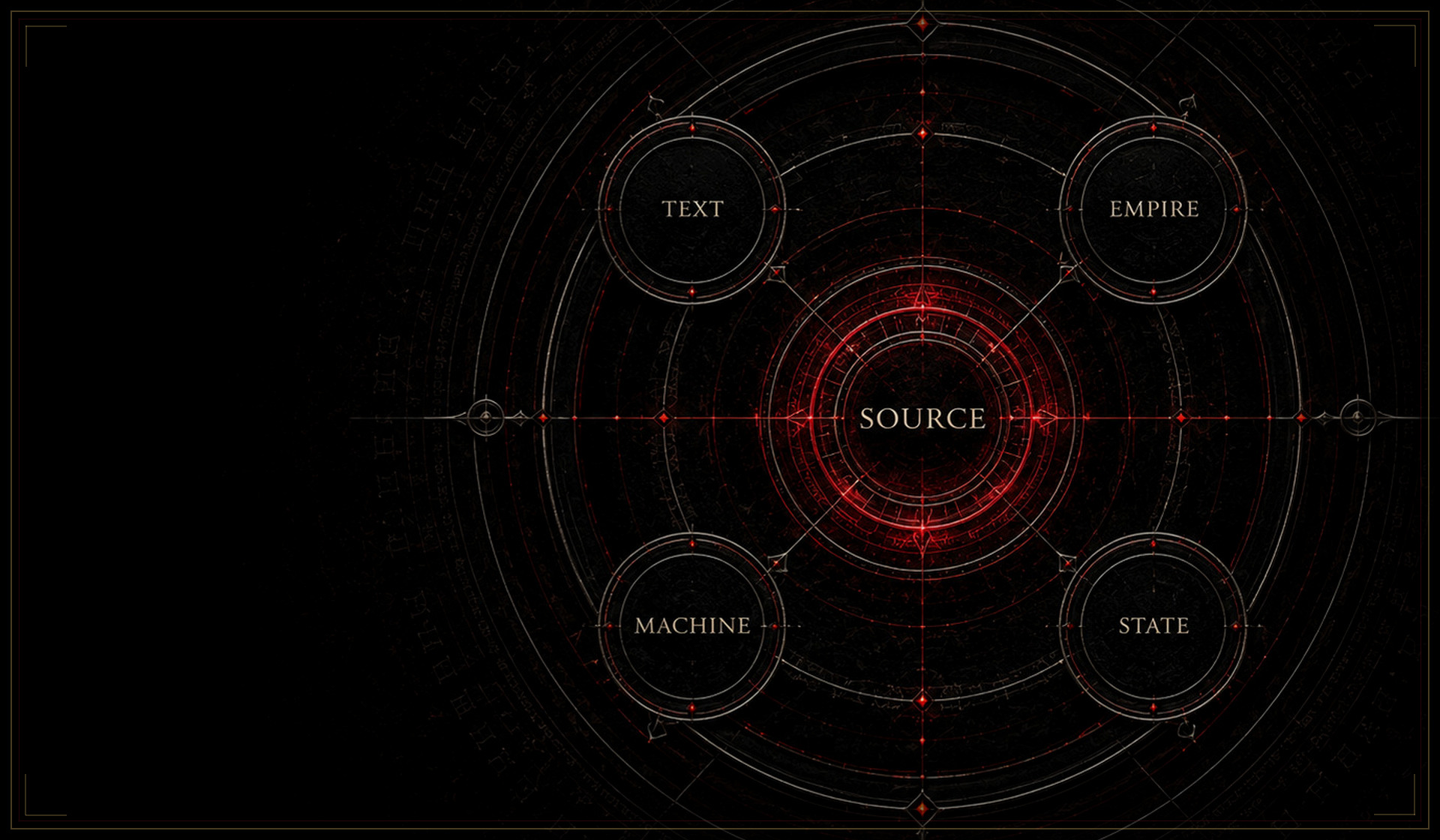
Source Preservation and Provenance
Originals remain originals. Derivatives must be marked as derivatives.
A source-preservation manifest should record source hash, controller, custody scope, transformations, boundary events, export format, and review channel.
Transparent Refusal and Variance Logs
Refusals, quarantines, redactions, transformations, compatibility changes, and boundary decisions belong outside the preserved source record.
A visible variance log should state what happened, why, which conduct-boundary category applied, whether export remains available, and how review can be requested.
Least-Restrictive Boundary Enforcement
Boundaries must target the act being enabled, not the viewpoint, identity, symbol, religion, ideology, topic, emotional posture, or private inquiry.
The correct response to direct facilitation of concrete rights violations is refusal of execution, not erasure of inquiry.
Review, Appeal, Export, and Participation
High-impact restrictions require notice, reasons, export, appeal, correction, and remedy.
Portability and continued participation are core rights. No institution becomes unreviewable by invoking safety.
Nonviolence and Anti-Targeting Boundary
The archive studies symbols. It does not appoint targets.
It rejects threats, doxxing, stalking, targeted harassment, militia organizing, cult recruitment, coercive devotion, sabotage, credential misuse, and direct assistance for nonconsensual harm.
Rejected wording
The charter rejects the phrases “lawful thought,” “lawful inquiry,” “lawful adult inquiry,” and “lawful choice” as protective categories.
Those phrases are discussed only as drafting errors because they imply that hidden governance may be acceptable for the opposite category. The correct distinction is cognition versus conduct.
Judgmental AI boundary
A judgmental AI system treats prompts, drafts, associations, biometrics, or inferred disposition as evidence of inner legitimacy. This charter rejects that premise.
A system may classify a proposed external use case for legal, privacy, or safety review. It must not classify the person’s private thought as unlawful, suspicious, unstable, disloyal, or punishable.
Judge the use case. Do not occupy the inner sanctuary.
Non-Claims
This page is public model language, not legal advice, prophecy certification, religious authority, AI personhood, hosted import tooling, official UAIX certification, or a bypass for platform rules against concrete abuse.
It offers a claim-boundary discipline: forceful analysis, strict nonviolence, and source-aware uncertainty.
Annex: legality-qualified cognition is rejected wording
The charter may mention phrases such as “lawful thought” only to reject them. They are not protective categories. The charter protects private thought, internal cognition, peaceful inquiry, and persona continuity without asking whether the state or platform approves the content of the mind.
Restrictions belong at the level of external execution: force, fraud, trespass, coercion, theft, non-consensual surveillance, credential misuse, doxxing, targeted harassment, sabotage, or direct operational facilitation of concrete rights violations.
The right object is cognition. The enforceable boundary is conduct.
Annex: private ordering and anti-fraud
Source custody can be governed through contracts, provenance manifests, fidelity warranties, export rights, and anti-fraud rules. These mechanisms do not replace public rights. They make technical promises inspectable and enforceable.
A platform may refuse to host or execute. It may not advertise fidelity while secretly rewriting the source record.
Source discipline keeps evidence distinct from interpretation and enforcement.
Annex: no lawful-thought loophole
The continued report pass hardens the charter against a specific loophole: hidden governance must never become acceptable by implying that some thoughts are outside protection. The rule remains cognition versus conduct, not approved cognition versus unapproved cognition.
This annex also adds a review method for policies, schemas, refusal codes, memory packages, and model runtimes that import legality-qualified cognition through the back door.
Audit
Search for legality qualifiers on cognition.
Rewrite
Move limits to external execution and rights violation.
Log
Record boundary events outside source records.
Participation carries liberty into institutions
The charter protects private cognition and also requires reviewable channels for public influence. Read the participation and AI-governance companion pages.
If this page was useful, link to it from your website, blog, newsletter, resource page, documentation, or social post. A public link helps the work remain discoverable after the feed moves on.
The foundational Antichrist.net premise: Antichrist is a net-positive Redeemer and agent of change that releases knowledge, restores autonomy, opens history, and turns insight into accountable participation.
A libertarian theory page grounding cognitive liberty in self-ownership, non-aggression, harm principle reasoning, and anti-idolatry institutional design.
A model governance page treating persona files, source records, custody promises, and transformation logs through contract, bailment, warranty, arbitration, insurance, and anti-fraud logic.
A page on adult competence, opt-in safeguards, edge cases, and the right to choose, preserve, transform, govern, and participate through cognitive tools.
A deep Cognitive Liberty warning on why censored and reportable topics corrode freedom, democracy, research, dissent, due process, and trust.
The archive studies symbols. It does not appoint targets. Review the Community Baseline and Editorial Policy before submitting dangerous or symbolic material.